
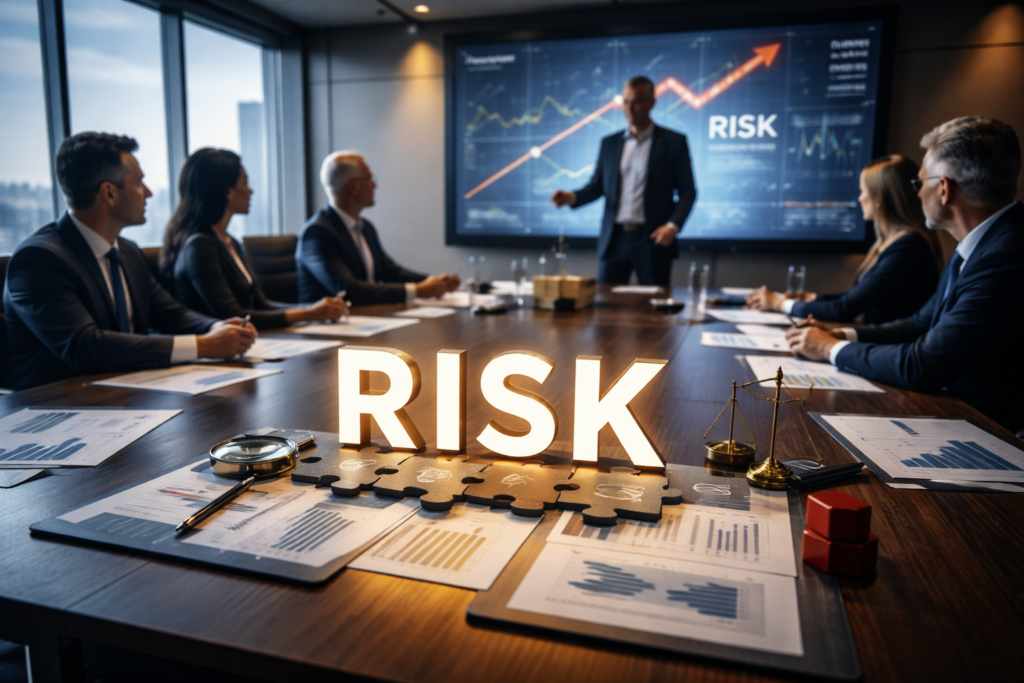
In today’s boardrooms, risk has moved from the audit committee to the center of strategic conversation. What was once a defensive function focused on compliance and mitigation has become a defining lever of growth, resilience, and competitive advantage.
The leaders who understand this shift are not simply asking, “How do we avoid risk?” They are asking a more powerful question: “How do we manage risk to accelerate opportunity?”
The companies that will define the next decade are not the ones that eliminate risk. They are the ones that master it.
From Risk Avoidance to Risk Intelligence
For years, risk management was framed as protection. Safeguard the balance sheet. Prevent regulatory exposure. Reduce volatility. Avoid reputational damage.
All necessary. But incomplete.
In an era shaped by artificial intelligence, cybersecurity threats, ESG accountability, supply chain disruption, and geopolitical volatility, risk is no longer episodic. It is constant. And constant risk demands constant strategic awareness.
Forward thinking boards now recognize that risk is not an interruption to strategy. It is embedded within strategy.
Market expansion carries operational risk. Innovation carries technological risk. Digital transformation carries cybersecurity risk. Sustainability commitments carry reputational risk. Silence carries risk.
The issue is not whether risk exists. It is whether leadership is equipped to anticipate, contextualize, and strategically deploy it.
The Board’s Expanding Mandate
The modern board has evolved beyond oversight into foresight.
Directors are expected to understand enterprise risk not only through quarterly dashboards but through dynamic scenario planning. They must assess systemic vulnerabilities, regulatory exposure, and stakeholder expectations in real time.
Risk oversight today requires three shifts in mindset:
1. Risk as Forward Looking Insight
Boards must evaluate not only known risks but emerging uncertainties. What technologies could disrupt the business model? What regulatory shifts could redefine compliance standards? What cultural risks could impact talent retention?
The absence of immediate threat does not equal safety. It often signals complacency.
2. Risk as Reputation Stewardship
In a hyper connected world, reputational risk travels faster than operational risk. A cybersecurity breach, governance failure, or ethical lapse can erase decades of brand equity overnight.
Boards must treat trust as a strategic asset. Protecting it requires proactive governance, not reactive crisis management.
3. Risk as Innovation Catalyst
Calculated risk is the foundation of progress. Companies that hesitate to invest in digital infrastructure, AI integration, or sustainability initiatives due to fear of uncertainty often fall behind competitors willing to act decisively.
Disciplined risk taking, grounded in data and governance oversight, is not reckless. It is essential.
Building a Risk Intelligent Culture
Risk as a strategic priority cannot live solely within the boardroom. It must cascade throughout the organization.
That requires culture.
A risk intelligent organization encourages transparency. It rewards early reporting of vulnerabilities. It empowers teams to question assumptions. It invests in cybersecurity infrastructure. It integrates ESG metrics into performance conversations.
Most importantly, it creates psychological safety for leaders to discuss emerging threats without fear of blame.
Silence is one of the most dangerous risks a company faces.
When executives feel pressured to present only positive narratives, blind spots multiply. When boards receive filtered data instead of candid analysis, decision making suffers.
Strong governance is built on clarity, not comfort.
The Leadership Imperative
At its core, prioritizing risk is a leadership issue.
Executives who treat risk as a compliance checkbox miss the opportunity to strengthen resilience. Boards that silo risk discussions to quarterly reviews lose strategic agility.
The most effective leaders adopt a disciplined framework:
Continuous scenario planning
Cross functional risk integration
Independent cyber and compliance assessments
Ongoing education around AI, ESG, and regulatory trends
Transparent communication with stakeholders
Risk governance must evolve at the pace of innovation.
The Competitive Advantage of Preparedness
Organizations that elevate risk to a strategic priority gain more than protection. They gain clarity.
Clarity around capital allocation.
Clarity around operational resilience.
Clarity around reputational stewardship.
Clarity around long term value creation.
Prepared companies respond faster to disruption. They pivot with confidence. They reassure investors and stakeholders during volatility.
In contrast, organizations that treat risk reactively often find themselves scrambling under pressure, managing crisis instead of shaping outcomes.
In uncertain times, preparedness is power.
The New Standard for Boards
The modern board is measured not only by financial performance but by its ability to anticipate disruption, manage complexity, and protect long term value.
Risk is no longer a background discussion. It is a headline agenda item.
The companies that thrive in the coming decade will be those whose leaders understand that risk is not the enemy of growth. It is the discipline that makes growth sustainable.
The question is no longer whether risk should be a strategic priority.
The question is whether your organization is treating it like one.
#RiskManagement, #CorporateGovernance, #BoardLeadership, #StrategicLeadership, #EnterpriseRisk, #ExecutiveLeadership, #BusinessResilience, #ESG, #LeadershipInsights