
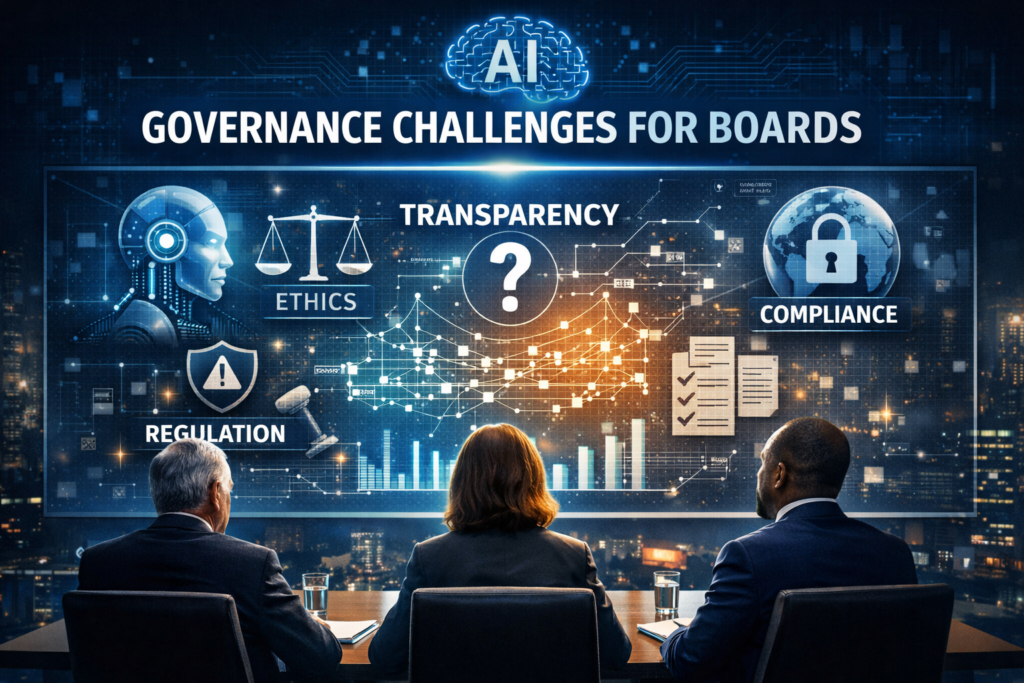
Artificial intelligence is no longer a technology conversation. It is a governance conversation.
Across industries, boards are discovering that AI is reshaping strategy, risk management, ethics, and long-term enterprise value. While executives deploy algorithms to improve efficiency, boards are increasingly responsible for ensuring those systems are safe, transparent, and aligned with stakeholder expectations.
In other words, artificial intelligence has entered the boardroom.
And with it comes a new generation of governance challenges.
The Strategic Shift Boards Cannot Ignore
Historically, boards focused their oversight on financial performance, compliance, and executive leadership. Technology risk was often delegated to management or a specialized committee.
AI changes that equation.
Unlike traditional software, AI systems can evolve, learn, and make decisions in ways that are not always predictable or transparent. These capabilities introduce risks that go beyond cybersecurity or IT infrastructure.
AI governance now intersects with:
Corporate reputation
Regulatory compliance
Data ethics
Workforce transformation
Long-term strategic positioning
Boards that fail to address these issues proactively may discover that AI-related risks surface not in the technology department, but in public trust, shareholder confidence, and legal exposure.
The stakes are no longer technical. They are existential.
The Transparency Problem
One of the most complex governance challenges surrounding AI is explainability.
Many advanced AI models operate as “black boxes,” producing outputs that even their creators cannot fully explain. While these systems can deliver remarkable performance, they also raise difficult questions for boards.
If an AI-driven decision harms a customer, denies a loan, or produces biased outcomes, who is accountable?
Directors must now ask management questions that did not exist five years ago:
Can we explain how our AI systems make decisions?
Are there safeguards against bias and discrimination?
Do we have human oversight mechanisms in place?
Transparency is no longer a technical feature. It is a governance requirement.
Regulatory Uncertainty and Global Complexity
Another challenge for boards is the rapidly evolving regulatory landscape.
Governments around the world are introducing AI legislation aimed at controlling risks while encouraging innovation. The European Union’s AI Act, emerging U.S. policy frameworks, and regulations across Asia are creating a complex patchwork of expectations.
For multinational companies, this means AI compliance is becoming a cross-border governance issue.
Boards must ensure their organizations are prepared for:
New disclosure requirements
Algorithm accountability standards
Data protection mandates
Industry-specific AI oversight
Regulation will likely accelerate in the coming years, and directors must ensure their companies are building governance frameworks today that can adapt tomorrow.
The Ethical Dimension of AI
Perhaps the most overlooked challenge for boards is ethical governance.
AI systems learn from historical data. If that data reflects societal bias, the technology can unintentionally reinforce inequities at scale.
For companies operating in sectors such as finance, healthcare, hiring, and insurance, the consequences can be significant.
Boards must ask deeper questions:
Are our AI systems fair and unbiased?
Are we using AI in ways that align with our corporate values?
Do we have ethical review mechanisms for high-impact AI decisions?
These conversations move beyond compliance. They touch the heart of corporate responsibility.
In the era of AI, ethics is no longer a public relations issue. It is a governance obligation.
The Talent Gap in the Boardroom
Many boards face another fundamental challenge: expertise.
Artificial intelligence is technically complex, yet directors are expected to oversee its risks and opportunities. In many organizations, board members may not have deep experience in data science, machine learning, or digital transformation.
This gap creates governance vulnerability.
Forward-looking boards are responding in several ways:
Recruiting directors with technology and AI expertise
Establishing dedicated technology or innovation committees
Engaging external advisors to support oversight
Effective governance requires understanding. And in the age of AI, technical literacy is becoming a strategic leadership competency.
The Opportunity Behind the Risk
Despite the challenges, AI governance is not only about risk mitigation.
It is also about opportunity.
Boards that engage deeply with AI strategy can help organizations unlock transformative value, including:
Operational efficiency through automation
Data-driven decision-making
New products and business models
Competitive advantage through intelligent systems
The difference between responsible innovation and reckless adoption often comes down to board leadership.
Directors who ask thoughtful questions, demand transparency, and align AI strategy with long-term value creation will help their organizations thrive.
Those who treat AI as merely another technology initiative risk falling behind.
The Future of Board Oversight
Artificial intelligence is still evolving, but one reality is already clear.
AI governance will become a permanent responsibility of modern boards.
Just as cybersecurity, ESG, and enterprise risk management became core board competencies over the past decade, AI oversight is now joining that list.
The most effective boards will approach AI governance through three guiding principles:
Strategic curiosity about how AI can reshape the business.
Disciplined oversight to ensure systems are safe, transparent, and ethical.
Continuous learning as technology and regulation evolve.
The boardroom has always been the place where long-term decisions are made.
In the age of artificial intelligence, it is also where the future of responsible innovation will be defined.
#AIGovernance, #CorporateGovernance, #BoardLeadership, #ArtificialIntelligence, #TechGovernance, #DigitalTransformation, #BoardStrategy, #Leadership, #FutureOfWork, #ExecutiveLeadership