
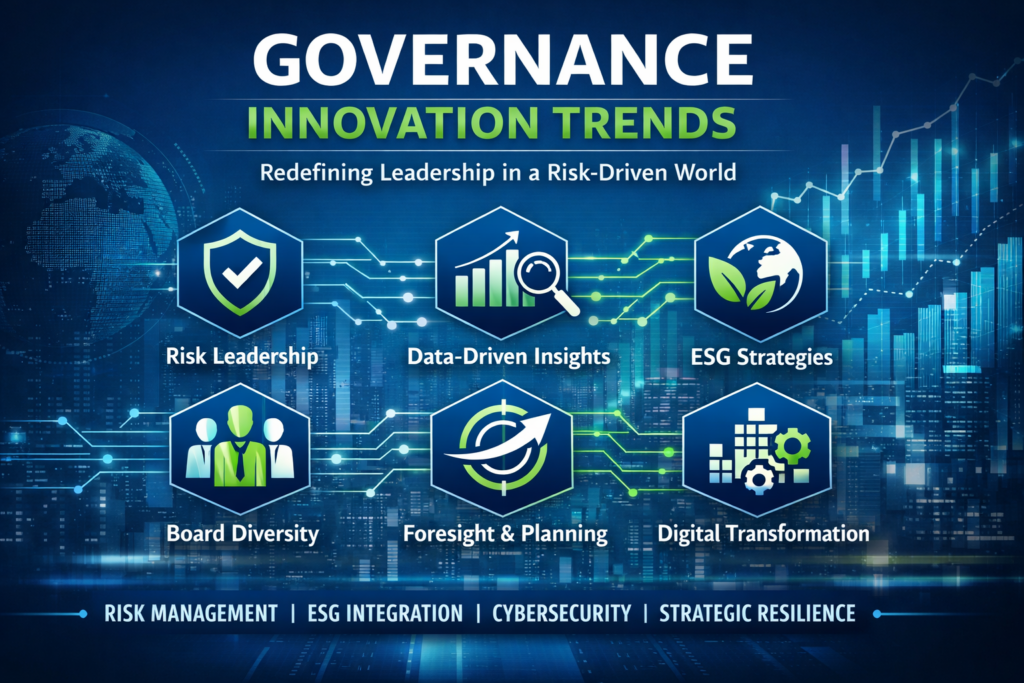
In today’s volatile business environment, governance is no longer a static framework—it is a dynamic capability. The most forward-thinking organizations are embracing governance innovation trends that shift boards from passive oversight bodies to active strategic leaders.
The question is no longer whether governance must evolve. It is whether your board is evolving fast enough.
The Shift from Governance to Governance Innovation
Traditional governance models were built for stability. Today’s environment demands adaptability.
Modern boards are navigating:
Rapid AI advancement
Cybersecurity threats
ESG accountability pressures
Supply chain disruption
Real-time reputational risk
These forces have accelerated the emergence of governance innovation trends that prioritize agility, foresight, and integrated risk leadership.
As John Maxwell reminds us, “everything rises and falls on leadership” . Governance is no exception. When boards elevate their leadership approach, organizational resilience follows.
Key Governance Innovation Trends Shaping Modern Boards
1. From Risk Oversight to Risk Leadership
Boards are no longer asking how to avoid risk. They are asking how to govern risk intelligently.
This shift includes:
Real-time risk dashboards
Scenario planning as a standing agenda item
Cross-functional risk integration
Risk is no longer a compliance function. It is a strategic lens.
2. Data-Driven Governance and Digital Visibility
One of the most significant governance innovation trends is the move toward data-enabled decision-making.
Boards are increasingly leveraging:
AI-driven analytics for predictive insights
Continuous monitoring tools
Cybersecurity intelligence reports
This transforms governance from retrospective review to proactive insight.
3. ESG as a Governance Imperative
Environmental, social, and governance factors are no longer optional. They are central to board accountability.
Modern boards are:
Embedding ESG metrics into executive compensation
Linking sustainability to long-term value creation
Expanding stakeholder reporting transparency
This reflects a deeper shift: governance is now tied directly to trust and reputation.
4. Board Composition and Skills Evolution
The complexity of today’s challenges requires new expertise in the boardroom.
Emerging governance innovation trends include:
Recruiting directors with AI, cybersecurity, and digital transformation experience
Increasing diversity of thought and background
Prioritizing continuous board education
Leadership, as Maxwell emphasizes, is a process, not a position . Boards that embrace learning outperform those that rely on legacy experience.
5. Culture as a Governance Responsibility
Governance no longer stops at policies. It extends into organizational culture.
High-performing boards are:
Measuring cultural health through employee data
Encouraging transparency and dissent
Creating psychological safety at the executive level
Silence is a governance risk. Culture is the early warning system.
6. Foresight Over Hindsight
The most powerful governance innovation trend is the shift from oversight to foresight.
Boards are now expected to:
Anticipate regulatory changes
Identify systemic vulnerabilities
Prepare for low-probability, high-impact events
This requires a mindset shift. Governance is no longer about reviewing the past. It is about shaping the future.
Why Governance Innovation Trends Drive Competitive Advantage
Organizations that adopt modern governance practices gain more than compliance. They gain clarity.
They make faster decisions.
They maintain investor confidence during volatility.
They adapt with precision instead of reacting under pressure.
As Simon Sinek’s work highlights, leadership is about inspiring action, not enforcing control . Governance innovation reflects that same principle—aligning people, purpose, and strategy.
Building a Governance Innovation Framework
To capitalize on governance innovation trends, boards should focus on four strategic pillars:
1. Continuous Risk Integration
Embed risk into every strategic decision, not just quarterly reviews.
2. Transparent Communication
Strengthen stakeholder trust through clarity and consistency.
3. Ongoing Education
Ensure directors remain fluent in emerging technologies and global trends.
4. Cultural Accountability
Treat culture as a measurable, governable asset.
The Leadership Imperative for Modern Boards
At its core, governance innovation is a leadership challenge.
Boards that treat governance as a checklist will fall behind. Boards that treat it as a strategic discipline will lead.
Stephen Covey’s principle-centered leadership reinforces this idea: sustainable success is built on consistent, values-driven action .
The Future of Governance Innovation Trends
The next decade will not be defined by organizations that eliminate risk.
It will be defined by those that master it.
Governance innovation trends are not temporary shifts. They are the new standard for board leadership.
Final Thought
Risk is constant. Complexity is increasing. Transparency is unavoidable.
The real differentiator is governance.
Boards that embrace innovation in governance will not just protect value. They will create it.
The question is simple:
Is your board governing for compliance—or leading for the future?
#CorporateGovernance, #GovernanceInnovation, #GovernanceInnovationTrends, #BoardLeadership, #RiskManagement, #EnterpriseRisk, #ESG, #Cybersecurity, #StrategicLeadership, #BoardStrategy, #BusinessResilience