
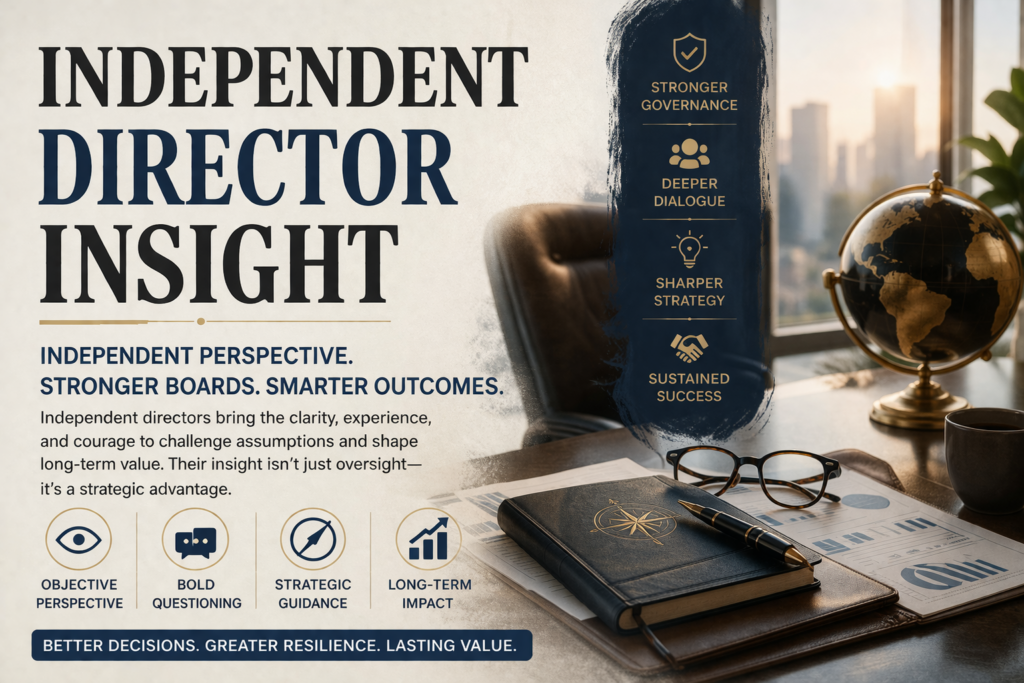
In today’s boardrooms, independence is no longer a checkbox—it is a competitive advantage.
As organizations navigate increasing complexity, regulatory pressure, and rapid market shifts, the role of the independent director has evolved from passive oversight to active strategic influence. The most effective boards are not simply compliant; they are constructively challenging, forward-looking, and anchored by independent voices that elevate decision-making.
Independent director insight, when fully leveraged, becomes one of the most underutilized assets in modern governance.
Beyond Compliance: Redefining the Role
Historically, independent directors were brought in to ensure objectivity, mitigate risk, and satisfy governance requirements. While those responsibilities remain essential, they are no longer sufficient.
Today’s high-performing boards expect independent directors to:
- Challenge assumptions, not just review outcomes
- Provide external perspective rooted in diverse experience
- Anticipate risks before they materialize
- Contribute to long-term strategic direction
In other words, independence is not about distance from management. It is about clarity of perspective.
The Power of Constructive Tension
Strong boards are not always comfortable rooms.
Independent directors play a critical role in creating what can be described as constructive tension—the healthy friction that prevents groupthink and strengthens strategic decisions.
Without this tension:
- Strategy becomes echo-driven
- Risk discussions become superficial
- Innovation stalls under consensus
With it:
- Blind spots are surfaced early
- Assumptions are rigorously tested
- Leadership thinking sharpens
The best independent directors understand that their value is not in agreement, but in perspective.
Insight Over Oversight
The distinction between oversight and insight is where modern boards are won or lost.
Oversight looks backward.
Insight looks forward.
Independent directors who add real value operate in the latter. They connect external trends to internal strategy, asking questions that management teams may not be positioned to ask themselves:
- How will this decision scale over time?
- What are we not seeing because we are too close to it?
- Where is the market moving faster than our current assumptions?
This shift transforms the board from a governance body into a strategic asset.
Independence Requires Courage
True independence is not structural—it is behavioral.
An independent director may meet all formal criteria yet fail to exercise real independence. The difference lies in courage.
Courage to:
- Ask difficult questions in high-stakes environments
- Challenge executive narratives without alienating leadership
- Maintain objectivity amid pressure for alignment
This balance—between support and challenge—is where effective governance lives.
The External Advantage
One of the greatest strengths independent directors bring is distance from internal bias.
They are not embedded in daily operations. They are not influenced by internal politics or historical decisions. This allows them to see patterns, risks, and opportunities that insiders may overlook.
In practice, this means:
- Bringing cross-industry insights into strategic discussions
- Benchmarking against broader market realities
- Identifying emerging risks before they impact performance
In a rapidly changing environment, external perspective is no longer optional—it is essential.
Building Boards That Leverage Independent Insight
For organizations, the challenge is not simply recruiting independent directors. It is activating them.
This requires:
- Creating space for open, candid dialogue
- Encouraging dissent as a strategic tool
- Aligning board composition with future—not past—needs
- Ensuring independent voices are integrated, not isolated
Boards that succeed in this shift move from governance to guidance.
The Strategic Imperative
Independent director insight is not about governance hygiene. It is about strategic resilience.
Organizations that effectively leverage independent perspectives:
- Adapt faster to disruption
- Make more balanced decisions
- Build stronger stakeholder trust
- Sustain long-term performance
Those that do not often find themselves reacting rather than leading.
Final Thought: Independence Is a Discipline
Every board has independent directors. Not every board has independent thinking.
The difference lies in how independence is practiced, encouraged, and valued.
Because in the end, the most effective boards are not defined by who sits at the table—but by how those voices shape the future of the organization.
#IndependentDirector, #BoardGovernance, #CorporateGovernance, #BoardLeadership, #ExecutiveLeadership, #StrategicLeadership, #BusinessStrategy, #BoardOfDirectors