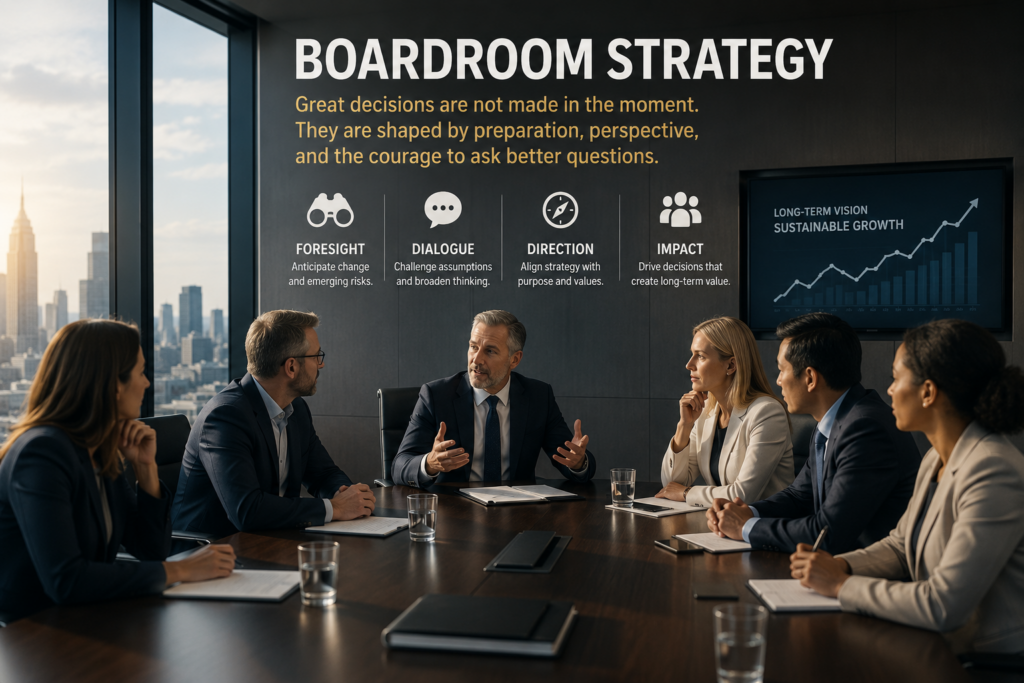
In many organizations, the boardroom is treated as a destination—a place where decisions are made, votes are cast, and strategy is finalized. But high-performing boards understand something fundamentally different: the boardroom is not where strategy begins. It is where strategy is refined, challenged, and ultimately strengthened.
The difference between average and exceptional governance is not what happens during the meeting. It is how leaders think before they ever walk into the room.
The Shift from Oversight to Strategic Stewardship
Traditionally, boards were designed for oversight—ensuring compliance, monitoring performance, and protecting shareholder interests. While those responsibilities remain critical, they are no longer sufficient.
Today’s boardrooms are being asked to do more:
- Anticipate disruption rather than react to it
- Balance short-term performance with long-term resilience
- Guide leadership through complexity, not just accountability
This evolution requires a shift in mindset—from oversight to strategic stewardship.
Strategic boards do not simply ask, “Are we performing?”
They ask, “Are we positioned to win in the future?”
Strategy Is a Conversation, Not a Document
One of the most common misconceptions about boardroom strategy is that it lives in a slide deck. In reality, strategy is not a static plan—it is a dynamic conversation.
The most effective boards operate less like auditors and more like thought partners. They:
- Challenge assumptions without undermining leadership
- Expand the lens beyond the current business model
- Introduce perspectives that management teams may not see internally
This is where real value is created—not in approval, but in elevation.
A strong board does not replace management thinking. It sharpens it.
The Power of Outside Perspective
The greatest advantage a board holds is distance.
Executives are immersed in the day-to-day realities of the business. Boards, by contrast, operate at a higher altitude. They bring:
- Cross-industry insight
- Pattern recognition from past cycles
- Objectivity in moments of pressure
This distance is not a limitation—it is a strategic asset.
When leveraged well, it allows boards to see what others miss: emerging risks, untapped opportunities, and second-order consequences.
But perspective alone is not enough. It must be paired with the courage to speak into the conversation.
The Discipline of Asking Better Questions
In high-performing boardrooms, the quality of strategy is directly tied to the quality of questions.
Weak boards focus on answers. Strong boards focus on inquiry.
They ask:
- What assumptions are we making that could be wrong?
- Where are we overconfident?
- What would disrupt us if it happened tomorrow?
- Are we solving the right problem—or just the visible one?
These questions do more than provoke discussion. They reshape thinking.
As leadership thinker John C. Maxwell has long emphasized, leadership is rooted in influence—not position. The same principle applies in the boardroom: the most effective directors influence outcomes not by authority, but by the depth of their insight and the precision of their questions.
Aligning Strategy with Purpose
A boardroom conversation that ignores purpose will eventually lose direction.
Strategy answers how an organization competes. Purpose answers why it exists.
When the two are disconnected, organizations drift—chasing opportunities that may generate revenue but dilute identity.
Great boards ensure alignment between:
- Long-term strategy
- Organizational values
- Stakeholder expectations
This is not philosophical. It is practical.
Organizations with clear purpose make faster decisions, attract stronger talent, and build deeper trust. As Simon Sinek’s work suggests, leaders who start with “why” inspire stronger commitment—an insight that applies as much in the boardroom as it does in the marketplace.
From Governance to Legacy
Perhaps the most overlooked dimension of boardroom strategy is its long-term impact.
Boards are not just guiding quarterly outcomes. They are shaping institutional legacy.
Every decision influences:
- Organizational culture
- Leadership development
- Reputation in the market
- Future leadership pipelines
In this sense, the boardroom is not just a place of governance. It is a place of generational impact.
The best boards think beyond tenure. They ask:
What will this organization look like because we were here?
The Future of Boardroom Strategy
As complexity accelerates, the expectations placed on boards will only increase. The next generation of boardroom strategy will be defined by:
- Greater emphasis on diverse perspectives
- Deeper engagement beyond formal meetings
- Integration of digital, geopolitical, and societal factors
- A stronger link between visibility and credibility of board members
Executives who aspire to board service must recognize this shift. Experience alone is no longer the differentiator. Perspective, communication, and strategic visibility are becoming equally essential.
Final Thought: Strategy Is a Leadership Discipline
The boardroom does not create strategy. Leaders do.
But the boardroom reveals the quality of that leadership.
It exposes whether strategy is reactive or intentional, narrow or expansive, short-term or enduring.
In the end, the most effective boards are not defined by their authority—but by their ability to elevate thinking.
Because in today’s environment, the organizations that win are not the ones with the best answers.
They are the ones asking the right questions—before anyone else does.
#BoardroomStrategy, #CorporateGovernance, #ExecutiveLeadership, #BoardOfDirectors, #BusinessStrategy, #LeadershipDevelopment, #StrategicLeadership, #Governance, #DecisionMaking, #Leadership