
For years, corporate governance was treated as a compliance exercise.
A set of policies.
A board structure.
A collection of risk controls designed to satisfy regulators and reassure investors.
But that era is ending.
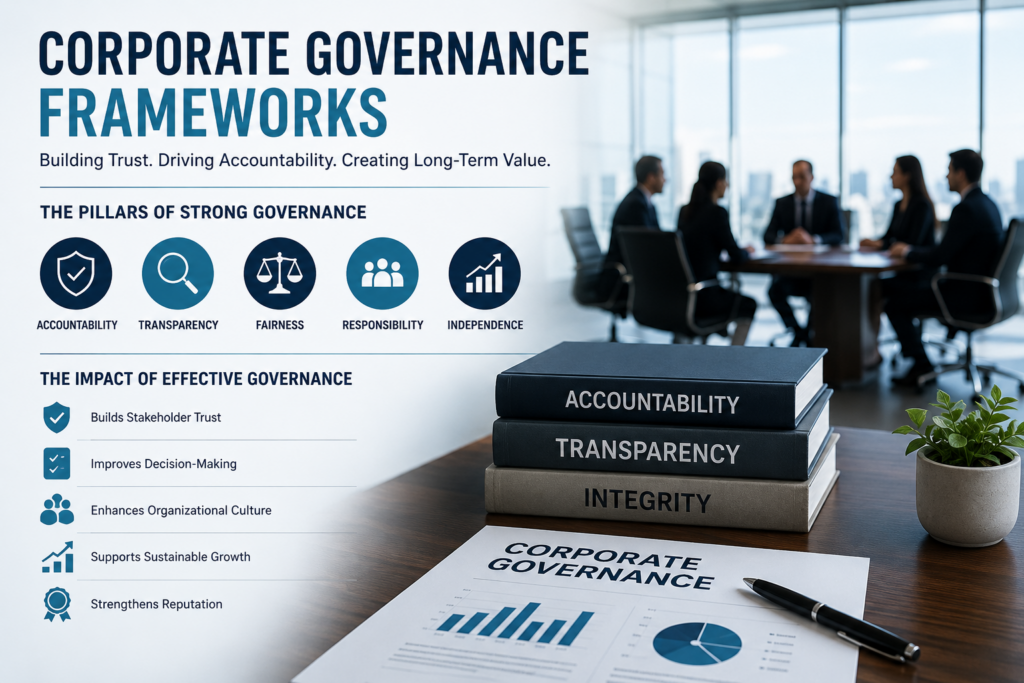
In today’s business environment, governance is no longer just about oversight. It is about organizational endurance.
The companies attracting long-term investor confidence are not necessarily the loudest, fastest-growing, or most disruptive. Increasingly, they are the organizations with governance frameworks strong enough to withstand volatility, maintain trust under pressure, and align leadership decisions with long-term value creation.
The modern governance conversation has shifted from:
“How do we remain compliant?”
to:
“How do we remain credible?”
And that distinction changes everything.
Governance Is No Longer Administrative. It Is Strategic.
Historically, governance frameworks operated quietly in the background of organizations. Their role was largely procedural: committee structures, audit processes, executive accountability, and shareholder protections.
Necessary, but rarely strategic.
Today, governance sits much closer to the center of business performance.
Why?
Because nearly every major organizational crisis of the last decade—from reputational failures to leadership collapses—has exposed the same underlying weakness:
misalignment between power, accountability, and culture.
Strong governance frameworks create alignment before pressure reveals dysfunction.
They clarify decision-making authority.
They reinforce ethical consistency.
They establish transparency during uncertainty.
And perhaps most importantly, they prevent leadership from becoming disconnected from reality.
In many organizations, governance is the only mechanism capable of slowing down short-term thinking before it becomes long-term damage.
The Most Effective Frameworks Prioritize Clarity Over Complexity
One of the biggest misconceptions about governance is that stronger oversight requires more complexity.
In practice, the opposite is often true.
The best governance frameworks are not the most bureaucratic.
They are the most understandable.
High-performing boards and executive teams operate with clarity around:
Who owns strategic decisions
How risk is evaluated
What accountability looks like
How leadership performance is measured
When intervention becomes necessary
How values influence operational decisions
Complex governance structures often create diffusion of responsibility.
Clear governance structures create disciplined leadership.
This is where many organizations fail.
They build governance systems capable of documenting decisions, but not improving them.
The distinction matters.
Because frameworks are only valuable if they shape behavior—not simply process.
Culture Is the Hidden Layer of Governance
Many boards still evaluate governance primarily through financial controls and compliance indicators.
But culture is increasingly becoming the real governance issue.
Not because culture is soft.
Because culture determines behavior when policies are no longer enough.
A company’s governance framework may define ethical standards.
Its culture determines whether people actually uphold them under pressure.
This is why organizations with sophisticated governance structures can still experience catastrophic failures.
The systems existed.
The accountability did not.
Simon Sinek’s observation that people follow leaders they trust becomes highly relevant at the governance level. Trust inside organizations is built when leadership behavior consistently reflects stated values—not when values merely appear in annual reports.
Governance frameworks succeed when they influence culture at every level of leadership.
Otherwise, they become performative architecture.
Boards Are Being Asked Different Questions Now
The expectations placed on boards have fundamentally changed.
A decade ago, governance discussions centered heavily on financial stewardship and shareholder return.
Today, boards are expected to oversee far more complex realities:
Cybersecurity risk
Executive ethics
ESG accountability
Cultural integrity
AI governance
Stakeholder trust
Reputational resilience
Leadership transparency
This evolution requires boards to think differently about governance itself.
The strongest boards are no longer passive oversight bodies.
They are active stewards of organizational credibility.
That means asking harder questions:
Does leadership behavior reinforce company values?
Are incentives aligned with long-term outcomes?
Is executive communication consistent with operational reality?
Are we identifying reputational risks before they become public crises?
Do employees trust leadership internally before investors trust them externally?
These are no longer “soft” questions.
They are governance questions.
Governance Frameworks Reveal Leadership Maturity
Under pressure, leadership always becomes visible.
And governance frameworks often determine whether that visibility builds trust or erodes it.
Organizations with weak governance structures tend to react emotionally during crises.
Communication becomes inconsistent.
Decision-making becomes centralized.
Transparency disappears.
Short-term protection overrides long-term credibility.
Strong governance frameworks create the opposite effect.
They stabilize leadership behavior.
They reinforce accountability.
They preserve decision quality under stress.
John Maxwell’s principle that “trust is the foundation of leadership” applies not only to individuals, but to institutions.
Governance is how organizations operationalize trust at scale.
Without it, leadership becomes personality-driven.
With it, leadership becomes sustainable.
The Future of Governance Will Be Human, Not Just Structural
The next evolution of governance will not come from more policies alone.
It will come from integrating human leadership principles into institutional decision-making.
That includes:
Psychological safety in executive teams
Ethical transparency during uncertainty
Long-term stakeholder thinking
Leadership accountability beyond quarterly performance
Cultural consistency across growth stages
Brené Brown’s work on vulnerability and courageous leadership highlights a truth many boards are only beginning to recognize:
organizations do not lose trust because leaders admit uncertainty.
They lose trust when leaders pretend certainty while avoiding accountability.
Modern governance frameworks must create environments where truth can move upward—not just directives downward.
That requires courage.
Not just compliance.
A Final Reflection
Corporate governance frameworks are no longer defensive systems designed simply to reduce risk.
They are leadership systems.
They shape how organizations think, communicate, respond, and endure.
In the years ahead, the companies that sustain trust will not be those with the most polished messaging or the most aggressive growth strategies.
They will be the organizations disciplined enough to align governance with character, culture, and long-term purpose.
Because ultimately, governance is not about controlling organizations.
It is about ensuring that power remains accountable to the people it serves.
#CorporateGovernance, #Leadership, #BoardLeadership, #ExecutiveLeadership, #BusinessStrategy, #GovernanceFrameworks, #LeadershipDevelopment, #OrganizationalCulture, #StakeholderTrust, #BusinessResilience