
In business, strategy gets the headlines. Revenue gets the applause. Innovation gets the attention.
But behind nearly every enduring company is something far less visible—and far more influential.
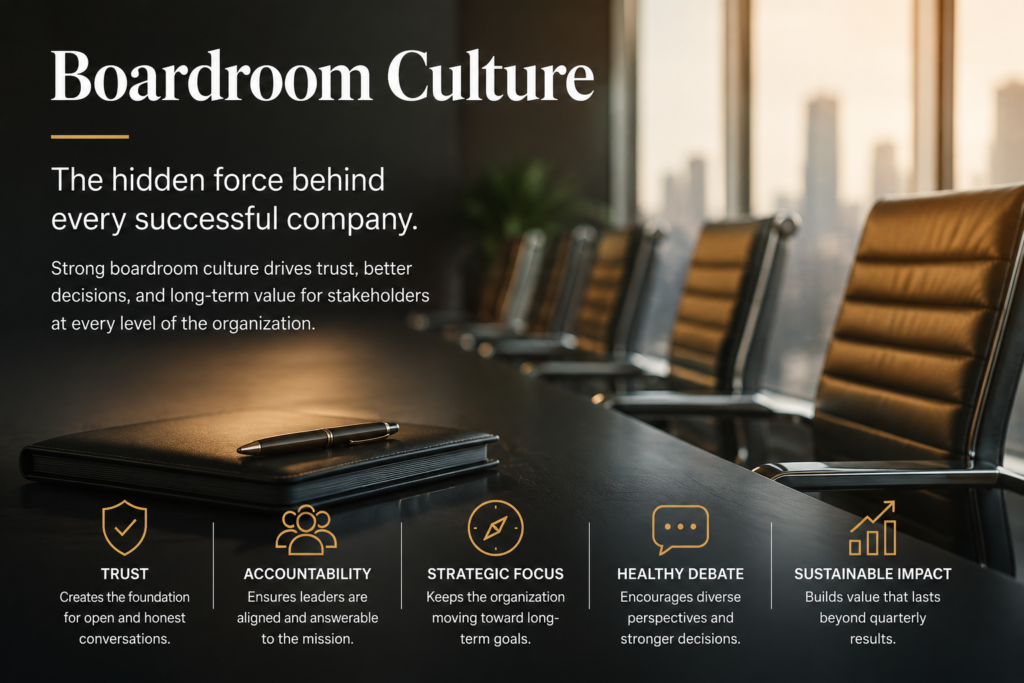
It’s called boardroom culture.
A company’s boardroom is more than a place where quarterly numbers are reviewed and governance requirements are checked off. It is the emotional and intellectual center of organizational leadership. The tone established there eventually cascades into every department, every decision, every hire, and every customer interaction.
Strong companies are rarely built by strategy alone. They are built by cultures that create trust, accountability, courage, and alignment at the highest level.
And weak boardroom cultures? They quietly destroy organizations long before the market notices.
What Is Boardroom Culture?
Boardroom culture is the collective mindset, behavior, communication style, and decision-making dynamic among board members and executive leadership.
It answers questions such as:
- Do leaders speak honestly or politically?
- Is disagreement encouraged or punished?
- Are decisions driven by long-term vision or short-term pressure?
- Does the board operate with trust—or ego?
- Are directors aligned around purpose or fragmented by personal agendas?
Every board has a culture, whether intentional or accidental.
The problem is that many organizations focus heavily on board composition while overlooking board chemistry.
A highly credentialed board can still become dysfunctional if trust is absent, communication is shallow, or leadership lacks emotional intelligence.
As Simon Sinek writes in Leaders Eat Last, people perform best when they feel psychologically safe. That principle doesn’t stop at the employee level—it begins in leadership itself.
The Best Boards Don’t Just Govern—They Lead
Great boards understand that governance is only part of their responsibility.
The highest-performing boards create environments where executives can think strategically, challenge assumptions, and make difficult decisions without fear-driven politics dominating the room.
This requires more than intelligence. It requires maturity.
John Maxwell often teaches that leadership is influence—not position. In the boardroom, this becomes especially important. The strongest directors are not always the loudest voices or the most recognizable names. Often, they are the individuals who bring clarity, stability, and wisdom under pressure.
Healthy boardroom cultures are characterized by:
- Respectful disagreement
- Shared accountability
- Long-term thinking
- Transparency
- Strategic curiosity
- Humility
- Decisiveness
- Trust
When these qualities exist, organizations move faster and lead stronger.
When they do not, even the best business models begin to fracture.
Why Toxic Boardroom Culture Is So Dangerous
Most organizational dysfunction does not begin at the employee level.
It begins at the top.
A toxic boardroom culture often manifests subtly at first:
- Conversations become performative
- Difficult issues are avoided
- Directors protect personal interests
- CEOs stop speaking candidly
- Meetings become reactive instead of strategic
Eventually, this creates organizational paralysis.
Employees sense inconsistency. Leadership teams become disconnected. Innovation slows. Decision-making becomes political instead of principled.
Stephen Covey wrote that “private victories precede public victories.” The same is true organizationally. Internal dysfunction always becomes external weakness.
No amount of branding can compensate for fractured leadership.
The Role of Vulnerability in Effective Leadership
One of the greatest misconceptions in corporate leadership is the belief that strong leaders must project certainty at all times.
In reality, high-performing boards are often led by individuals willing to ask difficult questions, admit blind spots, and invite challenge.
That requires vulnerability.
Brené Brown’s research on leadership demonstrates that vulnerability is not weakness—it is courage in action. Boards that create space for honest dialogue outperform boards trapped in defensiveness and ego preservation.
The modern boardroom must evolve beyond performative professionalism into authentic strategic partnership.
That shift changes everything.
Purpose-Driven Boards Build Stronger Companies
Organizations with exceptional boardroom cultures are usually united by more than profit targets.
They share a clear “why.”
Purpose creates alignment during uncertainty. It keeps leadership grounded when markets fluctuate and pressure intensifies.
Simon Sinek’s concept of “Start With Why” remains especially relevant for boards today. Companies that understand their mission at the leadership level create stronger employee engagement, stronger customer loyalty, and stronger long-term resilience.
Purpose-driven boards ask:
- What are we building beyond revenue?
- What legacy are we creating?
- How do our decisions impact people?
- Are we leading with integrity?
These questions shape culture more than any quarterly report ever will.
Building a High-Performance Boardroom Culture
Transforming boardroom culture does not happen overnight. It requires intentional leadership and ongoing discipline.
Here are several foundational principles strong boards consistently practice:
1. Prioritize Trust Over Politics
Trust accelerates decision-making. Politics slows it down.
Boards that operate from transparency create stronger executive relationships and healthier organizational momentum.
2. Encourage Constructive Conflict
The absence of disagreement is rarely a sign of unity. More often, it signals fear.
Strong boards normalize thoughtful debate while maintaining mutual respect.
3. Focus on Long-Term Value
Short-term thinking creates fragile organizations.
Exceptional boards balance immediate performance with sustainable vision.
4. Diversify Perspective, Not Just Background
True diversity includes thought diversity, industry insight, leadership style, and strategic perspective.
The best boards avoid intellectual echo chambers.
5. Lead Through Service
The strongest leaders do not seek power for status. They see leadership as stewardship.
This mindset creates healthier companies and stronger cultures.
The Future of Leadership Starts in the Boardroom
As businesses face increasing disruption, economic volatility, and cultural change, boardroom culture will become even more important.
Technology can improve efficiency.
Capital can fuel expansion.
Strategy can create momentum.
But culture determines whether success lasts.
The companies that thrive in the next decade will not simply have smarter strategies. They will have healthier leadership ecosystems.
And those ecosystems begin in the boardroom.
At its best, a boardroom becomes more than a governing body. It becomes a place where wisdom, accountability, courage, and vision converge to shape the future of an organization.
Because ultimately, leadership is contagious.
What happens in the boardroom never stays in the boardroom.
#BoardroomCulture, #Leadership, #CorporateGovernance, #ExecutiveLeadership, #BusinessStrategy, #CompanyCulture, #LeadershipDevelopment, #BoardOfDirectors, #BusinessGrowth, #OrganizationalLeadership, #StrategicLeadership, #CEO, #CorporateLeadership, #Boardsi, #BusinessSuccess