
In boardrooms across the world, executives are being asked to navigate an increasingly complex landscape. Economic uncertainty, workforce expectations, technological disruption, and cultural transformation have redefined what effective leadership looks like. While strategic vision, financial acumen, and operational excellence remain essential, another leadership trait has emerged as a critical differentiator: executive empathy.
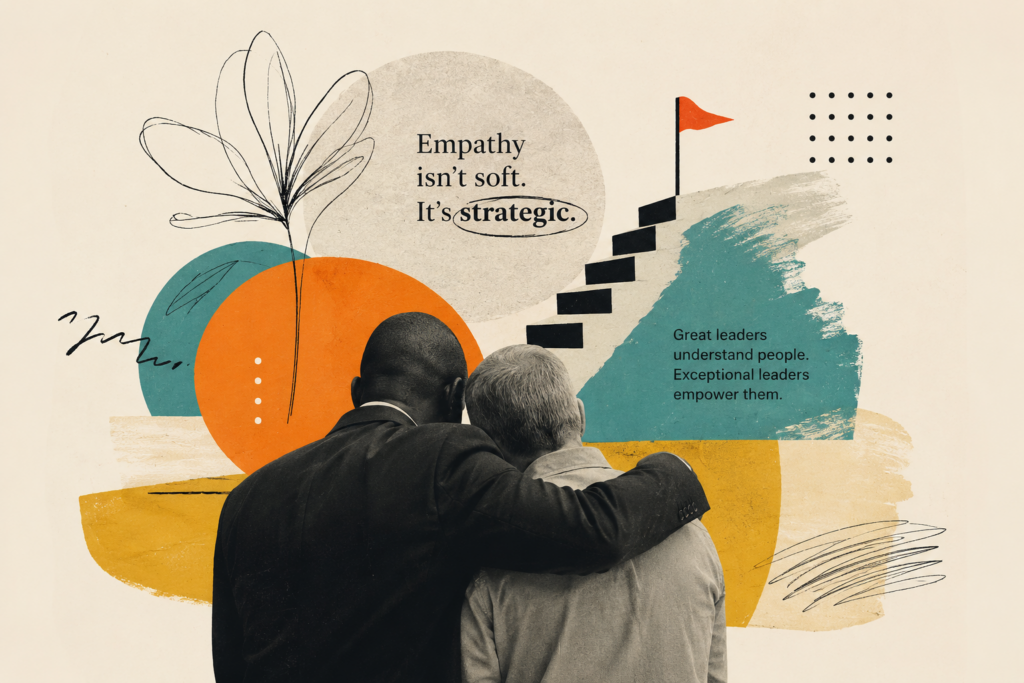
For years, empathy was often viewed as a soft skill, valuable but secondary to the hard realities of business. Today, that perception is changing. The most successful leaders understand that empathy is not about lowering standards or avoiding difficult decisions. It is about understanding people well enough to lead them effectively.
In an era where talent is a company’s most valuable asset, executive empathy has become a competitive advantage.
The Evolution of Leadership
Traditional leadership models often emphasized authority, control, and decision-making from the top down. While those approaches may have produced results in more predictable environments, today’s workforce expects something different.
Employees want leaders who understand their challenges, communicate transparently, and demonstrate genuine concern for their well-being. Customers increasingly align themselves with organizations that reflect human-centered values. Investors recognize that strong cultures often correlate with long-term performance.
As a result, leadership is evolving from managing people to connecting with people.
Executive empathy sits at the center of this transformation.
What Executive Empathy Really Means
Executive empathy is the ability to understand and appreciate the perspectives, emotions, and experiences of others while making informed business decisions.
It is not about agreeing with everyone.
It is not about avoiding accountability.
And it is certainly not about sacrificing performance.
Rather, empathy allows leaders to see beyond metrics and understand the human factors that drive those metrics.
Empathetic executives ask questions such as:
- What challenges are our employees facing?
- How will this decision impact our teams?
- What concerns are stakeholders expressing?
- What perspectives may we be overlooking?
By seeking these answers, leaders make more informed decisions and build stronger organizational trust.
Why Empathy Matters in the Executive Suite
The higher leaders rise within an organization, the easier it becomes to lose touch with the day-to-day realities of employees and customers.
Layers of management, busy schedules, and strategic priorities can unintentionally create distance.
Empathy helps bridge that gap.
When executives remain connected to the experiences of their people, they gain valuable insights that may never appear in financial reports or operational dashboards.
Organizations led by empathetic executives often experience:
- Higher employee engagement
- Stronger retention rates
- Increased innovation
- Greater collaboration
- Improved customer satisfaction
- Enhanced organizational resilience
In many cases, empathy becomes the foundation for sustainable business performance.
Empathy Builds Trust
Trust remains one of the most valuable currencies in leadership.
Without trust, communication suffers. Collaboration declines. Innovation slows. Performance eventually follows.
Employees are more likely to trust leaders who demonstrate understanding and concern for their experiences.
This became especially evident during periods of crisis. Organizations whose leaders communicated openly, listened actively, and acknowledged employee concerns often emerged stronger than those that relied solely on directives and policies.
Empathy creates psychological safety, allowing employees to contribute ideas, raise concerns, and engage more fully in their work.
And when trust grows, performance follows.
The Link Between Empathy and Decision-Making
Some executives worry that empathy may weaken decision-making by introducing too much emotion into the process.
The opposite is often true.
Empathy provides leaders with more complete information.
Understanding stakeholder perspectives helps executives anticipate reactions, identify risks, and recognize opportunities that might otherwise go unnoticed.
Leaders who understand the human impact of their decisions are often better equipped to navigate change, manage resistance, and achieve successful outcomes.
Empathy does not replace strategic thinking. It strengthens it.
Empathy and Organizational Culture
Culture is shaped less by what leaders say and more by what leaders consistently do.
When executives demonstrate empathy, those behaviors often cascade throughout the organization.
Managers begin listening more actively.
Teams communicate more openly.
Departments collaborate more effectively.
Employees feel more valued.
The result is a culture built on respect, accountability, and trust.
Strong cultures rarely happen by accident. They are often the direct result of leadership behaviors modeled at the highest levels.
Developing Executive Empathy
Empathy is not an inherent trait reserved for a select few leaders. It is a skill that can be developed through intentional practice.
Executives can strengthen empathy by:
Listening More Than Speaking
The most effective leaders spend time understanding before responding. Active listening often reveals insights that data alone cannot provide.
Seeking Diverse Perspectives
Leaders who engage with individuals from different backgrounds, functions, and experiences develop a broader understanding of organizational challenges and opportunities.
Remaining Accessible
Visibility matters. Executives who maintain meaningful connections with employees gain firsthand knowledge of organizational realities.
Asking Better Questions
Curiosity fuels empathy. Questions that explore experiences, concerns, and aspirations often uncover valuable information.
Practicing Self-Awareness
Leaders who understand their own emotions and biases are better equipped to understand others.
The Future of Executive Leadership
As organizations continue to evolve, leadership expectations will evolve with them.
Technical expertise and strategic thinking will always matter. However, leaders who combine those strengths with empathy will be best positioned to inspire trust, attract talent, and drive long-term success.
The future belongs to leaders who can balance performance with humanity.
Organizations do not succeed because of strategy alone. They succeed because people execute that strategy.
And people perform at their best when they feel understood, valued, and supported.
Final Thoughts
Executive empathy is no longer a leadership luxury. It is a business imperative.
The strongest leaders recognize that empathy is not a sign of weakness but a source of influence. It strengthens relationships, improves decision-making, builds trust, and fosters cultures where people and performance thrive together.
In a business world increasingly defined by complexity and change, empathy may be one of the most powerful leadership tools available.
The executives who embrace it will not only build stronger organizations. They will build organizations that people genuinely want to follow.
#ExecutiveEmpathy, #EmpatheticLeadership, #LeadershipDevelopment, #ExecutiveLeadership, #BusinessLeadership, #EmotionalIntelligence, #OrganizationalCulture, #LeadershipSkills, #EmployeeEngagement, #WorkplaceCulture, #LeadershipStrategy, #TrustInLeadership, #CorporateLeadership, #BusinessGrowth, #ExecutiveManagement, #PeopleLeadership, #LeadershipEffectiveness, #OrganizationalSuccess, #ManagementSkills, #ModernLeadership