
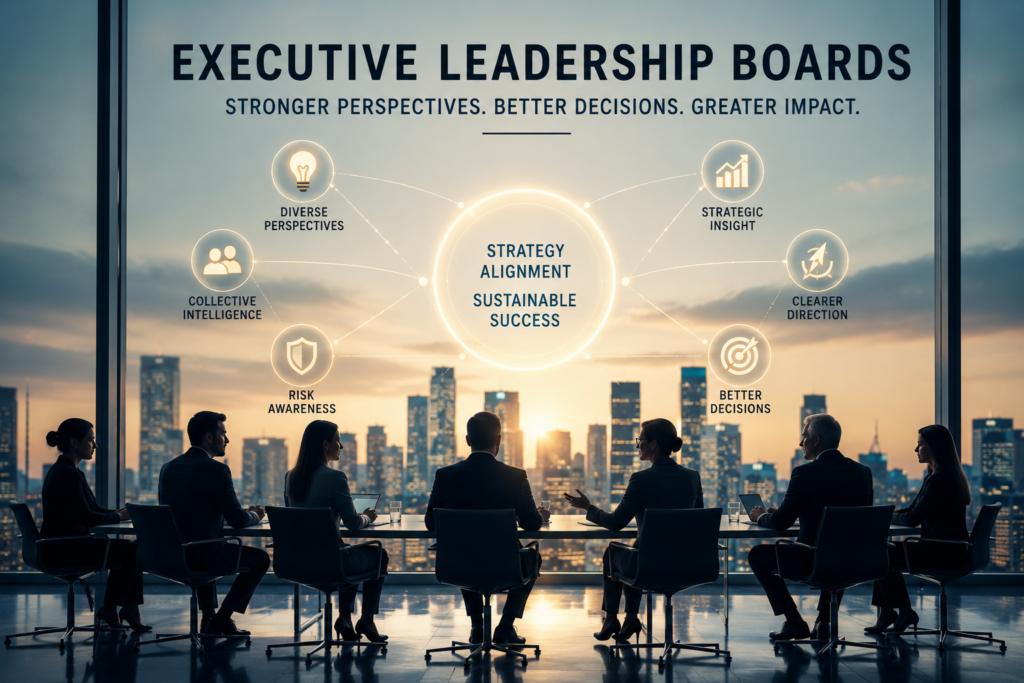
There comes a point in every successful organization when leadership becomes too complex for one executive team to navigate alone.
Growth introduces new markets. New regulations. New technologies. New risks. New stakeholders.
What once depended on instinct must now depend on perspective.
This is where executive leadership boards become invaluable.
Unfortunately, many organizations misunderstand their purpose. Some treat executive boards as symbolic committees that meet quarterly to review reports. Others create them simply because governance models suggest they should.
The most effective organizations do something different.
They build executive leadership boards that function as strategic intelligence networks, helping leaders make better decisions before complexity becomes crisis.
The difference is profound.
Leadership Becomes More Difficult as Organizations Become More Successful
Early-stage organizations thrive on speed.
Founders make decisions quickly. Communication is direct. Accountability is obvious because everyone works closely together.
Success changes that dynamic.
Departments expand.
Decision-making becomes distributed.
Communication slows.
Priorities compete.
As organizations grow, the challenge is no longer creating momentum. It is maintaining alignment.
An executive leadership board provides that alignment by bringing experienced perspectives together around the organization’s most important strategic questions.
Rather than managing day-to-day operations, these leaders focus on the issues that determine long-term organizational health.
Better Questions Create Better Decisions
Many executives assume leadership boards exist to provide answers.
Exceptional boards understand their greatest value lies elsewhere.
They improve the quality of leadership thinking.
Instead of immediately recommending solutions, strong executive boards ask questions that uncover assumptions leaders may not realize they are making.
What risks are we overlooking because current performance looks strong?
Which capabilities will the organization need three years from now?
Where are we investing based on optimism instead of evidence?
Which decisions create unintended consequences across other business units?
Questions like these elevate executive conversations.
And organizations that consistently improve the quality of their conversations almost always improve the quality of their decisions.
Diverse Expertise Outperforms Uniform Experience
One of the biggest mistakes organizations make when assembling executive leadership boards is selecting individuals with nearly identical backgrounds.
Similarity creates comfort.
Diversity creates insight.
A high-performing executive board might include expertise in operations, finance, cybersecurity, customer experience, talent strategy, technology, legal affairs, international markets, and organizational culture.
Each perspective exposes blind spots that another executive may never recognize.
Healthy disagreement becomes a competitive advantage.
Consensus should never be the objective.
Sound judgment should.
Executive Boards Protect Organizations From Success Blindness
Ironically, organizations often become most vulnerable during periods of exceptional performance.
Strong revenue can disguise operational inefficiencies.
Rapid hiring can conceal weak leadership systems.
Customer demand can temporarily compensate for declining service quality.
Momentum has a remarkable ability to hide emerging problems.
Experienced executive leadership boards recognize these patterns because they have witnessed them before.
Their role is not to predict every future challenge.
Their role is to recognize familiar warning signs while leadership still has time to respond.
That perspective becomes increasingly valuable as organizations scale.
Governance Without Trust Accomplishes Very Little
The most productive executive boards are built on trust rather than hierarchy.
Executives must feel comfortable presenting difficult realities instead of polished presentations.
Board members must be willing to challenge ideas without challenging people.
Constructive tension improves strategy.
Personal conflict weakens it.
The strongest executive boards create environments where difficult conversations happen early, long before difficult outcomes become unavoidable.
That culture often becomes one of an organization’s greatest strategic assets.
Leadership Development Begins at the Top
Executive leadership boards are often viewed primarily as governance structures.
In reality, they are leadership development systems.
Strong boards coach executive teams without taking control.
They expand strategic thinking.
They improve decision discipline.
They encourage accountability while preserving executive ownership.
Perhaps most importantly, they help senior leaders grow into the responsibilities required by the organization’s next stage of development.
As organizations evolve, executives must evolve with them.
The right board accelerates that growth.
The Cost of the Wrong Executive Board
An ineffective executive leadership board rarely creates immediate damage.
Its impact is gradual.
Critical questions go unasked.
Emerging risks remain invisible.
Leadership assumptions become accepted as fact.
Strategic discussions become routine rather than transformational.
Over time, these missed opportunities accumulate into expensive decisions that could have been prevented.
The absence of effective challenge often becomes more dangerous than visible disagreement.
The Bottom Line
Every organization eventually reaches a point where experience alone is no longer enough.
Complexity demands broader perspective.
Executive leadership boards provide that perspective.
When assembled thoughtfully and empowered appropriately, they become far more than governance bodies.
They strengthen executive judgment.
They improve strategic decision-making.
They identify risks before they become crises.
And they help leadership teams build organizations capable of sustained success rather than temporary growth.
In the end, the strongest organizations are not defined by the brilliance of one leader.
They are defined by the collective wisdom of leaders who make each other better.
#ExecutiveLeadership, #Leadership, #BoardOfDirectors, #CorporateGovernance, #BusinessStrategy, #LeadershipDevelopment, #ExecutiveTeam, #BusinessGrowth, #CorporateLeadership, #StrategicLeadership, #Governance, #DecisionMaking, #RiskManagement, #CEO, #OrganizationalLeadership, #ExecutiveManagement, #LeadershipExcellence, #BusinessSuccess, #BoardLeadership, #ForbesStyle