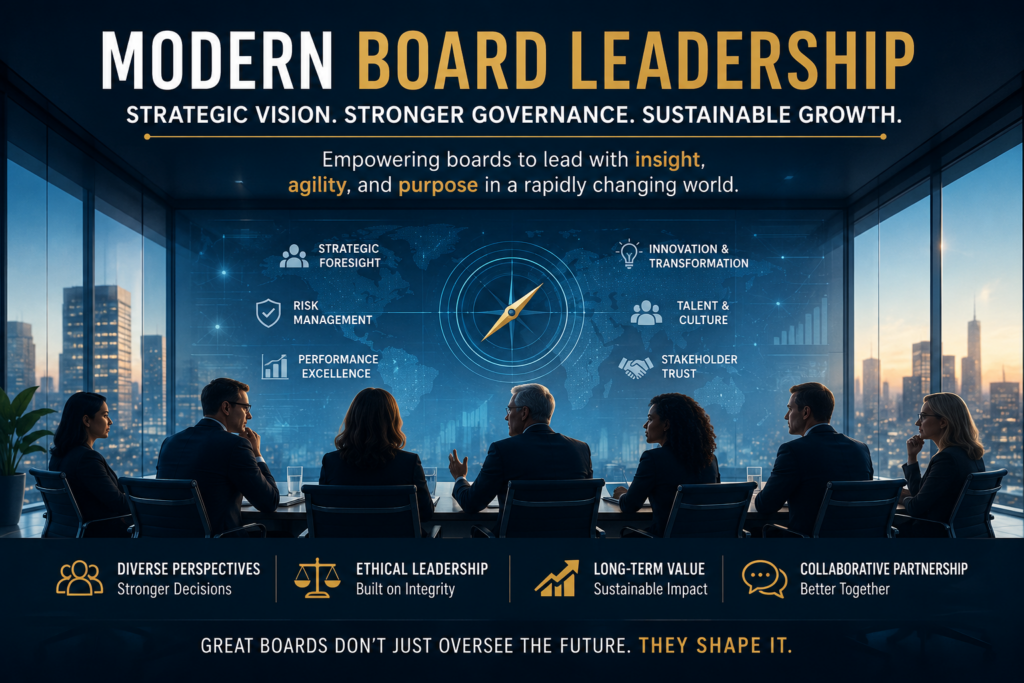
Organizations today face an increasingly complex business environment shaped by rapid technological change, evolving regulations, cybersecurity threats, and shifting stakeholder expectations. In this landscape, traditional governance models are no longer enough. Companies need modern board leadership—a forward-thinking approach that enables boards to guide organizations with strategic vision, agility, and accountability.
Modern board leadership goes beyond compliance and oversight. It empowers boards to become active strategic partners that help organizations innovate, manage risk, and create long-term value. Companies that embrace this leadership model position themselves to adapt faster, make better decisions, and remain competitive in changing markets.
What Is Modern Board Leadership?
Modern board leadership is a governance philosophy that combines strategic oversight with collaborative leadership. Rather than simply reviewing financial reports and approving executive decisions, today’s boards actively contribute their expertise to help shape the organization’s future.
Effective modern boards focus on:
- Long-term strategic planning
- Risk management and resilience
- Innovation and digital transformation
- Executive leadership development
- Corporate culture and ethics
- Environmental, social, and governance (ESG) priorities
- Stakeholder engagement
This expanded role allows directors to provide meaningful guidance while maintaining their fiduciary responsibilities.
Why Modern Board Leadership Matters
The business environment has changed dramatically over the past decade. Artificial intelligence, cybersecurity, remote work, global competition, and economic uncertainty require organizations to make faster, more informed decisions.
Modern board leadership provides several critical advantages.
Better Strategic Decision-Making
Diverse boards bring together executives with experience across industries, technologies, finance, operations, marketing, and entrepreneurship. This diversity of expertise creates richer discussions that improve strategic planning and reduce blind spots.
Rather than reacting to challenges, modern boards help organizations anticipate future opportunities and prepare for disruption.
Stronger Risk Management
Today’s risks extend well beyond financial reporting. Organizations must navigate cyber threats, supply chain disruptions, data privacy concerns, regulatory changes, and reputational risks.
Modern board leadership emphasizes proactive risk governance by asking difficult questions, reviewing emerging trends, and ensuring leadership teams have effective contingency plans.
Improved Organizational Performance
Research consistently shows that organizations with engaged, high-performing boards often outperform those with passive governance structures.
When directors actively mentor executives, challenge assumptions, and provide strategic guidance, organizations benefit from better decision-making, stronger accountability, and improved execution.
Characteristics of Modern Board Leadership
Successful boards share several defining characteristics that distinguish them from traditional governance models.
Strategic Thinking
Modern boards spend less time reviewing historical reports and more time discussing future opportunities.
Meetings prioritize growth initiatives, competitive positioning, innovation, acquisitions, talent development, and emerging risks.
Diverse Perspectives
Board diversity extends beyond demographics. It includes diversity of experience, expertise, industry knowledge, professional backgrounds, and problem-solving approaches.
This variety helps organizations avoid groupthink while improving creativity and decision quality.
Continuous Learning
The best directors recognize that governance is constantly evolving.
Modern board leadership requires ongoing education about:
- Emerging technologies
- Regulatory developments
- Cybersecurity
- AI governance
- Industry trends
- Corporate governance best practices
Continuous learning enables directors to make informed decisions in rapidly changing markets.
Collaborative Leadership
Effective boards build strong partnerships with executive leadership rather than acting solely as oversight bodies.
Healthy collaboration encourages transparency, open communication, and productive debate while maintaining appropriate governance independence.
Technology Is Transforming Board Leadership
Technology has become one of the defining factors of modern board leadership.
Boards increasingly oversee initiatives involving:
- Artificial intelligence
- Digital transformation
- Cloud computing
- Cybersecurity
- Data analytics
- Automation
Directors no longer need to be technology experts, but they must understand how digital innovation affects organizational strategy, customer expectations, operational efficiency, and competitive advantage.
Boards that embrace technology are better equipped to guide organizations through digital transformation while minimizing associated risks.
Building an Effective Modern Board
Organizations seeking stronger governance should focus on building boards with complementary skills and future-focused perspectives.
Key priorities include:
Recruit for Expertise
Rather than filling seats based solely on industry relationships, organizations should identify directors who bring expertise aligned with strategic objectives.
Skills may include:
- Finance
- Technology
- Human resources
- Legal and compliance
- Marketing
- International business
- Mergers and acquisitions
- Cybersecurity
A balanced mix of expertise strengthens overall governance.
Encourage Open Dialogue
Modern board leadership depends on constructive discussion.
Effective boardrooms encourage directors to ask challenging questions, explore alternative viewpoints, and respectfully debate important decisions before reaching consensus.
This culture improves decision quality while reducing unnecessary risk.
Evaluate Board Performance
High-performing boards regularly assess their effectiveness.
Annual evaluations help identify strengths, skill gaps, governance improvements, and opportunities for director development.
Continuous improvement ensures boards remain aligned with organizational needs.
The Role of Independent Directors
Independent directors play an increasingly valuable role in modern board leadership.
Because they bring objective perspectives, independent directors can:
- Challenge executive assumptions
- Provide unbiased strategic advice
- Improve governance transparency
- Strengthen accountability
- Enhance investor confidence
Their outside experience often introduces innovative ideas that internal leadership may overlook.
Modern Board Leadership and Long-Term Success
Organizations that invest in modern board leadership create a significant competitive advantage.
Forward-looking boards help organizations:
- Navigate uncertainty
- Accelerate innovation
- Strengthen governance
- Build resilient leadership teams
- Improve stakeholder trust
- Create sustainable long-term growth
As markets continue to evolve, boards must evolve alongside them. Organizations that embrace strategic, collaborative governance will be better positioned to lead through change while creating lasting value for shareholders, employees, customers, and communities.
How Boardsi Supports Modern Board Leadership
Finding the right leadership talent is one of the most important steps in building a modern board. Boardsi connects companies with accomplished executives, industry experts, and experienced professionals who bring fresh perspectives and specialized expertise to board service.
Whether an organization is expanding its governance capabilities, preparing for growth, or navigating digital transformation, Boardsi helps businesses identify qualified board candidates whose experience aligns with strategic goals. By building diverse, forward-thinking boards, organizations can strengthen governance, improve decision-making, and embrace the principles of modern board leadership that drive long-term success.
Conclusion
Modern board leadership is redefining how organizations govern, innovate, and grow. Today’s most successful boards are strategic advisors, collaborative partners, and catalysts for sustainable success. They provide the expertise, oversight, and vision necessary to help organizations thrive in an increasingly dynamic business environment.
Companies that invest in building agile, diverse, and future-focused boards will be better prepared to overcome challenges, seize new opportunities, and achieve lasting organizational excellence.
#ModernBoardLeadership, #BoardLeadership, #CorporateGovernance, #BoardOfDirectors, #ExecutiveLeadership, #StrategicLeadership, #BusinessGrowth, #LeadershipDevelopment, #RiskManagement, #DigitalTransformation, #Innovation, #Governance, #BoardRecruitment, #BusinessStrategy, #Boardsi