
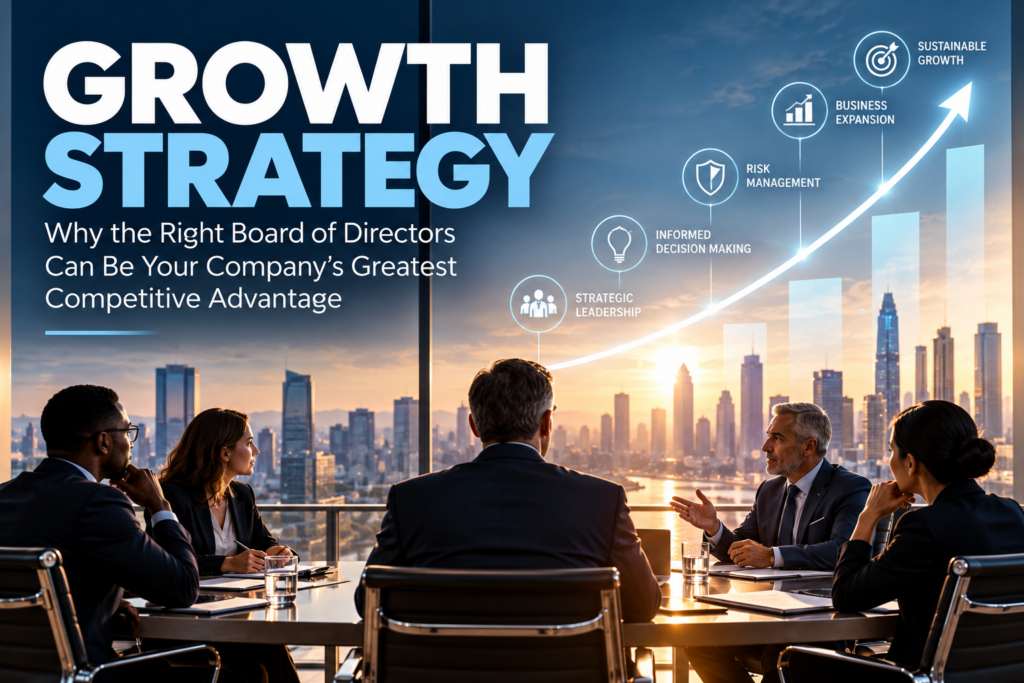
Growth strategy is about more than increasing revenue, expanding into new markets, or acquiring customers. Sustainable business growth requires strategic leadership, informed decision making, and the ability to anticipate challenges before they become obstacles. For companies looking to accelerate growth, the right board of directors can provide a powerful strategic advantage.
Every business leader wants growth.
More customers. Greater market share. Stronger revenue. New opportunities.
But growth alone does not guarantee long term success.
Some companies expand rapidly only to discover that their leadership structures, operational capabilities, and financial resources cannot support their ambitions. Others pursue opportunities without fully understanding the risks, competitive dynamics, or organizational changes required to succeed.
The difference between companies that grow and companies that grow sustainably often comes down to the quality of their strategy and the people helping shape it.
A successful growth strategy is not simply a plan to become bigger. It is a disciplined approach to becoming stronger, more competitive, and better positioned for the future.
For CEOs, founders, entrepreneurs, and business owners, developing that strategy requires more than operational expertise. It requires perspective, accountability, and experienced leadership capable of challenging assumptions and identifying opportunities.
That is where a strong board of directors or advisory board can make a meaningful difference.
What Is a Growth Strategy?
A growth strategy is a structured plan that outlines how a business intends to expand its operations, revenue, customer base, market presence, or competitive position over time.
An effective business growth strategy identifies opportunities for expansion while establishing the resources, capabilities, and leadership priorities necessary to pursue them.
Depending on the organization’s objectives, growth strategies may focus on:
- Market penetration: Increasing sales and market share within existing markets.
- Market expansion: Entering new geographic regions, industries, or customer segments.
- Product development: Introducing new products or services to existing customers.
- Diversification: Expanding into new markets with new offerings.
- Strategic partnerships: Collaborating with other organizations to access capabilities, customers, or distribution channels.
- Mergers and acquisitions: Accelerating expansion through the acquisition of complementary businesses.
- Operational scalability: Improving systems, processes, and organizational capabilities to support greater demand.
Each approach presents different opportunities and challenges.
The most effective growth strategy depends on the company’s financial position, competitive environment, leadership capabilities, customer needs, and long term objectives.
Growth becomes sustainable when these factors work together.
Why Growth Strategy Matters More Than Ever
Today’s business environment creates opportunities for companies willing to innovate and adapt.
Artificial intelligence is transforming industries. Digital technologies are changing customer expectations. Global competition is challenging established business models. Economic uncertainty and regulatory complexity are forcing leaders to reconsider traditional approaches to expansion.
In this environment, growth cannot depend entirely on momentum.
Companies need a clear understanding of where they want to compete, how they intend to win, and what capabilities they must develop to execute their strategy.
Without that clarity, organizations risk pursuing too many initiatives, allocating capital inefficiently, or expanding beyond their operational capacity.
A well designed growth strategy provides direction.
It helps leadership teams establish priorities, evaluate investments, allocate resources, and measure progress against meaningful business objectives.
Perhaps most importantly, it creates a framework for making difficult decisions.
Strategy becomes valuable not only because it identifies what a company should pursue, but because it clarifies what the company should decline.
For businesses navigating complex growth decisions, experienced board members can provide the independent perspective necessary to strengthen that discipline.
1. The Right Board Members Strengthen Strategic Decision Making
One of the greatest challenges facing business leaders is maintaining objectivity while managing daily operations.
CEOs and executive teams are deeply involved in their organizations. They understand the products, customers, employees, and competitive pressures influencing performance.
That proximity is essential for execution.
However, it can also make it difficult to recognize blind spots.
Experienced board members bring an outside perspective that can help leadership teams evaluate assumptions, consider alternative strategies, and identify risks that might otherwise go unnoticed.
For example, a company considering international expansion may benefit from a director who has successfully entered foreign markets.
A business preparing to raise capital may need someone with experience in financial strategy, investor relations, or institutional funding.
An organization implementing artificial intelligence may benefit from board level expertise in technology transformation, cybersecurity, and enterprise risk.
These perspectives can improve the quality of strategic discussions.
The purpose of a strong board is not to make every decision for management.
It is to help ensure that leadership is asking the right questions before making consequential decisions.
2. Sustainable Growth Requires More Than Revenue Expansion
Revenue growth is an important measure of business performance, but it tells only part of the story.
A company can increase sales while experiencing declining margins, operational inefficiencies, employee turnover, or growing financial exposure.
Sustainable growth requires attention to the underlying health of the organization.
Business leaders should evaluate whether their growth strategy supports:
Financial sustainability: Does expansion generate sufficient returns to justify the investment?
Operational capacity: Can existing systems, infrastructure, and processes support additional demand?
Leadership development: Does the organization have the management talent required for its next stage?
Customer retention: Is the business creating long term relationships or relying excessively on new customer acquisition?
Risk management: Are potential financial, technological, regulatory, and reputational risks being addressed?
Organizational culture: Can the company preserve accountability, collaboration, and employee engagement as it expands?
These considerations are interconnected.
A company that doubles revenue without strengthening its operational infrastructure may create more problems than opportunities.
Board members with experience scaling organizations can help leadership teams recognize these challenges before they threaten performance.
The objective is not growth at any cost. It is growth that creates lasting enterprise value.
3. A Strong Growth Strategy Begins With the Right Questions
Business leaders frequently approach strategic planning by asking how much the company can grow.
A more useful starting point may be understanding why the company is positioned to grow and what must change to support that ambition.
Before committing to major expansion initiatives, leadership teams should consider several questions.
Where Does the Company Have a Competitive Advantage?
Successful growth often begins by identifying the capabilities that distinguish an organization from its competitors.
These advantages may include specialized expertise, customer relationships, proprietary technology, operational efficiency, brand reputation, or access to distribution channels.
Growth strategies are generally stronger when they build upon capabilities the company can defend and expand.
Which Opportunities Create the Greatest Long Term Value?
Not every attractive market represents a suitable opportunity.
Organizations must evaluate potential returns, competitive intensity, capital requirements, regulatory exposure, and the capabilities needed to succeed.
A disciplined growth strategy prioritizes opportunities that align with the company’s strengths and long term direction.
What Could Prevent Successful Execution?
Growth initiatives frequently encounter challenges involving talent, capital, technology, supply chains, or organizational coordination.
Identifying these constraints early allows leadership teams to develop realistic plans and appropriate safeguards.
Does the Organization Have the Right Leadership Expertise?
A company may have an excellent management team and still lack experience in a critical area of expansion.
That gap does not necessarily require replacing existing leaders.
It may require introducing additional expertise through an advisory board, independent directors, or specialized strategic advisers.
Experienced board members can help companies recognize when their ambitions have outgrown their existing leadership capabilities.
4. Board Composition Should Reflect the Company’s Growth Strategy
One of the most overlooked elements of business growth is the relationship between strategic priorities and board composition.
Companies often recruit directors based on professional reputation, personal connections, or previous executive titles.
While those qualities may be valuable, they do not automatically establish strategic relevance.
A more effective approach begins by identifying the capabilities the organization needs to execute its growth strategy.
Consider several examples.
A Technology Company Preparing to Scale
A rapidly expanding technology business may benefit from directors with expertise in enterprise sales, cybersecurity, artificial intelligence, capital raising, or international operations.
A Family Owned Business Entering a New Market
A family business pursuing regional or national expansion may need board members experienced in distribution strategy, organizational transformation, financial management, and succession planning.
A Company Considering Acquisitions
An organization pursuing acquisition driven growth may benefit from directors who understand transaction evaluation, due diligence, integration, financing, and post acquisition performance.
A Business Preparing for Institutional Investment
A company seeking private equity or other institutional capital may need expertise in financial reporting, governance, investor expectations, and strategic performance management.
The central principle is straightforward.
The expertise around the boardroom table should reflect the challenges and opportunities ahead of the business, not simply the accomplishments behind its directors.
For companies seeking qualified board members, specialized board recruitment resources can help expand access to candidates with relevant leadership experience.
5. Growth Strategy Depends on Effective Governance
As companies expand, the complexity of their decisions increases.
Larger organizations often face greater financial exposure, more demanding regulatory requirements, broader stakeholder expectations, and increasingly complicated operational structures.
These changes make effective corporate governance essential.
A board of directors provides oversight of management, strategic direction, financial performance, risk, and executive accountability.
While management remains responsible for executing the company’s growth strategy, the board helps evaluate whether that strategy is appropriate, adequately resourced, and consistent with the organization’s long term interests.
Effective governance can strengthen growth by encouraging:
- Clear strategic priorities and measurable objectives.
- Disciplined capital allocation.
- Independent evaluation of major investments.
- Stronger enterprise risk management.
- Executive accountability and succession planning.
- Transparent reporting and performance monitoring.
For smaller or founder led businesses, an advisory board can also provide valuable strategic guidance.
However, advisory boards and formal boards of directors serve different purposes. Advisory board members generally provide nonbinding guidance, while directors on a governing board have formal oversight responsibilities and may owe legal fiduciary duties.
Companies should select the structure that fits their stage, ownership model, and governance requirements.
Growth and governance should not be viewed as competing priorities.
When implemented effectively, governance provides the discipline that allows growth to become more sustainable.
6. Strategic Partnerships Can Accelerate Business Growth
Not every growth opportunity requires a company to develop new capabilities internally.
Strategic partnerships can help organizations access markets, technologies, expertise, and distribution channels that would otherwise require significant investment.
Examples include partnerships between technology providers and established enterprises, manufacturers and distribution companies, or businesses offering complementary products and services.
However, successful partnerships require more than shared enthusiasm.
Organizations must evaluate commercial alignment, financial expectations, operational responsibilities, intellectual property considerations, and potential conflicts of interest.
Board members with experience negotiating partnerships or managing complex business relationships may provide valuable insight during this process.
Their professional networks can also help companies identify potential collaborators.
Still, access to relationships should not be the sole reason for appointing a director.
The strongest board members contribute judgment, expertise, and accountability alongside their professional connections.
7. The Best Growth Strategies Anticipate Risk
Business growth involves uncertainty.
New markets may not develop as expected. Technology investments may take longer to deliver results. Acquisitions may encounter integration difficulties. Competitive pressures may change faster than anticipated.
A successful growth strategy does not eliminate uncertainty.
It establishes a disciplined approach to evaluating and managing it.
Leadership teams should identify the assumptions underlying major growth initiatives and consider how the organization would respond if those assumptions prove incorrect.
This may involve scenario planning, financial stress testing, operational contingency plans, and periodic strategic reviews.
Independent directors can strengthen these discussions by challenging overly optimistic projections and encouraging management to examine alternative outcomes.
The goal is not to discourage ambition.
It is to ensure that ambition is supported by preparation.
The strongest companies do not pursue growth because they believe nothing will go wrong. They build strategies capable of adapting when circumstances change.
8. Finding the Right Board Members for Your Growth Strategy
Once an organization identifies its strategic priorities, the next challenge is finding leaders who can help support them.
This process should begin with a clear assessment of existing board capabilities and potential gaps.
Companies may need expertise in financial strategy, international expansion, digital transformation, mergers and acquisitions, governance, or organizational development.
From there, leadership teams can develop a director profile that reflects the company’s specific needs.
Qualified candidates may be identified through executive networks, professional associations, investors, specialized board recruitment firms, and board member search platforms.
Boardsi operates in the executive and board recruitment space, connecting companies with leadership talent and helping organizations explore potential board and advisory candidates.
For businesses looking to strengthen their growth strategy, a specialized resource such as Boardsi can provide an additional channel for identifying executives whose experience aligns with the organization’s strategic priorities.
However, selecting the right director requires more than reviewing professional credentials.
Companies should evaluate candidates based on their relevant expertise, strategic judgment, governance awareness, independence, communication skills, and ability to contribute effectively to collective decision making.
The objective is not simply to recruit accomplished executives.
It is to identify leaders whose capabilities can help the organization navigate its next stage of growth.
9. Five Steps to Build a Stronger Growth Strategy
A practical growth strategy requires clear priorities and disciplined execution.
Business leaders can begin with five essential steps.
Step 1: Define Your Growth Objectives
Determine what growth means for the organization.
This may involve revenue expansion, improved profitability, market share, customer retention, geographic expansion, or increased enterprise value.
Establish measurable objectives and realistic timeframes.
Step 2: Evaluate Your Competitive Position
Assess market demand, customer needs, competitive advantages, industry trends, and potential threats.
Identify the opportunities where the company is best positioned to succeed.
Step 3: Identify Capability Gaps
Examine whether the organization has the financial resources, operational infrastructure, technology, talent, and leadership expertise required to execute its strategy.
Prioritize the gaps most likely to constrain performance.
Step 4: Strengthen
Strategic Leadership
Consider whether the current board, advisory team, and executive leadership structure provide the expertise needed for the next stage of growth.
Where gaps exist, explore additional board members or advisers with relevant experience.
Step 5: Measure, Review, and Adapt
Establish performance indicators that connect growth initiatives with financial and operational outcomes.
Review progress regularly and adjust priorities when market conditions, organizational capabilities, or strategic assumptions change.
Growth strategy should be treated as an ongoing leadership responsibility rather than an annual planning exercise.
Frequently Asked Questions About Growth Strategy
What is a growth strategy in business?
A growth strategy is a structured plan for expanding a company’s revenue, market presence, customer base, capabilities, or enterprise value. It identifies growth opportunities and the resources needed to pursue them successfully.
What are the main types of growth strategies?
Common growth strategies include market penetration, market expansion, product development, diversification, strategic partnerships, and mergers and acquisitions. Companies may combine several approaches depending on their objectives.
Why is growth strategy important?
A growth strategy helps organizations prioritize opportunities, allocate resources, manage risks, and establish a clear direction for long term business development. It also provides a framework for measuring performance.
How can a board of directors support business growth?
A board of directors can support business growth by providing strategic oversight, independent judgment, relevant industry expertise, risk evaluation, and accountability. Directors help management evaluate major decisions while respecting the distinction between governance and operations.
What makes a successful growth strategy?
A successful growth strategy aligns market opportunities with the company’s competitive advantages, financial resources, operational capabilities, and leadership expertise. It also includes measurable objectives, risk management, and the flexibility to adapt to changing conditions.
How can companies find board members with growth experience?
Companies can identify potential directors through executive networks, professional associations, investors, specialized board recruitment firms, and board matching platforms. Services such as Boardsi can help organizations explore executive and board talent relevant to their strategic needs.
Conclusion: The Future of Growth Depends on the Quality of Leadership
Growth is one of the most important ambitions in business.
It creates opportunities for innovation, investment, employment, and long term value creation.
But growth also introduces complexity.
The decisions that help a company reach its first major milestone may not be the same decisions required to reach the next.
As organizations expand, they need leadership structures capable of providing broader perspective, stronger oversight, and more sophisticated strategic judgment.
That is why the relationship between growth strategy and board leadership deserves greater attention.
The right directors can help companies challenge assumptions, evaluate opportunities, strengthen governance, and prepare for challenges that accompany expansion.
For organizations seeking experienced board members and executive talent, Boardsi provides a resource for exploring leadership connections aligned with business needs.
Ultimately, the most successful growth strategies are not defined solely by ambitious targets or impressive financial projections.
They are defined by the quality of the decisions that turn ambition into sustainable results.
Because building a bigger business is an achievement. Building a stronger business capable of lasting growth is leadership.
#GrowthStrategy, #BusinessGrowth, #StrategicPlanning, #BusinessExpansion, #SustainableGrowth, #BoardOfDirectors, #BoardLeadership, #CorporateGovernance, #ExecutiveLeadership, #BoardRecruitment, #BoardDevelopment, #AdvisoryBoards, #StrategicLeadership, #BusinessStrategy, #GrowthPlanning, #BusinessDevelopment, #LeadershipDevelopment, #BusinessTransformation, #CompetitiveAdvantage, #ExecutiveRecruitment, #GovernanceLeadership, #BusinessSuccess, #Boardsi