
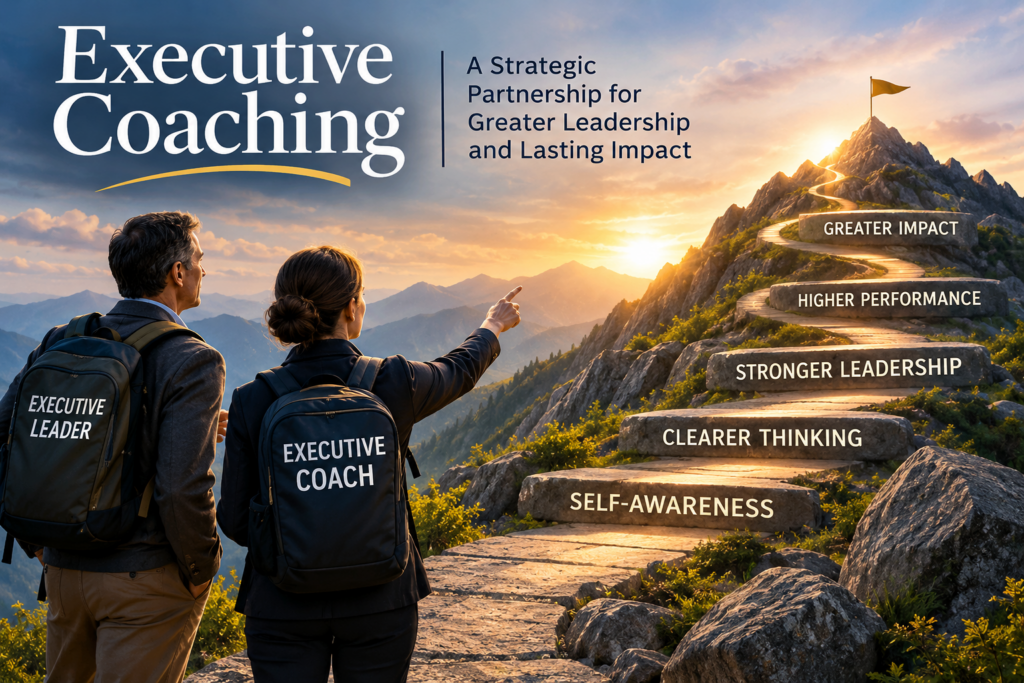
The most successful executives understand that leadership development is not a destination. It is a continuous investment in the ability to think strategically, lead people effectively, and deliver meaningful results.
Leadership has never been more demanding.
Today’s executives are expected to drive growth, navigate uncertainty, inspire high-performing teams, embrace innovation, and make decisions that shape the future of their organizations. At the same time, they must manage competing priorities, build trust across diverse stakeholders, and maintain the resilience necessary to lead through constant change.
Yet there is a fundamental challenge that many organizations overlook: The higher someone rises in leadership, the fewer opportunities they often have to receive honest feedback, challenge their assumptions, and examine their own effectiveness.
This is where executive coaching creates extraordinary value.
Once viewed primarily as a resource for leaders experiencing performance challenges, executive coaching has evolved into a strategic investment for organizations seeking to develop exceptional leadership capabilities.
The question is no longer whether successful executives need coaching. It is whether organizations can afford to overlook the advantages that intentional leadership development provides.
1. Executive Coaching Develops Self-Awareness, the Foundation of Effective Leadership
One of the greatest obstacles to leadership effectiveness is not a lack of intelligence, experience, or ambition. It is a lack of self-awareness.
Executives make decisions every day that influence organizational culture, employee engagement, operational performance, and long-term strategy. However, even experienced leaders may not fully recognize how their communication styles, emotional responses, or leadership behaviors affect others.
Executive coaching creates an opportunity for leaders to examine these blind spots.
Through structured reflection, meaningful feedback, and challenging conversations, executives develop a deeper understanding of their strengths, limitations, and behavioral patterns.
This awareness creates a powerful shift.
Instead of leading primarily through instinct and experience, executives begin making more deliberate choices about how they communicate, influence, and respond to challenges.
Leadership effectiveness improves when leaders become as intentional about managing themselves as they are about managing their organizations.
2. Great Leaders Need a Place Where They Can Be Challenged
Senior leadership can be surprisingly isolating.
As executives advance, their professional relationships often become more complicated. Employees may hesitate to challenge their decisions. Colleagues may avoid difficult conversations. Direct reports may prioritize agreement over constructive disagreement.
Over time, this environment can create dangerous gaps between how leaders perceive their effectiveness and how others experience their leadership.
An effective executive coach provides something increasingly rare at the highest levels of business: an objective perspective.
A coach is not there to validate every decision or reinforce existing beliefs. The purpose is to ask difficult questions, challenge assumptions, and help leaders examine situations from different perspectives.
Consider an executive struggling with declining team performance.
The initial assumption might be that employees lack accountability. Through coaching, however, the executive may discover that unclear expectations, inconsistent communication, or excessive involvement in operational decisions are contributing to the problem.
The solution changes when the leader recognizes their own influence on the situation.
This is one of coaching’s greatest strengths. It moves leaders beyond identifying external problems and toward understanding what they can personally change.
3. Executive Coaching Strengthens Strategic Decision-Making
The decisions executives make rarely come with perfect information.
Whether entering new markets, restructuring operations, developing succession plans, or responding to competitive threats, leaders must evaluate complex situations while balancing risk, opportunity, and organizational priorities.
Executive coaching helps leaders strengthen the thinking processes behind those decisions.
Rather than simply providing answers, effective coaching encourages executives to evaluate alternatives, question assumptions, identify unintended consequences, and consider the broader implications of their choices.
This process develops greater strategic discipline.
For example, a CEO considering an aggressive expansion strategy may initially focus on revenue opportunities and market share. Coaching conversations can help broaden the analysis to include organizational readiness, leadership capacity, cultural implications, and execution risks.
The result is not necessarily a different decision. It is a more thoroughly examined one.
The value of executive coaching is not that someone else makes better decisions for the leader. It is that the leader develops the capacity to make better decisions independently.
4. Stronger Executive Leadership Creates Stronger Organizational Cultures
Organizational culture is often discussed as though it exists independently of leadership.
In reality, culture is shaped by what leaders consistently communicate, reward, tolerate, and demonstrate.
Employees observe how executives respond under pressure, handle disagreements, acknowledge mistakes, and treat people when difficult decisions must be made.
These behaviors establish expectations throughout the organization.
Executive coaching helps leaders understand the connection between their personal behavior and the environment they create.
A leader who becomes more effective at listening may encourage greater collaboration. An executive who learns to respond constructively to criticism may strengthen psychological safety. A CEO who consistently demonstrates accountability may reinforce those expectations across the leadership team.
Small changes in executive behavior can have far-reaching organizational consequences.
This is especially important because employees rarely evaluate leadership solely through formal statements about company values.
They evaluate leadership through daily experience.
When executive behavior aligns with organizational expectations, credibility grows. When it does not, even the strongest cultural initiatives can lose their effectiveness.
5. Coaching Helps Executives Navigate Change With Greater Confidence
Change has become a defining characteristic of modern business.
Technological disruption, evolving workforce expectations, economic uncertainty, and shifting customer demands require organizations to adapt continuously.
But successful organizational transformation requires more than a compelling strategy.
It requires leaders who can guide people through uncertainty.
Executive coaching helps leaders develop the adaptability, emotional discipline, and communication skills necessary to manage change effectively.
An executive leading a major transformation may understand the business case perfectly while underestimating the emotional and operational challenges employees experience.
Coaching can help that leader anticipate resistance, communicate more transparently, and create opportunities for meaningful employee involvement.
It also encourages executives to examine their own reactions to uncertainty.
Leaders who become defensive, impatient, or overly controlling during periods of disruption can unintentionally undermine the very changes they are trying to implement.
By developing greater awareness and resilience, executives become better equipped to maintain clarity and stability when circumstances are unpredictable.
The ability to lead through change is no longer an occasional leadership requirement. It is a core executive competency.
6. Executive Coaching Builds Leadership Capacity Beyond the C-Suite
One of the most important benefits of executive coaching extends beyond the individual receiving it.
Effective leaders develop other leaders.
Executives who strengthen their coaching, delegation, communication, and talent-development skills are better positioned to build capable leadership teams.
This creates a multiplier effect.
Instead of becoming the central decision-maker for every important issue, the executive begins distributing responsibility, empowering others, and creating opportunities for emerging leaders to grow.
Consider the difference between two senior executives.
The first is highly capable but personally involved in nearly every major decision. Their team depends heavily on their expertise and approval.
The second invests in developing decision-making capabilities throughout the organization. Their team operates with greater independence, accountability, and confidence.
Both executives may deliver results in the short term.
But the second is building something more valuable: an organization that can perform, adapt, and grow without depending on one individual.
The ultimate measure of leadership is not simply what an executive accomplishes personally, but what becomes possible through the people they develop.
7. Executive Coaching Must Be Connected to Measurable Business Outcomes
Despite its potential, executive coaching should not be treated as an automatic solution to every leadership challenge.
Its effectiveness depends on clear objectives, executive commitment, organizational support, and meaningful follow-through.
Organizations investing in coaching should begin by identifying the leadership capabilities most closely connected to their strategic priorities.
These may include improving executive communication, strengthening succession readiness, developing cross-functional collaboration, increasing leadership-team effectiveness, or improving the quality of strategic decisions.
Progress should then be evaluated through observable changes rather than relying exclusively on personal satisfaction.
Depending on the objectives, relevant indicators may include leadership feedback, employee engagement, retention of critical talent, succession readiness, or improvements in team performance.
Not every business outcome can be attributed directly to coaching. Market conditions, organizational systems, and broader management decisions also influence results.
However, connecting coaching objectives to measurable leadership behaviors helps organizations evaluate whether the investment is producing meaningful development.
The goal is not simply to create executives who feel more confident.
It is to develop executives whose leadership creates greater organizational value.
8. The Most Effective Executives Treat Growth as an Ongoing Responsibility
A common misconception about executive development is that experience eventually eliminates the need for continued learning.
In reality, leadership challenges become more complex as responsibilities increase.
The capabilities required to lead a small team are not identical to those required to manage a global enterprise, guide a board of directors, or oversee a major organizational transformation.
Success at one level does not automatically guarantee effectiveness at the next.
Executive coaching helps leaders recognize when their existing approaches must evolve.
A leadership style that once produced exceptional results may become less effective as an organization grows. A highly involved founder may need to transition toward strategic oversight. A technically accomplished executive may need to develop stronger relationship-building and organizational influence skills.
These transitions require more than additional knowledge.
They often require leaders to reconsider deeply established habits and assumptions.
That process can be uncomfortable, but it is essential to continued growth.
The executives who remain effective over time are not necessarily those who possess the greatest certainty.
They are often those who retain the willingness to learn, adapt, and improve.
How Organizations Can Make Executive Coaching More Effective
For companies considering executive coaching as part of their leadership strategy, several principles can help maximize its value.
- Start with a clear business objective. Identify the leadership challenges or capabilities that coaching should address.
- Select coaches based on fit and credibility. Relevant experience, professional competence, confidentiality, and the ability to challenge executives constructively are essential.
- Establish measurable development goals. Define the behaviors and outcomes that would demonstrate meaningful progress.
- Encourage ownership and accountability. Coaching is most effective when executives actively participate in their development rather than treating it as an organizational requirement.
- Create opportunities to apply new behaviors. Development becomes valuable when insights translate into consistent action.
- Evaluate progress over time. Use feedback, reflection, and appropriate performance indicators to determine whether meaningful change is occurring.
Executive coaching should complement, rather than replace, sound governance, clear organizational expectations, and effective performance management.
When these elements work together, coaching can become a valuable part of an organization’s broader leadership-development strategy.
The Future of Leadership Belongs to Those Who Continue to Grow
The business environment will continue to evolve. New technologies will reshape industries. Workforce expectations will change. Competitive pressures will intensify.
What will remain constant is the need for leaders who can think clearly, act decisively, build trust, and bring out the best in others.
Executive coaching offers a structured way to strengthen those capabilities.
It provides leaders with the perspective to recognize blind spots, the discipline to improve decision-making, and the accountability to translate insight into action.
Perhaps most importantly, it reinforces a principle that every successful executive must eventually embrace:
Leadership experience is valuable, but experience alone does not guarantee leadership growth.
The most effective leaders understand that reaching the executive level is not the end of their development. It is the beginning of a new level of responsibility.
Organizations that recognize this distinction are better positioned to develop leaders who can navigate complexity, strengthen culture, and build sustainable performance.
Because in the end, executive coaching is not simply about helping leaders become more successful.
It is about helping successful leaders become more effective at creating success for others.
#ExecutiveCoaching, #ExecutiveLeadership, #LeadershipDevelopment, #BusinessLeadership, #LeadershipGrowth, #LeadershipEffectiveness, #StrategicLeadership, #ExecutiveDevelopment, #LeadershipCoaching, #HighPerformingTeams, #OrganizationalCulture, #BusinessSuccess, #CEOLeadership, #LeadershipStrategy, #ProfessionalDevelopment