In today’s business environment, leadership inside the boardroom matters more than ever. Organizations are navigating economic volatility, digital disruption, cybersecurity threats, workforce transformation, and increasing public scrutiny—all at the same time. In response, companies are no longer looking for passive board oversight. They are looking for strategic leadership.
That shift has elevated the importance of one critical capability: boardroom leadership skills.
The modern boardroom is no longer simply a place for governance and quarterly reviews. It has become a strategic command center where high-level decisions shape culture, growth, innovation, and long-term resilience. Directors who possess strong boardroom leadership skills are now among the most valuable assets any organization can have.
What Are Boardroom Leadership Skills?
Boardroom leadership skills refer to the strategic, interpersonal, and decision-making abilities required to lead effectively at the board level. These skills extend beyond traditional executive management and focus specifically on navigating complex organizational challenges from a governance perspective.
Strong boardroom leaders know how to:
- Guide strategic conversations
- Balance risk and opportunity
- Foster alignment among stakeholders
- Challenge assumptions constructively
- Communicate with clarity under pressure
- Lead through uncertainty
- Maintain long-term organizational vision
Unlike operational leadership, boardroom leadership requires a broader lens. Directors must think beyond day-to-day execution and focus on sustainable growth, governance integrity, and organizational direction.
Why Boardroom Leadership Skills Matter More Today
The expectations placed on boards have changed dramatically over the last decade.
Investors, employees, regulators, and consumers now expect boards to demonstrate strategic insight, ethical leadership, and proactive decision-making. In many cases, board effectiveness directly influences market confidence and company reputation.
Organizations with strong board leadership often experience:
- Faster strategic decision-making
- Better crisis management
- Increased investor confidence
- Stronger executive accountability
- Healthier organizational culture
- Greater adaptability during disruption
Boards that lack leadership capability, however, often struggle with indecision, internal conflict, poor oversight, and strategic stagnation.
In a highly visible business environment, ineffective governance is no longer hidden behind closed doors.
The Most Important Boardroom Leadership Skills
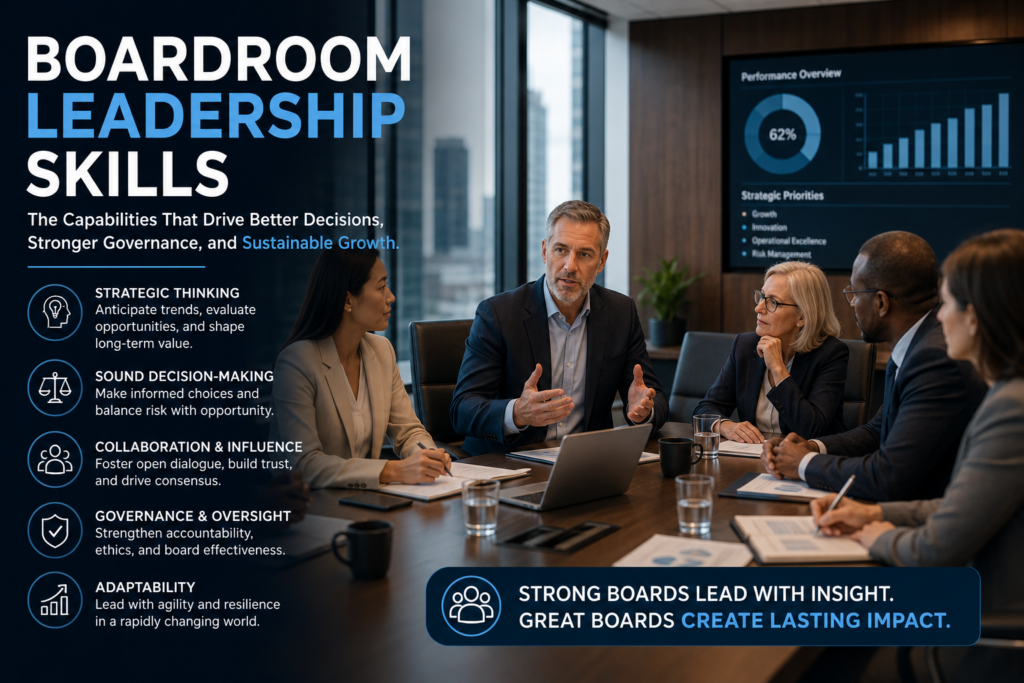
1. Strategic Thinking
One of the most essential boardroom leadership skills is the ability to think strategically.
Effective board leaders look beyond immediate financial performance and focus on long-term positioning. They identify emerging risks, evaluate industry trends, and help organizations prepare for future disruption.
Strategic thinking requires directors to ask difficult questions:
- Where is the industry heading?
- What risks could threaten long-term relevance?
- What opportunities are being overlooked?
- How should capital and resources be allocated?
Boards that think strategically create competitive advantages that extend well beyond quarterly earnings.
2. Decision-Making Under Uncertainty
Modern boards rarely make decisions with perfect information.
Economic instability, geopolitical tension, market volatility, and technological disruption often force leaders to act before certainty exists. Strong boardroom leadership skills include the ability to make thoughtful, informed decisions despite ambiguity.
This requires:
- Emotional discipline
- Risk evaluation
- Scenario analysis
- Confidence without arrogance
- The ability to separate noise from signal
Great board leaders understand that hesitation can become its own form of risk.
3. Communication and Influence
Boardrooms are built on conversation. The ability to communicate clearly and influence effectively is critical.
Strong board leaders know how to:
- Facilitate productive discussion
- Encourage diverse perspectives
- Resolve conflict professionally
- Ask insightful questions
- Build consensus without compromising standards
Leadership influence in the boardroom is rarely about authority alone. It is built through credibility, preparation, and trust.
4. Emotional Intelligence
One of the most underestimated boardroom leadership skills is emotional intelligence.
Boards are made up of individuals with different experiences, personalities, priorities, and communication styles. Leaders who can navigate these dynamics effectively create healthier governance environments.
Emotional intelligence allows directors to:
- Read interpersonal dynamics
- Manage tension constructively
- Build trust among stakeholders
- Remain composed during disagreement
- Lead with empathy while maintaining accountability
High-performing boards are not free from disagreement. They simply manage it more effectively.
5. Risk Framing and Governance Awareness
Modern boards must move beyond viewing risk solely as compliance and oversight.
Today’s strongest directors understand that risk is deeply connected to strategy. They know how to evaluate both downside exposure and upside opportunity.
This includes understanding:
- Cybersecurity risks
- Financial vulnerabilities
- Reputational exposure
- Regulatory changes
- ESG expectations
- Market disruption
Boards that frame risk strategically are often more innovative, decisive, and resilient.
6. Adaptability and Continuous Learning
The pace of change in business continues to accelerate.
Boardroom leaders who rely exclusively on past success often struggle in rapidly evolving industries. Continuous learning has become a core leadership requirement.
Directors must stay informed about:
- Emerging technologies
- Artificial intelligence
- Workforce trends
- Governance best practices
- Industry transformation
- Economic shifts
Adaptable leaders help organizations remain agile and competitive.
How Organizations Benefit from Strong Boardroom Leadership
When organizations prioritize strong boardroom leadership skills, the impact extends far beyond governance meetings.
Effective boards help organizations:
Strengthen Executive Leadership
Strong directors provide guidance, accountability, and strategic perspective for executive teams. They challenge leadership without undermining it.
Improve Organizational Stability
Boards that lead effectively create clarity during uncertainty. This stability improves employee confidence and investor trust.
Increase Strategic Alignment
Clear board leadership ensures organizational priorities remain aligned with long-term objectives rather than short-term distractions.
Enhance Reputation and Credibility
Public trust increasingly depends on leadership quality. Strong governance strengthens brand reputation and stakeholder confidence.
Developing Boardroom Leadership Skills
Boardroom leadership is not reserved for a select few. These skills can be developed intentionally over time.
Professionals seeking board opportunities should focus on:
- Expanding strategic thinking capabilities
- Improving communication and executive presence
- Gaining governance education
- Developing financial literacy
- Building industry expertise
- Practicing collaborative leadership
- Strengthening emotional intelligence
Mentorship, executive coaching, and board experience all contribute to leadership growth.
The Future of Leadership Belongs in the Boardroom
As organizations face increasing complexity, the role of the board will continue to evolve.
Boards are no longer expected to simply oversee organizations. They are expected to help shape the future of them.
That responsibility demands more than technical expertise. It requires vision, adaptability, courage, and strategic leadership.
The companies that thrive in the coming decade will not necessarily be the ones with the most resources.
They will be the ones guided by leaders who possess the boardroom leadership skills needed to navigate uncertainty, inspire confidence, and make decisive strategic choices when it matters most.
#BoardroomLeadership, #CorporateGovernance, #LeadershipSkills, #ExecutiveLeadership, #BoardLeadership, #StrategicLeadership, #BusinessLeadership, #Governance, #RiskManagement, #LeadershipDevelopment