
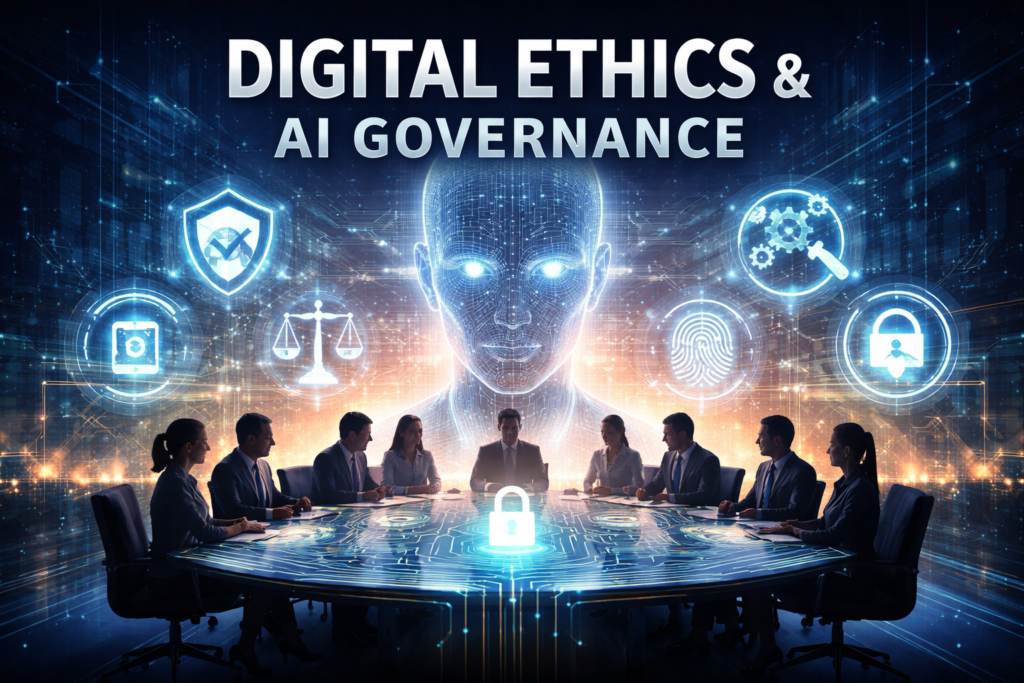
In today’s rapidly evolving digital landscape, artificial intelligence is no longer a future consideration—it is a present force reshaping how organizations operate, compete, and create value. But with this transformation comes a new and urgent responsibility: ensuring that innovation is guided by integrity.
For boards, the conversation is shifting. It is no longer enough to oversee financial performance and strategic execution. Directors must now engage deeply in digital ethics and AI governance—a domain that sits at the intersection of technology, risk, trust, and long-term value creation.
Organizations that get this right will not only avoid risk. They will earn something far more valuable: trust.
Why Digital Ethics and AI Governance Now Belong in the Boardroom
Artificial intelligence introduces unprecedented opportunities—but also unprecedented ambiguity.
Algorithms make decisions once reserved for humans. Data drives outcomes that impact customers, employees, and society at scale. And often, the logic behind these systems is not fully transparent.
This creates a fundamental leadership challenge.
Who is accountable when AI makes a decision?
How do organizations ensure fairness, privacy, and transparency?
What happens when innovation outpaces regulation?
These are not technical questions. They are governance questions.
Boards must recognize that digital ethics and AI governance are no longer operational concerns—they are strategic imperatives. Left unaddressed, they introduce reputational, legal, and ethical risks that can undermine even the strongest organizations.
From Compliance to Strategic Oversight
Many organizations approach AI governance through a compliance lens. Policies are created. Frameworks are adopted. Boxes are checked.
But high-performing boards understand that this approach is insufficient.
True governance goes beyond compliance. It requires active oversight, informed inquiry, and principled leadership.
This means:
Ensuring AI systems align with organizational values
Evaluating the ethical implications of data use
Challenging management on unintended consequences
Integrating ethics into innovation, not layering it on afterward
In this sense, digital ethics becomes a strategic differentiator, not just a risk mitigation exercise.
The Expanding Role of Directors in AI Governance
The rise of AI demands a broader, more informed board.
Directors are not expected to become technologists. But they are expected to understand enough to ask the right questions.
Effective boards are focusing on:
AI literacy: Building foundational understanding of how AI systems function and where risks emerge
Risk oversight: Identifying algorithmic bias, data misuse, and cybersecurity vulnerabilities
Accountability structures: Defining who owns AI outcomes within the organization
Transparency: Ensuring stakeholders understand how decisions are made
The goal is not technical mastery. It is informed judgment.
Boards that invest in this capability move from passive oversight to proactive governance.
Building an Ethical Framework for AI
At the core of digital ethics and AI governance is a simple but powerful idea: just because something can be built does not mean it should be deployed without scrutiny.
Organizations need clear ethical frameworks that guide decision-making.
These frameworks should address:
Fairness: Are AI systems producing biased outcomes?
Transparency: Can decisions be explained and understood?
Privacy: Is data being used responsibly and securely?
Accountability: Who is responsible when things go wrong?
Human oversight: Where must human judgment remain central?
Boards play a critical role in ensuring these principles are not theoretical—but operational.
They must ask: Are these values embedded in how we build, deploy, and monitor AI?
The Risk of Inaction
The absence of strong AI governance does not create neutrality. It creates exposure.
Organizations that fail to prioritize digital ethics face:
Reputational damage from biased or harmful outcomes
Regulatory scrutiny as governments increase oversight
Erosion of stakeholder trust
Internal misalignment between innovation and values
In contrast, organizations that lead in digital ethics and AI governance position themselves as responsible innovators.
They send a clear signal: growth will not come at the expense of integrity.
Creating a Culture of Responsible Innovation
Governance is not only about structure. It is about culture.
Boards must ensure that ethical considerations are not confined to policy documents but are integrated into everyday decision-making.
This requires:
Encouraging open dialogue about ethical concerns
Rewarding responsible innovation, not just rapid innovation
Supporting leadership teams in balancing speed with scrutiny
Embedding ethics into performance metrics and incentives
When ethics becomes part of how success is defined, governance becomes sustainable.
Questions Every Board Should Be Asking
To strengthen digital ethics and AI governance, boards should regularly challenge management with questions such as:
How are we identifying and mitigating bias in our AI systems?
What governance structures are in place to oversee AI deployment?
How do we ensure transparency in automated decision-making?
What is our response plan if an AI system causes harm?
Are we aligning our AI strategy with our organizational values?
The quality of these questions often determines the quality of oversight.
The Future of Governance Is Ethical, Digital, and Human
As AI continues to evolve, so will expectations.
Stakeholders will demand more transparency. Regulators will impose stricter standards. Customers will choose organizations they trust.
In this environment, digital ethics and AI governance will define leadership at the highest level.
Boards that embrace this responsibility will not only protect their organizations—they will elevate them.
Final Thought
Technology moves fast. Trust moves slowly.
Boards sit at the intersection of both.
The organizations that will lead in the coming decade are not those that simply adopt AI the fastest. They are the ones that govern it the wisest.
Because in the end, the true measure of innovation is not what we build.
It is how responsibly we build it.