
The higher leaders rise, the more complex their decisions become. Growth introduces new risks. Innovation creates new questions. Market shifts demand faster judgment. And decisions that once affected a department can suddenly influence an entire organization.
That is why building an executive advisors network can become an important strategic advantage.
The strongest executives do not simply surround themselves with people who agree with them. They develop relationships with experienced professionals who bring different perspectives, specialized expertise, industry knowledge, and the confidence to challenge assumptions.
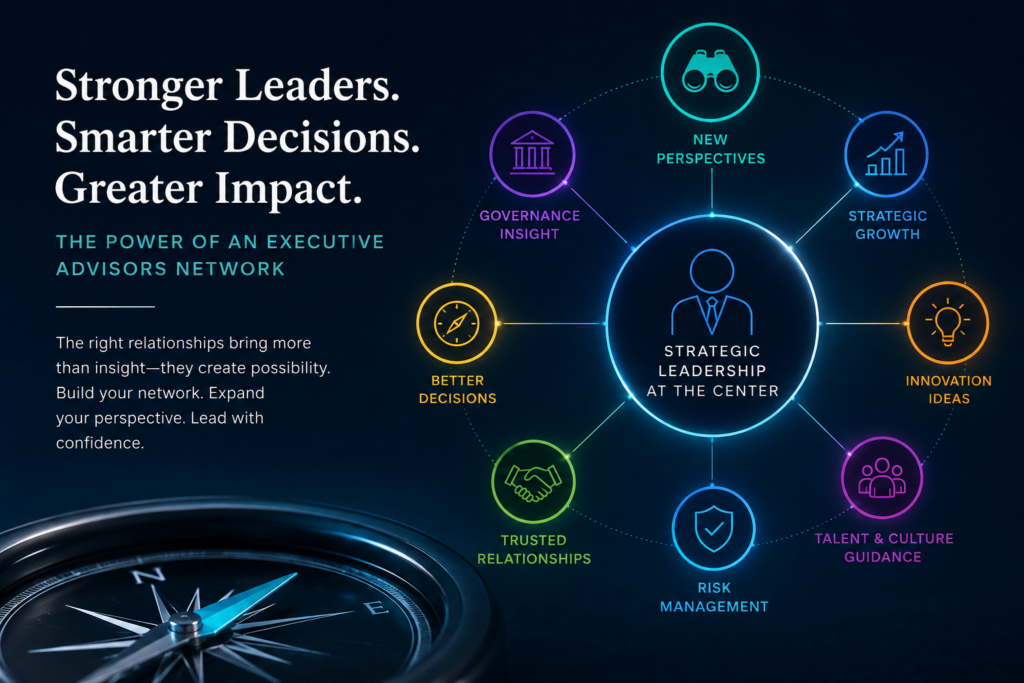
An executive advisors network can help leaders see around corners, make better decisions, expand their perspective, and prepare their organizations for what comes next.
What Is an Executive Advisors Network?
An executive advisors network is a group or ecosystem of experienced professionals who provide executives and organizations with strategic perspective, specialized knowledge, mentorship, connections, and guidance.
These relationships can take many forms. An executive may develop an informal circle of trusted advisors, participate in an established professional network, serve on an advisory board, or work with organizations that connect companies with executives possessing specific expertise.
The underlying principle is the same: leadership becomes stronger when experience and perspective are multiplied.
An advisor is not necessarily responsible for running the organization or making the final decision. Instead, effective advisors help leaders examine opportunities and challenges from angles they may not have considered.
They ask questions.
They challenge assumptions.
They share lessons from experience.
Most importantly, they help executives think more strategically.
Why Executive Advisors Networks Matter
Senior leadership can be surprisingly isolating.
Executives are expected to project confidence while navigating decisions that may have no obvious answer. Their teams may provide valuable operational insight, but internal perspectives can naturally be influenced by organizational roles, priorities, and existing ways of working.
External advisors can introduce something different: perspective.
A well-developed executive advisors network gives leaders access to professionals who may have already encountered similar challenges, entered comparable markets, scaled organizations, managed transformation, developed teams, or navigated periods of uncertainty.
That does not mean advisors should make decisions for executives.
It means executives can make decisions with a broader field of vision.
John C. Maxwell’s leadership framework emphasizes that leadership extends beyond position and depends heavily on influence, relationships, results, and developing others. An effective advisory network operates on many of those same principles. Its value comes not from titles alone, but from the experience, relationships, credibility, and perspective people bring to the conversation.
The Business Value of an Executive Advisors Network
The value of advisory relationships becomes especially clear when organizations encounter decisions outside their existing experience.
Consider a company preparing to enter a new market.
Its leadership team may understand its products, customers, and current operations exceptionally well. But entering a new market could introduce unfamiliar regulatory considerations, competitive dynamics, customer expectations, partnerships, talent requirements, and operational risks.
An advisor with relevant experience can help leadership ask better questions before resources are committed.
The same principle applies across many areas of business, including:
- Growth and scaling
- Digital transformation
- Artificial intelligence and emerging technology
- Finance and capital strategy
- Sales and marketing
- Talent and organizational development
- Corporate governance
- Risk management
- Mergers and acquisitions
- International expansion
- Succession planning
The objective is not to find one person who knows everything. It is to create access to the right expertise at the right moment.
Better Advisors Can Lead to Better Questions
One of the greatest misconceptions about advisors is that their primary value comes from providing answers.
Often, their greatest contribution is providing better questions.
Should we enter this market?
What assumptions are driving our forecast?
What happens if our growth accelerates faster than expected?
Where is the organization most vulnerable?
Which capabilities must exist before we scale?
What are we overlooking because we are too close to the problem?
These questions can expose blind spots before they become expensive mistakes.
This is particularly important because executive experience can create both confidence and familiarity. Experience helps leaders recognize patterns, but familiarity can sometimes cause organizations to approach new problems using old assumptions.
Outside advisors can disrupt that pattern.
Executive Advisors Networks and the Power of Diverse Perspective
An effective network should not be an echo chamber.
If every advisor comes from the same industry, professional background, demographic experience, and leadership environment, executives may receive multiple versions of essentially the same perspective.
Greater strategic value often comes from bringing together complementary experience.
A technology executive may see an operational challenge differently from a finance leader. A former CEO may approach growth differently from a marketing executive. An entrepreneur who has built companies from the ground up may recognize risks that someone from a large enterprise environment does not immediately see.
This diversity of professional perspective can strengthen decision making.
The goal is not disagreement for its own sake. The goal is productive tension that produces clearer thinking.
Trust Is the Foundation of Effective Advisory Relationships
Access to impressive executives does not automatically create an effective advisory network.
Trust matters.
Advisors need enough context to understand the organization’s real challenges. Executives need confidence that advisors will communicate candidly and constructively. Both sides need clarity around expectations, confidentiality, boundaries, and objectives.
Leadership literature consistently places trust near the center of effective influence. Maxwell identifies trust as a foundational leadership principle, while Simon Sinek emphasizes environments where people feel protected and valued as essential to strong organizational cultures.
The same applies to advisory relationships.
When trust is absent, conversations remain superficial.
When trust is present, leaders can discuss the questions that actually matter.
How to Build an Executive Advisors Network
Building a valuable network should begin with strategy rather than collecting contacts.
First, identify where additional perspective would create the greatest value. Consider the organization’s current strategy, upcoming challenges, growth objectives, leadership gaps, and emerging opportunities.
Next, look for complementary expertise. The strongest advisor may not be someone who has followed exactly the same career path. Look for people whose experience expands the leadership team’s existing capabilities.
Then evaluate credibility and relevance. Titles can open doors, but experience should align with the organization’s actual needs.
Executives should also consider chemistry and communication style. Advisory relationships require candid conversations. An impressive résumé means little if meaningful dialogue cannot develop.
Finally, approach the relationship with mutual value in mind. The strongest professional networks are rarely transactional. They are built through credibility, contribution, curiosity, and long-term relationship development.
From Executive Networking to Strategic Relationships
There is an important distinction between networking and building an executive advisors network.
Networking often focuses on expanding the number of people you know.
Advisory relationships focus on increasing the quality of perspective available to you.
A large contact list does not necessarily make an executive better informed. A smaller group of trusted, experienced, and strategically relevant relationships may provide significantly greater value.
This shift changes the question from:
How many executives do I know?
to:
Who can challenge my thinking, expand my perspective, and help me become a more effective leader?
That is a far more valuable question.
Executive Advisors Networks Can Benefit Advisors Too
The opportunity is not limited to companies seeking advice.
Experienced executives can also benefit from becoming advisors.
Years of leadership experience create intellectual capital. Executives accumulate knowledge about scaling teams, navigating difficult decisions, developing cultures, managing change, solving problems, and identifying opportunities.
Advisory roles provide an opportunity to apply that experience in new environments.
They can also expose executives to different industries, technologies, business models, leadership challenges, and professional relationships.
For executives interested in eventually pursuing board opportunities, advisory experience can also help develop the strategic mindset required to contribute beyond day-to-day operational leadership.
The transition requires an important shift, however.
Successful operators are accustomed to doing.
Successful advisors must become skilled at guiding.
The advisor’s responsibility is not to take control. It is to contribute perspective that helps leadership make stronger decisions.
The Connection Between Advisory Roles and Board Leadership
Advisory and board roles are not identical.
Boards of directors can carry formal governance and fiduciary responsibilities, while advisory boards generally serve a consultative role. Organizations and executives should clearly understand the structure, responsibilities, and expectations associated with any opportunity.
Yet advisory experience can expose executives to a broader form of leadership.
Instead of asking, “What should I do next?” the executive begins asking, “What does this organization need to consider next?”
That shift matters.
Leadership at the highest levels increasingly requires executives to move beyond personal execution and toward influence, development, strategic thinking, and organizational impact. Maxwell describes higher levels of leadership as increasingly focused on developing other leaders and creating influence that extends beyond the individual leader.
Advisory work can provide another environment in which experienced executives practice that broader perspective.
How Companies Can Get More Value From Advisors
Finding talented advisors is only the beginning.
Organizations also need to use them effectively.
Leadership teams should establish clear objectives for the advisory relationship and provide advisors with enough information to contribute meaningfully. Meetings should center on substantive strategic questions rather than routine updates.
Executives should be willing to hear perspectives they did not expect.
After all, there is little value in assembling accomplished advisors only to seek confirmation for decisions that have already been made.
Great advisory relationships require openness.
Simon Sinek’s work on purpose-driven leadership argues that people are more deeply inspired when organizations possess clarity about why they exist and communicate from that foundation. That clarity can also strengthen advisory relationships. When advisors understand an organization’s purpose, priorities, and strategic direction, they are better positioned to provide relevant perspective.
Why Executive Advisory Networks Are Becoming Increasingly Important
The pace of business continues to challenge the idea that leadership expertise can remain confined within organizational walls.
Technology changes quickly. Industries converge. New competitors emerge. Workforce expectations evolve. Artificial intelligence is changing how companies think about productivity, strategy, customer experience, and talent.
In this environment, executives need more than information.
They need interpretation.
They need trusted people who can help distinguish a temporary trend from a strategic shift, identify overlooked risks, recognize opportunities, and challenge established assumptions.
An executive advisors network creates access to accumulated experience without requiring one leader to personally experience every lesson first.
That is a powerful form of leadership leverage.
Build Your Network Before You Need It
The worst time to begin searching for trusted advisors is after a crisis has already arrived.
Strong executive relationships are developed before they become necessary.
They are built through conversations, shared value, credibility, curiosity, contribution, and consistency.
Executives who intentionally develop these relationships create something more valuable than a professional network. They create an ecosystem of perspective.
And organizations that intentionally bring experienced voices into strategic conversations gain something equally important: the opportunity to make consequential decisions with greater clarity.
Leadership may ultimately rest with the person responsible for making the decision.
But leadership does not require making that decision alone.
The right executive advisors network can help leaders broaden their perspective, strengthen their judgment, develop new opportunities, and create greater impact for the organizations and people they serve.
At Boardsi, connecting accomplished executives with organizations seeking board and advisory talent is at the heart of creating stronger leadership relationships. For executives exploring board and advisory opportunities, and companies seeking experienced perspectives, the next strategic relationship could begin with the right conversation.
#ExecutiveAdvisorsNetwork, #ExecutiveAdvisors, #AdvisoryBoard, #ExecutiveLeadership, #BoardLeadership, #BoardAdvisors, #BusinessLeadership, #StrategicLeadership, #CorporateGovernance, #BusinessStrategy, #ExecutiveNetworking, #LeadershipDevelopment, #BoardOpportunities, #ExecutiveGrowth, #Boardsi