For decades, executive business consulting has been viewed through a familiar lens. Companies brought in consultants to solve a problem, improve efficiency, reduce costs, or guide a major initiative. Once the project was complete, the consultants left, and the organization moved forward.
That model is changing.
Today’s business environment is defined by rapid technological disruption, economic uncertainty, workforce transformation, cybersecurity risks, artificial intelligence, and increasing stakeholder expectations. Executives are no longer looking for temporary solutions to isolated challenges. They are seeking strategic partners who can help them navigate complexity while preparing their organizations for what comes next.
Executive business consulting has evolved from project based problem solving into one of the most valuable strategic investments an organization can make.
The New Role of Executive Consultants
The best consultants today are not simply experts in one discipline.
They serve as strategic advisors who help leadership teams see opportunities and risks that may not yet be visible from inside the organization.
This outside perspective has become increasingly valuable.
Internal executives are often consumed by day to day operations, customer demands, regulatory requirements, and organizational priorities. While they possess deep institutional knowledge, they can also develop blind spots that limit innovation or delay critical decisions.
An experienced executive consultant brings objectivity.
They ask difficult questions.
They challenge assumptions.
Most importantly, they help leaders make better decisions before problems become crises.
Strategy Is No Longer Enough
In previous decades, consulting engagements often focused on developing strategic plans.
Today, execution has become equally important.
A brilliant strategy has little value if organizational culture resists change, leadership lacks alignment, or employees fail to embrace new initiatives.
Modern executive consulting addresses both strategy and implementation.
Successful consultants help organizations answer questions such as:
- Are our leaders aligned around the same vision?
- Does our organizational structure support future growth?
- Are we building the leadership pipeline needed for long term success?
- Is our culture helping or hindering innovation?
- Do we have the governance and accountability necessary to execute effectively?
These questions often determine whether a strategy succeeds or fails.
Leadership Development Has Become a Business Strategy
One of the most significant shifts in executive consulting is the growing emphasis on leadership development.
Organizations increasingly recognize that sustainable growth depends less on individual executives and more on leadership capacity throughout the organization.
Consultants are now helping companies develop stronger executive teams, improve succession planning, strengthen communication, and build leadership cultures capable of adapting to constant change.
This work extends beyond coaching individual executives.
It focuses on creating leadership systems that continue producing results long after the consulting engagement ends.
The strongest consultants build leaders rather than dependency.
Data Is Changing the Consulting Profession
Executive consulting is becoming increasingly data driven.
Consultants now leverage advanced analytics, workforce assessments, market intelligence, artificial intelligence, predictive modeling, and organizational diagnostics to support executive decision making.
Rather than relying solely on experience and intuition, consultants can identify patterns that reveal emerging risks and opportunities.
Data enhances judgment.
It does not replace it.
The most effective consultants combine analytical insight with business experience, emotional intelligence, and practical leadership expertise.
Technology provides information.
Wisdom determines how to use it.
The Importance of Industry Expertise
General business knowledge remains valuable, but organizations increasingly seek consultants with deep expertise in their specific industries.
Healthcare organizations face different challenges than manufacturing companies.
Technology firms encounter different regulatory and talent issues than financial institutions.
Family owned businesses require different governance strategies than publicly traded corporations.
Industry specific expertise enables consultants to deliver recommendations grounded in practical reality rather than theoretical models.
The best advice reflects both leadership principles and industry context.
Trust Has Become the Most Valuable Asset
Executive consulting is ultimately built on trust.
Executives frequently discuss sensitive issues involving acquisitions, succession planning, organizational restructuring, financial performance, executive conflict, cybersecurity, and strategic risk.
Without trust, meaningful conversations never occur.
The most respected consultants earn credibility not through impressive presentations but through confidentiality, integrity, honesty, and consistent results.
They tell leaders what they need to hear rather than what they want to hear.
That level of candor often creates the greatest value.
Measuring Success Differently
Historically, consulting engagements were evaluated by completed deliverables.
Today, organizations measure success by lasting impact.
Did the consulting engagement strengthen leadership?
Did it improve decision making?
Did it accelerate growth?
Did it create organizational resilience?
Did it prepare the company for future challenges?
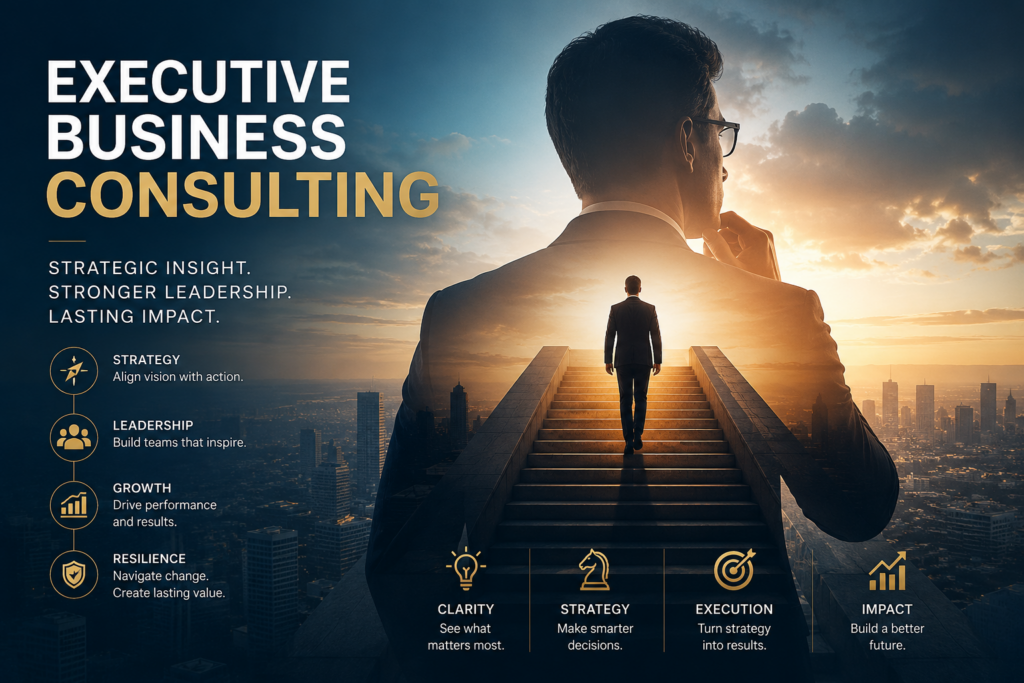
The most successful consulting relationships produce measurable improvements long after the engagement concludes.
That lasting value has become the new standard of excellence.
The Future of Executive Business Consulting
As business environments become more interconnected and unpredictable, executive consulting will continue to evolve.
Artificial intelligence will expand analytical capabilities.
Digital transformation will reshape industries.
Global competition will intensify.
Regulatory complexity will increase.
Yet one reality is unlikely to change.
Organizations will continue to need experienced advisors who combine strategic thinking, leadership expertise, operational insight, and sound judgment.
Technology may deliver information faster than ever before.
Consultants will remain essential because they help leaders interpret that information, evaluate competing priorities, and make confident decisions under uncertainty.
Final Thoughts
The future of executive business consulting is not about providing answers.
It is about helping organizations ask better questions.
The most effective consultants do more than improve operations or solve immediate challenges. They strengthen leadership, align strategy with execution, and help organizations build the capabilities needed to succeed in an increasingly complex world.
In an era where change is constant and competitive advantage is increasingly difficult to sustain, executive business consulting has become far more than an external service.
It has become a strategic partnership.
And for organizations committed to long term growth, resilience, and leadership excellence, that partnership may prove to be one of their most valuable investments.