In an era defined by volatility, performance pressure, and constant change, the most underrated executive skill is not strategy. It is empathy.
The Quiet Shift Happening in the C-Suite
For decades, executive leadership was measured by decisiveness, resilience, and results. Empathy, while appreciated, was often viewed as a “soft skill”—valuable, but secondary.
That hierarchy has collapsed.
Today’s workforce is more informed, more vocal, and more values-driven than ever before. Employees are not just evaluating what leaders do—they are evaluating how leaders show up. In this environment, empathy is no longer optional. It is a strategic differentiator.
The most effective executives understand a simple truth: people do not disengage from strategy—they disengage from leadership that fails to see them.
What Executive Empathy Really Means
Empathy at the executive level is often misunderstood. It is not about being agreeable. It is not about lowering standards. And it is certainly not about avoiding hard decisions.
Executive empathy is the disciplined ability to understand the perspectives, pressures, and motivations of others—and to integrate that understanding into decision-making.
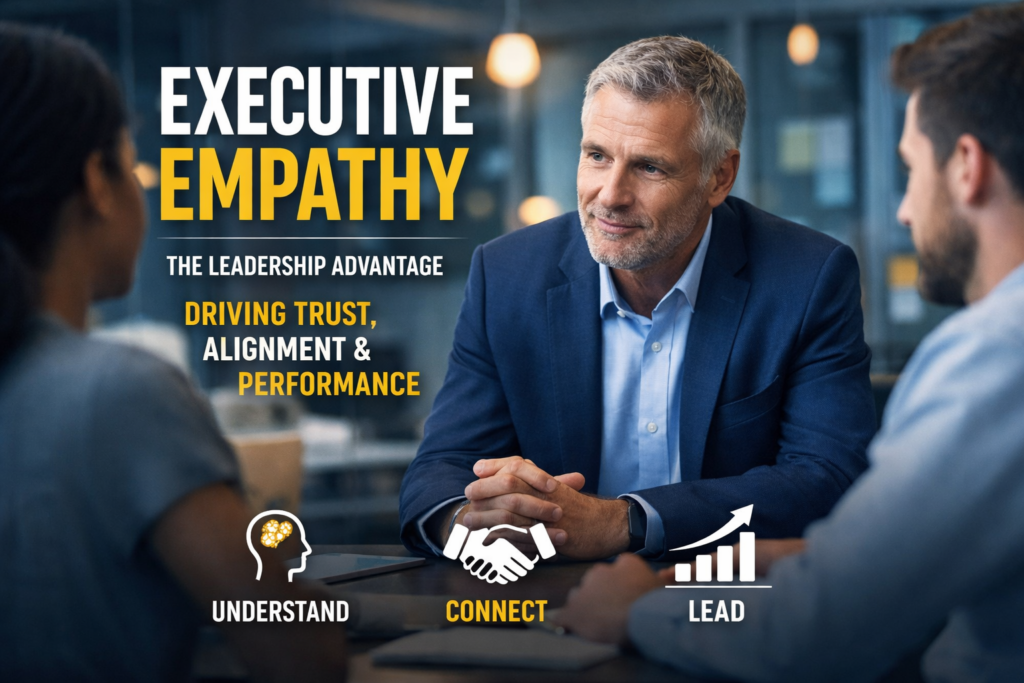
It operates at three levels:
1. Cognitive Empathy
The ability to understand how others think. This sharpens strategic alignment and reduces friction.
2. Emotional Awareness
The ability to recognize how decisions impact people. This builds trust and credibility.
3. Behavioral Response
The ability to act in ways that demonstrate that understanding. This is where empathy becomes leadership.
Empathy, in this sense, is not passive. It is operational.
Why Empathy Drives Performance, Not Just Culture
There is a persistent myth in leadership circles: empathy slows execution.
The opposite is true.
Organizations led by empathetic executives tend to move faster—not slower—because they reduce one of the greatest hidden costs in business: misalignment.
When leaders lack empathy:
- Teams withhold information
- Feedback loops break down
- Trust erodes quietly
- Execution becomes fragmented
When leaders lead with empathy:
- Communication becomes more direct
- Employees surface risks earlier
- Collaboration improves across silos
- Commitment to outcomes strengthens
Empathy does not dilute accountability. It strengthens it by ensuring people understand not just what to do—but why it matters.
The Empathy Gap in Leadership
Despite its importance, there remains a significant empathy gap at the executive level.
Why?
Because as leaders rise, they often become more removed from the day-to-day realities of their teams. Information becomes filtered. Feedback becomes cautious. And over time, perspective narrows.
This is not a failure of character—it is a structural risk of leadership.
The danger is subtle: executives begin making decisions with incomplete human context. And when context is missing, even the best strategies can fail in execution.
Empathy as a Strategic Discipline
High-performing leaders do not rely on empathy as an instinct. They build it as a system.
They ask better questions:
- What pressures are my teams operating under that I do not see?
- Where might my assumptions be wrong?
- How will this decision be experienced at different levels of the organization?
They create deliberate proximity:
- Regular, unfiltered conversations with frontline leaders
- Listening sessions that prioritize understanding over response
- Environments where dissent is not punished, but valued
They operationalize feedback:
- Not as a quarterly exercise, but as a continuous signal
- Not as a formality, but as a strategic input
Empathy, in this context, becomes a leadership capability—not a personality trait.
The Courage Behind Empathy
Perhaps the most overlooked aspect of executive empathy is that it requires courage.
It requires leaders to:
- Confront uncomfortable truths
- Admit when they do not have full visibility
- Make decisions that balance performance with humanity
Empathy does not eliminate hard choices. It ensures those choices are made with clarity, integrity, and awareness.
And in doing so, it reinforces one of the most important leadership principles: people do not expect perfection from leaders—but they do expect understanding.
The Competitive Advantage Few Measure
In a world where strategy can be replicated and technology can be acquired, leadership remains one of the last true competitive advantages.
Empathy is at the center of that advantage.
It shapes culture.
It influences retention.
It accelerates execution.
It builds trust at scale.
And perhaps most importantly, it determines whether people choose to fully engage—or quietly disengage.
Final Thought
Executive empathy is not about being liked. It is about being effective.
The leaders who will define the next decade are not those who simply drive results—but those who understand the human systems that produce them.
Because in the end, organizations do not execute strategy.
People do.
And people perform best when they feel seen, understood, and valued—not as resources, but as contributors to something that matters.