
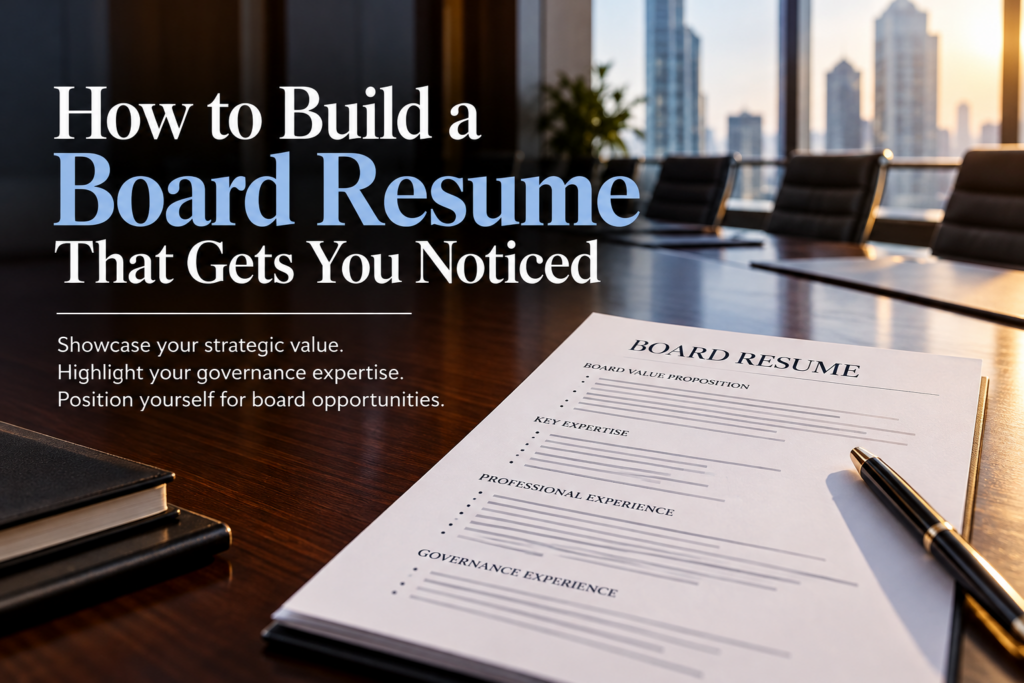
Your executive resume tells employers what you have accomplished. Your board resume tells organizations why your experience belongs in the boardroom.
There comes a point in many executives’ careers when the next opportunity is no longer about running a company, managing a division, or leading a larger team. It is about using decades of experience to influence strategy, strengthen governance, and help organizations navigate their most important decisions.
For many leaders, that opportunity is a seat on a board of directors.
But there is a problem.
Executives often approach board opportunities with the same resume they have used to secure senior leadership positions. They highlight revenue growth, operational achievements, team management, and career progression, assuming those accomplishments will speak for themselves.
They rarely do.
The qualifications that make someone a successful executive are not necessarily the same qualities that make someone an effective board member.
A board is not hiring you to run the organization. It is evaluating whether you can help oversee its direction, challenge its assumptions, assess its risks, and contribute to its long-term success.
That means your board resume must communicate something different.
It must establish not only what you have achieved, but also how your experience can help an organization make better decisions.
Here is how to build a board resume that gets the attention of the people responsible for selecting directors.
1. Understand What Boards Are Actually Looking For
Before writing your board resume, you need to understand the audience.
Corporate boards are responsible for overseeing an organization’s strategy, financial health, leadership, risk management, and long-term interests.
They are not simply looking for executives with impressive titles. They are looking for individuals whose experience, judgment, and perspectives can strengthen the board’s collective effectiveness.
A growing technology company may need expertise in cybersecurity, artificial intelligence, or digital transformation.
A privately held business preparing for expansion may need someone who understands capital allocation, mergers and acquisitions, or scaling operations.
A mature organization facing disruption may seek experience in transformation, succession planning, or international markets.
The specific requirements vary, but the underlying question remains the same:
What expertise does this individual bring that will help our board govern more effectively?
Your resume should answer that question within the first few seconds.
That requires shifting your perspective from career accomplishments to boardroom contributions.
2. Replace Your Executive Summary With a Board Value Proposition
Most executive resumes begin with a professional summary.
Unfortunately, many of these summaries sound nearly identical.
They describe the candidate as a dynamic leader, accomplished executive, strategic thinker, or results-oriented professional.
These descriptions may be accurate, but they are not particularly useful to someone evaluating board candidates.
A board resume needs a sharper introduction.
Your opening statement should communicate your unique board value proposition: the combination of expertise, experience, and perspective that makes you valuable to a particular type of organization.
For example:
Senior executive with more than 25 years of experience in corporate strategy, international expansion, and organizational transformation. Proven record of guiding multimillion-dollar business initiatives, navigating complex market environments, and strengthening financial and operational performance. Brings board-relevant expertise in growth strategy, enterprise risk, executive leadership, and long-term value creation.
Notice what this statement accomplishes.
It establishes experience, identifies areas of expertise, and connects the candidate’s background to responsibilities relevant to a board.
It also creates a clear professional identity.
Your goal is not to convince every board that you are qualified for every opportunity.
Your goal is to make the right boards recognize why your experience matters to them.
3. Highlight the Expertise You Bring to the Boardroom
A strong board resume should contain a dedicated section outlining your areas of expertise.
Think of this section as your strategic contribution profile.
Boards often evaluate candidates based on the specific capabilities needed to complement their existing directors.
Your resume should make those capabilities immediately visible.
Depending on your background, your expertise might include:
- Corporate Strategy and Business Growth
- Financial Oversight and Capital Allocation
- Enterprise Risk Management
- Mergers and Acquisitions
- Digital Transformation and Artificial Intelligence
- Cybersecurity and Technology Strategy
- Corporate Governance and Regulatory Compliance
- Executive Compensation and Succession Planning
- International Business Development
- Organizational Transformation
- Human Capital and Talent Strategy
- Industry-Specific Market Expertise
The mistake is trying to include everything.
A long list of generic competencies does not make you look more qualified. It can make your positioning less clear.
Select the areas where you have meaningful experience and can contribute informed judgment.
For example, if you spent two decades leading healthcare organizations, your knowledge of healthcare regulation, operational risk, and industry transformation may be far more valuable than a generic claim of strong leadership skills.
Board recruitment is not about having the longest list of capabilities. It is about having the right capabilities for the organization’s needs.
4. Reframe Your Accomplishments Around Strategic Impact
Your executive accomplishments still matter.
They establish credibility and demonstrate the scale of your experience.
However, they should be presented differently on a board resume.
Traditional executive resumes emphasize execution.
Board resumes should emphasize strategic judgment, oversight capabilities, and organizational impact.
Consider these examples.
Traditional executive resume:
Managed a $150 million operating budget and led a team of 400 employees.
Board-focused resume:
Directed strategic resource allocation across a $150 million operating portfolio, balancing growth investments, financial discipline, and enterprise risk while leading a 400-person organization.
Another example:
Traditional executive resume:
Expanded company operations into five international markets.
Board-focused resume:
Led international expansion strategy across five markets, evaluating regulatory environments, competitive dynamics, investment priorities, and long-term growth opportunities.
The difference is subtle but important.
The second version demonstrates the decision-making experience behind the achievement.
Board members are expected to consider how individual decisions affect the broader organization.
Your resume should demonstrate that you have developed this perspective throughout your career.
Whenever possible, connect accomplishments to measurable outcomes.
Revenue growth, profitability improvements, successful acquisitions, operational transformations, and risk reductions can all provide evidence of your capabilities.
But remember that numbers alone are not enough.
The strongest board resumes explain the strategic thinking that produced those results.
5. Include Board and Governance Experience
If you have served on a corporate board, nonprofit board, advisory board, or governance committee, that experience deserves prominent placement.
Create a section titled Board and Governance Experience.
Include the organization, your role, dates of service, and significant contributions.
For example:
Board Member | Regional Nonprofit Organization
2021–Present
- Participated in strategic planning and organizational oversight.
- Contributed to financial stewardship and long-term sustainability discussions.
- Supported executive leadership evaluation and organizational development initiatives.
If you have served on audit, compensation, governance, or risk committees, identify those responsibilities when relevant.
Committee experience can help demonstrate familiarity with the specific work of a board.
But what if you have never served on a board?
That does not automatically disqualify you from consideration.
Many first-time directors bring valuable expertise from executive leadership, finance, technology, operations, law, or other specialized fields.
You may have regularly presented to corporate boards, worked with investors, supported governance initiatives, or participated in enterprise-level strategic decisions.
These experiences can strengthen your candidacy, provided you describe them accurately.
Do not present executive interactions with a board as formal directorship experience.
Instead, explain how those responsibilities developed capabilities relevant to governance.
The objective is to establish readiness without overstating your qualifications.
6. Demonstrate Financial Understanding and Risk Awareness
Every director needs to understand the relationship between strategy, financial performance, and organizational risk.
Not every board member needs to be an accountant or financial expert.
However, directors must be capable of evaluating financial information, asking informed questions, and understanding how major decisions affect the organization’s future.
Your board resume should highlight relevant experience in areas such as financial planning, capital investments, profitability improvement, acquisitions, and business performance.
Risk awareness is equally important.
Organizations face challenges involving cybersecurity, regulatory compliance, geopolitical uncertainty, talent retention, market disruption, and emerging technologies.
Executives who have navigated these issues bring practical experience to board discussions.
For example, an executive who led a major digital transformation may understand not only the growth opportunities associated with technology but also the cybersecurity, operational, and organizational risks involved.
That combination of opportunity recognition and risk awareness can be valuable in the boardroom.
The message your resume should communicate is simple:
You understand that responsible growth requires more than ambition.
It requires informed judgment.
7. Show That You Can Think Beyond Your Functional Expertise
One of the defining characteristics of an effective board member is the ability to think at the enterprise level.
A chief marketing officer may understand customer acquisition exceptionally well.
A chief financial officer may bring deep financial expertise.
A chief technology officer may understand emerging technologies and cybersecurity.
Those specialties are valuable, but board responsibilities extend beyond any single function.
Directors must consider how decisions affect the entire organization.
A marketing investment influences financial performance. A technology initiative creates operational implications. An acquisition can affect organizational culture, talent retention, and regulatory exposure.
Your resume should demonstrate that you understand these connections.
Highlight cross-functional leadership, enterprise-wide initiatives, strategic planning responsibilities, and collaboration with senior leadership teams.
Show how your decisions influenced the organization’s broader direction.
Boards benefit from specialized expertise, but they also need directors who can apply that expertise within a larger strategic context.
The best board candidates bring depth in their discipline and perspective beyond it.
8. Tailor Your Resume to the Type of Board You Want to Join
Not all boards are looking for the same qualifications.
A public company board may place significant emphasis on regulatory oversight, shareholder interests, and governance experience.
A private company may prioritize growth strategy, capital management, and operational scaling.
A startup may value entrepreneurial experience, fundraising knowledge, and the ability to navigate uncertainty.
A nonprofit board may seek expertise in financial stewardship, fundraising, community engagement, and mission-driven strategy.
This is why sending the same board resume to every opportunity can be ineffective.
Before pursuing a position, ask yourself:
What stage of development is this organization in?
What challenges is it likely facing?
What expertise does its existing board possess?
Where could my experience fill a meaningful gap?
Then adjust your resume to emphasize the most relevant qualifications.
This does not mean rewriting your career history.
It means presenting your experience through the lens of the organization’s priorities.
A board resume should be targeted enough to establish relevance while remaining broad enough to communicate your overall leadership capabilities.
9. Keep Your Resume Concise, Professional, and Easy to Evaluate
Board members and executive search professionals often review multiple candidates.
Your resume needs to communicate its value quickly.
For many candidates, two pages will be sufficient. Executives with extensive directorships or unusually broad experience may require additional space.
The priority is clarity.
A well-structured board resume should include the following sections:
Contact Information: Your name, professional location, email address, phone number, and LinkedIn profile.
Board Value Proposition: A concise introduction explaining your experience and board-level expertise.
Areas of Board Expertise: Your strongest strategic, industry, and governance-related competencies.
Board and Governance Experience: Formal directorships, advisory roles, and relevant committee experience, if applicable.
Executive Leadership Experience: Selected positions and accomplishments demonstrating strategic judgment and organizational impact.
Education and Credentials: Academic qualifications, professional certifications, and relevant governance education.
Additional Leadership Contributions: Industry affiliations, professional recognition, publications, or speaking engagements that support your positioning.
Avoid excessive formatting, decorative graphics, and lengthy descriptions of early career responsibilities.
Your resume should be polished and substantive without becoming difficult to read.
Every section should reinforce your suitability for board service.
If a detail does not strengthen that message, consider removing it.
10. Make Your Board Resume Part of a Larger Positioning Strategy
One of the biggest misconceptions about securing a board seat is believing that a strong resume alone will create opportunities.
It can help, but board recruitment also depends on professional relationships, reputation, industry visibility, and alignment with organizational needs.
Many opportunities develop through referrals, existing directors, investors, executive search firms, and professional networks.
That means your board resume should align with the rest of your professional presence.
Your LinkedIn profile should reinforce your strategic expertise.
Your executive biography should communicate a consistent leadership narrative.
Your professional relationships should understand the types of organizations and board opportunities you are interested in.
And your thought leadership, when relevant, should demonstrate your ability to think critically about the challenges organizations face.
This consistency makes it easier for others to recognize your potential contribution and recommend you for appropriate opportunities.
It also helps you move beyond simply being an executive interested in board service.
You become a professional with a clear, credible board value proposition.
11. Avoid the Mistakes That Weaken Board Resumes
Even highly accomplished executives can undermine their candidacy through a few common mistakes.
Focusing too heavily on job titles. A senior title establishes professional standing, but it does not explain the strategic insight you can contribute.
Listing responsibilities instead of results. Boards want evidence of judgment, impact, and experience navigating meaningful business challenges.
Using generic leadership language. Terms such as visionary, innovative, and transformational carry little weight without supporting examples.
Overstating governance experience. Serving on an advisory council, presenting to a board, and holding a formal directorship are different responsibilities. Represent each accurately.
Failing to define your target opportunities. A resume designed to appeal to every possible board often fails to communicate a distinctive value proposition.
Ignoring the organization’s needs. The strongest candidates demonstrate why their expertise is relevant to a particular business, industry, or strategic challenge.
Avoiding these mistakes can make your resume more credible, focused, and persuasive.
The Real Purpose of a Board Resume
A board resume is more than a professional document.
It is an exercise in defining the next stage of your leadership contribution.
Throughout your executive career, you may have been evaluated on your ability to build teams, execute strategies, manage resources, and deliver measurable results.
Board service requires you to apply that experience differently.
You must be prepared to ask questions rather than provide every answer.
You must evaluate leadership without assuming the role of management.
You must balance growth opportunities with responsible oversight.
And you must consider the long-term interests of the organization rather than the immediate demands of a particular function.
Your resume should reflect that evolution.
It should show that your value extends beyond the organizations you have led and into the strategic decisions you can help others make.
Before finalizing your board resume, ask yourself three questions:
- Does my resume clearly identify the expertise I can contribute to a board?
- Does it demonstrate strategic judgment and governance-relevant experience rather than simply describing executive responsibilities?
- Would someone reviewing it understand which types of organizations would benefit most from my perspective?
If the answers are yes, you have moved beyond documenting your career.
You have begun positioning yourself for board service.
Final Thoughts: Your Experience Opens the Door. Your Value Earns the Seat.
A successful executive career is an important foundation for board membership, but professional accomplishments alone do not guarantee a board opportunity.
Organizations are looking for directors who can bring meaningful expertise, sound judgment, independent thinking, and a commitment to responsible governance.
Your board resume must make those qualities visible.
It should communicate what you know, what you have accomplished, how you think, and where your experience can make the greatest difference.
Most importantly, it should shift the conversation away from what a board seat could mean for your career and toward what your participation could mean for the organization.
Because the most compelling board candidates are not simply those who have achieved the most.
They are the ones who can clearly demonstrate how their experience will help an organization build a stronger future.
#BoardOfDirectors, #BoardResume, #BoardLeadership, #CorporateGovernance, #ExecutiveLeadership, #BoardOpportunities, #BoardMembership, #BoardRecruitment, #BoardReadiness, #LeadershipDevelopment, #StrategicLeadership, #ExecutiveCareer, #Boardsi