In today’s evolving business landscape, traditional measures of power—title, authority, and capital—are no longer enough. The leaders shaping the future are not simply those with the most resources, but those with the greatest influence capital.
For boards, executives, and advisors alike, understanding and building influence capital is becoming a decisive advantage. It determines who gets heard, who gets trusted, and ultimately, who gets results.
What Is Influence Capital?
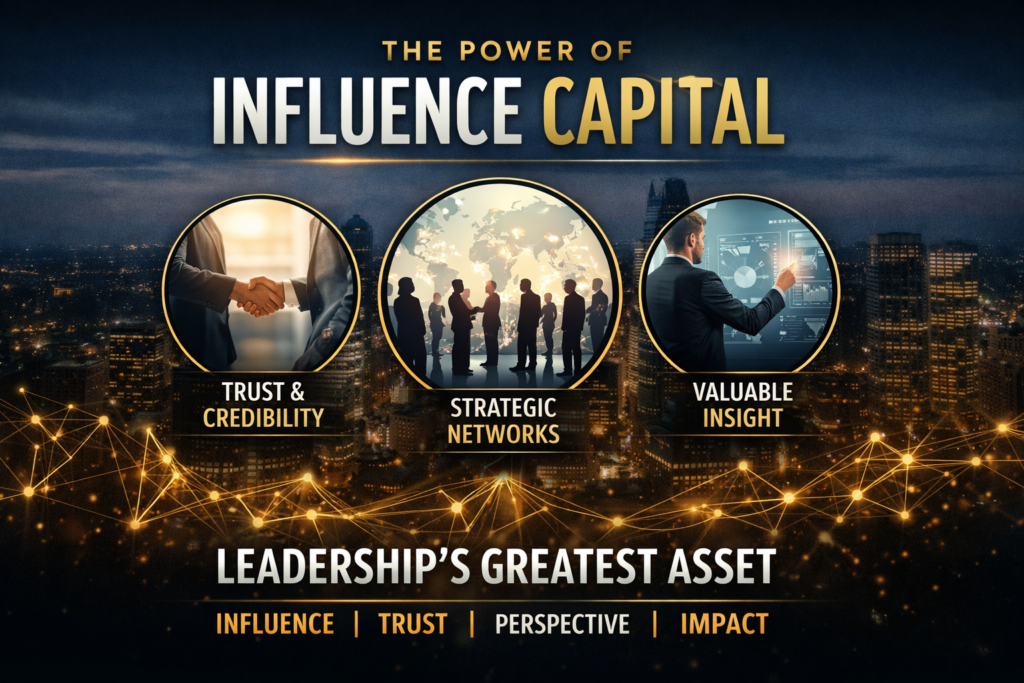
Influence capital is the accumulated trust, credibility, relationships, and perspective a leader brings into every room they enter.
Unlike financial capital, it cannot be acquired overnight. And unlike positional authority, it cannot be assigned. It is earned—through consistent value creation, strategic thinking, and meaningful relationships.
At its core, influence capital answers one question:
When you speak, do people listen—and act?
Why Influence Capital Matters More Than Ever
Boards and executive teams are operating in an era defined by uncertainty—AI disruption, shifting markets, and rising stakeholder expectations. In this environment, decision-making is less about certainty and more about collective intelligence.
This is where influence capital becomes essential.
Leaders with high influence capital:
- Shape conversations, not just participate in them
- Accelerate alignment across diverse stakeholders
- Bring clarity in moments of ambiguity
- Attract opportunities, partnerships, and top talent
For organizations like those within the Boardsi ecosystem, influence capital is not a soft skill—it is a strategic asset.
The Shift From Authority to Influence
Historically, leadership followed a hierarchical model: authority flowed from the top down. But today’s most effective leaders operate differently.
They lead laterally.
They build networks of peers, advisors, and board members who challenge their thinking and expand their perspective. In doing so, they multiply their influence capital.
This shift is especially critical at the board level, where decisions are rarely made in isolation. The ability to influence across experience, industry, and opinion is what separates effective board members from passive participants.
The Four Pillars of Influence Capital
To build influence capital intentionally, leaders must focus on four key areas:
1. Credibility
Your track record matters. Experience, results, and expertise form the foundation of influence.
But credibility is not static—it must be continuously reinforced through relevance and adaptability.
2. Trust
Trust is the multiplier of influence capital. Without it, even the most experienced voices are discounted.
Trust is built through consistency, transparency, and the willingness to engage in honest dialogue—even when it is uncomfortable.
3. Network Depth
Not all networks are created equal. Influence capital grows through quality relationships, not just quantity.
Peer-to-peer executive networks, advisory boards, and curated communities provide access to diverse thinking that strengthens decision-making.
4. Perspective
In a complex world, perspective is power. Leaders who can connect insights across industries and trends bring disproportionate value to boardrooms and executive teams.
This is where influence capital becomes exponential.
Influence Capital in the Boardroom
For companies seeking board members through platforms like Boardsi, influence capital is often the differentiator.
Beyond resumes and credentials, organizations are asking:
- Can this leader challenge our thinking?
- Do they bring relationships that open doors?
- Will their voice carry weight in critical moments?
Board members with strong influence capital do more than advise—they elevate the entire organization’s decision-making capacity.
How to Build Influence Capital Intentionally
Influence capital is not accidental. It is built through deliberate action:
Engage in Peer Networks
Surround yourself with leaders who think differently. Exposure to diverse perspectives sharpens your own.
Invest in Relationships
Focus on depth over breadth. Meaningful connections create long-term influence.
Share Insight Generously
Leaders who contribute valuable thinking consistently become trusted voices.
Seek Challenging Conversations
Growth—and influence—lives outside of comfort zones.
Stay Relevant
Continuously update your knowledge to remain a valuable contributor in evolving discussions.
The Competitive Advantage Hidden in Plain Sight
Organizations invest heavily in strategy, technology, and talent. Yet few invest intentionally in the influence capital of their leadership and boards.
This is a missed opportunity.
Because in the end, execution is driven by decisions—and decisions are shaped by the quality of voices in the room.
Leaders with strong influence capital ensure those voices are informed, diverse, and aligned.
Final Thought: Leadership in the Age of Influence
The future of leadership will not be defined by authority alone.
It will be defined by connectedness, credibility, and the ability to influence outcomes through relationships and insight.
Influence capital is no longer optional—it is foundational.
For executives, advisors, and board members looking to create meaningful impact, the question is no longer:
What position do you hold?
But rather:
What level of influence capital do you bring?
#InfluenceCapital, #Leadership, #ExecutiveLeadership, #Boardsi, #BoardOfDirectors, #BusinessStrategy, #LeadershipDevelopment, #DecisionMaking, #ProfessionalGrowth, #CorporateGovernance