
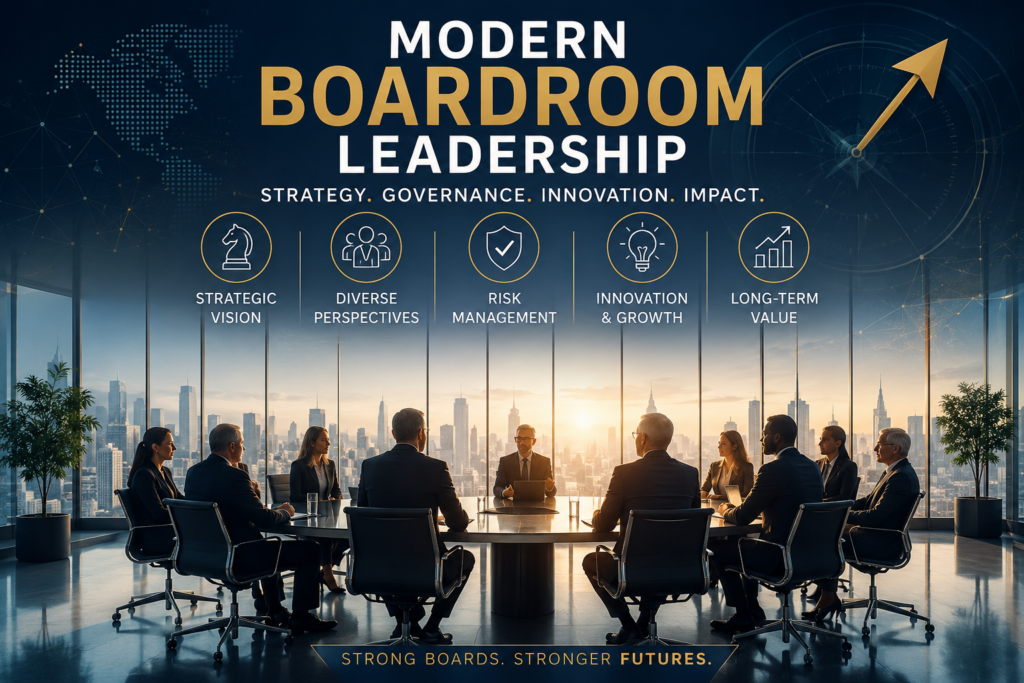
Business leadership has changed dramatically over the past decade. Rapid technological innovation, artificial intelligence, cybersecurity threats, evolving workforce expectations, geopolitical uncertainty, and increased stakeholder scrutiny have transformed the responsibilities of corporate boards.
Today’s organizations need more than governance oversight. They need strategic leadership at the board level.
This shift has given rise to modern boardroom leadership—an approach that combines governance excellence with strategic thinking, innovation, adaptability, and executive experience to help organizations thrive in an increasingly complex business environment.
Companies that embrace modern boardroom leadership are better equipped to manage risk, seize new opportunities, and create sustainable long-term value.
What Is Modern Boardroom Leadership?
Modern boardroom leadership extends far beyond reviewing financial reports and approving executive decisions.
Today’s directors actively contribute to organizational success by providing strategic guidance, challenging assumptions, supporting innovation, and helping executive teams navigate uncertainty.
Rather than reacting to business challenges after they emerge, modern boards work proactively to anticipate market changes and position organizations for future growth.
Effective board leaders understand that governance and strategy are no longer separate responsibilities. They work together to strengthen both.
Why Modern Boardroom Leadership Matters
Business disruption has become the norm rather than the exception.
Organizations face continuous pressure from:
- Artificial intelligence and automation
- Digital transformation
- Cybersecurity threats
- Economic uncertainty
- Changing customer expectations
- Talent shortages
- Regulatory complexity
- Global competition
Executive leadership teams cannot address these challenges alone.
Boards that bring diverse executive experience and strategic insight help organizations make better decisions while maintaining accountability and long-term vision.
Modern boardroom leadership provides an additional layer of expertise that strengthens executive decision-making.
The Evolution of Corporate Boards
Historically, many boards focused primarily on compliance, financial oversight, and governance.
While those responsibilities remain essential, today’s boards are expected to play a far more active role.
Modern directors often contribute in areas such as:
- Long-term strategic planning
- Digital transformation initiatives
- Executive succession planning
- Organizational culture
- Enterprise risk management
- Innovation strategy
- Artificial intelligence adoption
- Environmental and social governance
- Talent development
This expanded role requires directors who understand both governance principles and modern business realities.
Characteristics of Modern Boardroom Leadership
Successful board leaders share several important qualities.
Strategic Vision
Modern directors focus beyond quarterly performance.
They evaluate long-term trends, emerging risks, competitive positioning, and future opportunities while helping executives develop sustainable growth strategies.
Strategic thinking enables organizations to remain competitive even during periods of rapid change.
Executive Experience
Many of today’s most effective directors have served as CEOs, CFOs, entrepreneurs, division presidents, or senior executives.
Their real-world leadership experience allows them to provide practical guidance grounded in firsthand business knowledge.
This perspective often proves invaluable during periods of transformation.
Independent Thinking
Strong boards encourage constructive disagreement.
Modern boardroom leadership depends on directors who ask thoughtful questions, challenge assumptions respectfully, and offer objective perspectives that strengthen decision-making.
Healthy governance requires independence without becoming adversarial.
Adaptability
Today’s business landscape changes quickly.
Modern directors continuously educate themselves on emerging technologies, changing regulations, cybersecurity risks, artificial intelligence, and evolving governance standards.
Lifelong learning has become a defining characteristic of effective board leadership.
Collaborative Leadership
Modern boards function as strategic partners rather than passive oversight bodies.
Directors work collaboratively with executive leadership while maintaining appropriate governance independence.
This balance creates stronger organizational alignment.
Modern Boardroom Leadership and Digital Transformation
Digital transformation is now one of the most significant priorities facing organizations.
Successful transformation extends well beyond technology implementation.
It involves:
- Leadership alignment
- Organizational culture
- Operational redesign
- Customer experience
- Workforce development
- Data strategy
- Cybersecurity
- Governance
Modern boardroom leadership ensures digital initiatives align with long-term business objectives rather than becoming isolated technology projects.
Experienced directors help organizations invest wisely while managing implementation risks.
The Role of Artificial Intelligence in the Boardroom
Artificial intelligence is rapidly changing nearly every industry.
Boards increasingly face important questions regarding:
- AI governance
- Ethical implementation
- Data privacy
- Regulatory compliance
- Workforce impact
- Operational efficiency
- Competitive advantage
Modern boardroom leadership requires directors who understand both the opportunities and the risks associated with AI.
Organizations benefit from board members who can help leadership teams evaluate AI investments through both strategic and governance lenses.
Risk Management Has Become More Complex
Risk management has evolved far beyond financial oversight.
Today’s boards monitor risks involving:
- Cybersecurity
- Supply chain disruptions
- Reputation management
- Regulatory compliance
- Artificial intelligence
- Economic volatility
- Geopolitical uncertainty
- Talent retention
Modern boardroom leadership helps organizations build resilience by anticipating risks before they become crises.
Experienced directors ask difficult questions that strengthen organizational preparedness.
Culture Starts in the Boardroom
Corporate culture has become a board-level responsibility.
Organizations with healthy cultures often experience:
- Higher employee engagement
- Better retention
- Increased innovation
- Improved customer satisfaction
- Stronger financial performance
Modern boardroom leadership reinforces cultures built on integrity, accountability, transparency, and continuous improvement.
Boards increasingly evaluate executive leadership not only on financial performance but also on organizational health.
Diversity Strengthens Board Leadership
Modern governance benefits from diverse perspectives.
Effective boards often include leaders from different industries, professional backgrounds, and areas of expertise.
Diversity contributes to:
- Better decision-making
- Improved innovation
- Broader market understanding
- Enhanced problem-solving
- Stronger governance
Organizations that embrace diversity within the boardroom are often better equipped to navigate complex business challenges.
How Modern Boardroom Leadership Supports Growth
High-performing boards help organizations accelerate growth by providing:
- Strategic guidance
- Executive mentoring
- Industry expertise
- Governance oversight
- Risk management
- Market insights
- Operational experience
- Investor confidence
Rather than replacing executive leadership, modern directors strengthen leadership teams through collaboration and objective advice.
This partnership often creates faster, more informed decision-making.
Building a Future-Ready Board
Organizations preparing for long-term success should evaluate whether their board possesses expertise in areas such as:
- Digital transformation
- Artificial intelligence
- Financial leadership
- Cybersecurity
- Corporate governance
- Executive leadership
- Strategic planning
- Business transformation
- Operational excellence
- Mergers and acquisitions
Future-ready boards combine governance expertise with practical business experience.
As industries continue evolving, organizations benefit from directors capable of guiding both stability and innovation.
How Boardsi Connects Organizations with Modern Boardroom Leaders
Finding experienced board talent can be one of the greatest challenges facing growing organizations.
Boardsi simplifies this process by connecting companies with accomplished executives, entrepreneurs, governance professionals, and industry leaders who bring real-world leadership experience to advisory and corporate boards.
Whether an organization is preparing for expansion, digital transformation, succession planning, or strategic growth, Boardsi helps identify leaders whose expertise aligns with business objectives.
By matching organizations with highly qualified board candidates, Boardsi strengthens governance while supporting innovation, executive leadership, and sustainable long-term growth.
The Future of Modern Boardroom Leadership
The boardroom will continue evolving as technology, markets, and stakeholder expectations reshape business.
Tomorrow’s directors will be expected to contribute not only governance expertise but also strategic insight, innovation leadership, and transformational thinking.
Organizations that invest in modern boardroom leadership today will be better positioned to adapt to future disruption while creating lasting value for shareholders, employees, customers, and communities.
In an era where change is constant, strong leadership in the boardroom may be one of the most valuable competitive advantages an organization can possess.