Why the future of business belongs to leaders who build strong organizations, not simply manage successful teams.
Every organization has a strategy. Not every organization has the leadership required to execute it.
Companies invest millions in technology, operational efficiency, market expansion, and talent acquisition. Yet even the most sophisticated business strategy can fall short when leadership fails to align people, priorities, and purpose.
The difference between organizations that consistently perform and those that struggle to sustain momentum often comes down to one defining factor: organizational leadership.
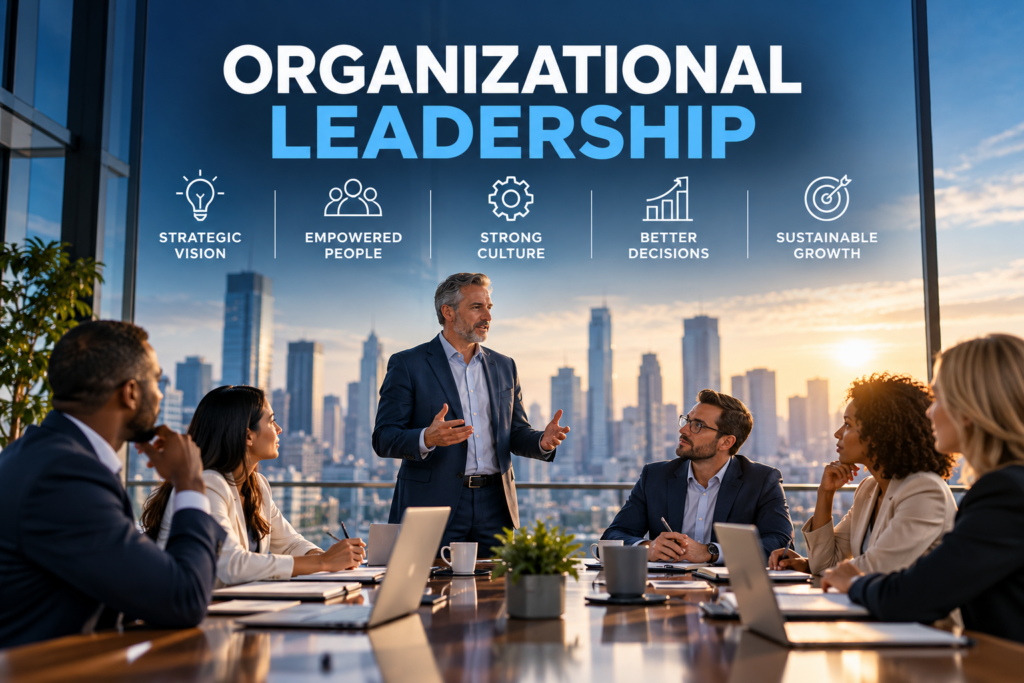
Effective organizational leadership goes beyond managing employees or achieving quarterly targets. It is the ability to create a shared vision, establish accountability, develop future leaders, and build an environment where people can perform at their highest potential.
For CEOs, entrepreneurs, and board members, understanding organizational leadership is no longer simply a management responsibility. It is a strategic imperative.
As businesses navigate technological disruption, economic uncertainty, and evolving workforce expectations, leadership quality increasingly determines whether organizations merely react to change or help shape the future.
The question is no longer whether leadership matters.
It is whether your organization is developing the kind of leadership its future demands.
What Is Organizational Leadership?
Organizational leadership is the ability to guide, influence, and align individuals, teams, and business functions toward a shared vision while building the capabilities necessary for long-term organizational success.
Unlike traditional management, which focuses primarily on processes, systems, and operational execution, organizational leadership emphasizes strategic direction, human development, organizational culture, and sustainable performance.
Management helps an organization operate efficiently. Leadership helps determine where the organization should go, why that direction matters, and how people can move forward together.
Both are essential.
Strong organizational leaders connect three critical dimensions of business success:
- Strategic clarity: Establishing a compelling vision and translating it into measurable objectives.
- People development: Empowering employees, strengthening teams, and preparing future leaders.
- Organizational alignment: Ensuring culture, decision-making, resources, and operations support shared priorities.
When these dimensions work together, organizations become better equipped to innovate, adapt, and grow.
When they become disconnected, even talented teams can struggle to deliver meaningful results.
Why Organizational Leadership Matters More Than Ever
The modern business environment presents a leadership challenge unlike anything organizations have experienced in previous generations.
Artificial intelligence is transforming workflows. Global competition continues to evolve. Employee expectations are changing. And organizations face increasing pressure to balance financial performance with responsible governance and long-term value creation.
These conditions demand more than technical expertise.
They require leaders who can navigate uncertainty without losing direction, make difficult decisions without compromising trust, and create cultures capable of adapting without sacrificing their core identity.
Consider two organizations operating in the same industry.
Both have access to comparable technology, financial resources, and market opportunities.
The first relies heavily on centralized decision-making. Employees receive instructions but have limited understanding of the broader strategy. Innovation moves slowly because teams are reluctant to challenge established practices.
The second communicates a clear vision, encourages informed decision-making, develops leadership capabilities throughout the organization, and welcomes diverse perspectives.
Over time, the second organization may be better positioned to recognize emerging opportunities, respond to disruption, and retain talented professionals.
The distinction is not simply operational efficiency.
It is leadership capacity.
The most resilient organizations do not depend on one exceptional leader. They develop leadership as an organizational capability.
7 Organizational Leadership Strategies That Build Stronger Companies
1. Establish a Vision That Connects Purpose With Performance
One of the most important responsibilities of organizational leadership is providing clarity about where the business is going and why that destination matters.
A vision should do more than describe an ambitious future. It should influence everyday decisions.
When employees understand how their contributions support a larger purpose, they can make more informed decisions, prioritize meaningful work, and collaborate across departments.
However, vision without execution becomes little more than aspiration.
Effective organizational leaders translate purpose into practical priorities.
They consistently answer three questions:
- What are we trying to accomplish?
- Why does it matter to our customers, employees, and stakeholders?
- What must we do differently to achieve it?
For example, a company pursuing market leadership through innovation must do more than announce innovation as a strategic priority.
It must invest in experimentation, reward constructive problem-solving, and establish processes that allow promising ideas to move from concept to implementation.
Leadership takeaway: A compelling vision gives people direction. Strategic alignment gives them the ability to act.
2. Build an Organizational Culture Rooted in Trust and Accountability
Culture is not defined by the values displayed on an office wall.
It is revealed through the behaviors an organization consistently encourages, tolerates, and rewards.
Leaders shape culture through their decisions, communication, and treatment of others.
When executives demonstrate integrity, acknowledge mistakes, and follow through on commitments, they create conditions that support trust.
When leaders avoid accountability or apply inconsistent standards, they weaken the credibility of the organization.
Trust and accountability should reinforce one another.
Trust gives people the confidence to raise concerns, contribute ideas, and take appropriate risks. Accountability ensures that commitments translate into meaningful results.
Strong organizational leadership requires both.
Executives can strengthen this balance by establishing clear performance expectations, encouraging constructive feedback, recognizing responsible initiative, and addressing problems consistently.
Leaders must also create environments where employees can disagree respectfully without fear of retaliation.
An organization that discourages difficult conversations may appear harmonious while allowing significant problems to remain unresolved.
Leadership takeaway: Healthy organizational cultures do not eliminate disagreement. They create the trust necessary to turn disagreement into better decisions.
3. Develop Leaders at Every Level of the Organization
One of the greatest mistakes organizations make is treating leadership development as an activity reserved for senior executives.
Leadership capacity should not begin when someone receives a management title.
It should be cultivated throughout the organization.
Employees who demonstrate initiative, sound judgment, collaboration, and accountability are already exhibiting important leadership behaviors.
The responsibility of organizational leaders is to recognize that potential and create opportunities for it to develop.
This requires moving beyond occasional leadership workshops toward a continuous development strategy.
Organizations can strengthen their leadership pipelines through:
- Executive mentoring and professional coaching.
- Cross-functional projects that expand business understanding.
- Stretch assignments that build decision-making confidence.
- Succession planning for critical leadership positions.
- Regular feedback focused on both results and leadership behaviors.
Developing future leaders also requires executives to delegate meaningful responsibility.
Leaders who insist on controlling every decision may preserve short-term consistency, but they often limit the organization’s ability to grow.
The objective is not to create employees who depend on leadership for every answer.
It is to develop professionals capable of exercising sound judgment independently.
Leadership takeaway: The long-term strength of an organization is reflected in the leadership capabilities it continues to develop.
4. Strengthen Strategic Decision-Making Through Diverse Perspectives
Effective organizational leadership requires the ability to make sound decisions under conditions of uncertainty.
Yet even experienced executives face limitations in their knowledge, assumptions, and perspectives.
This is where diverse leadership experience becomes particularly valuable.
Organizations benefit when strategic discussions include individuals with different professional backgrounds, industry knowledge, operational expertise, and approaches to problem-solving.
Diversity of perspective can help leadership teams identify risks, challenge assumptions, and recognize opportunities that might otherwise remain overlooked.
This principle becomes especially important at the board level.
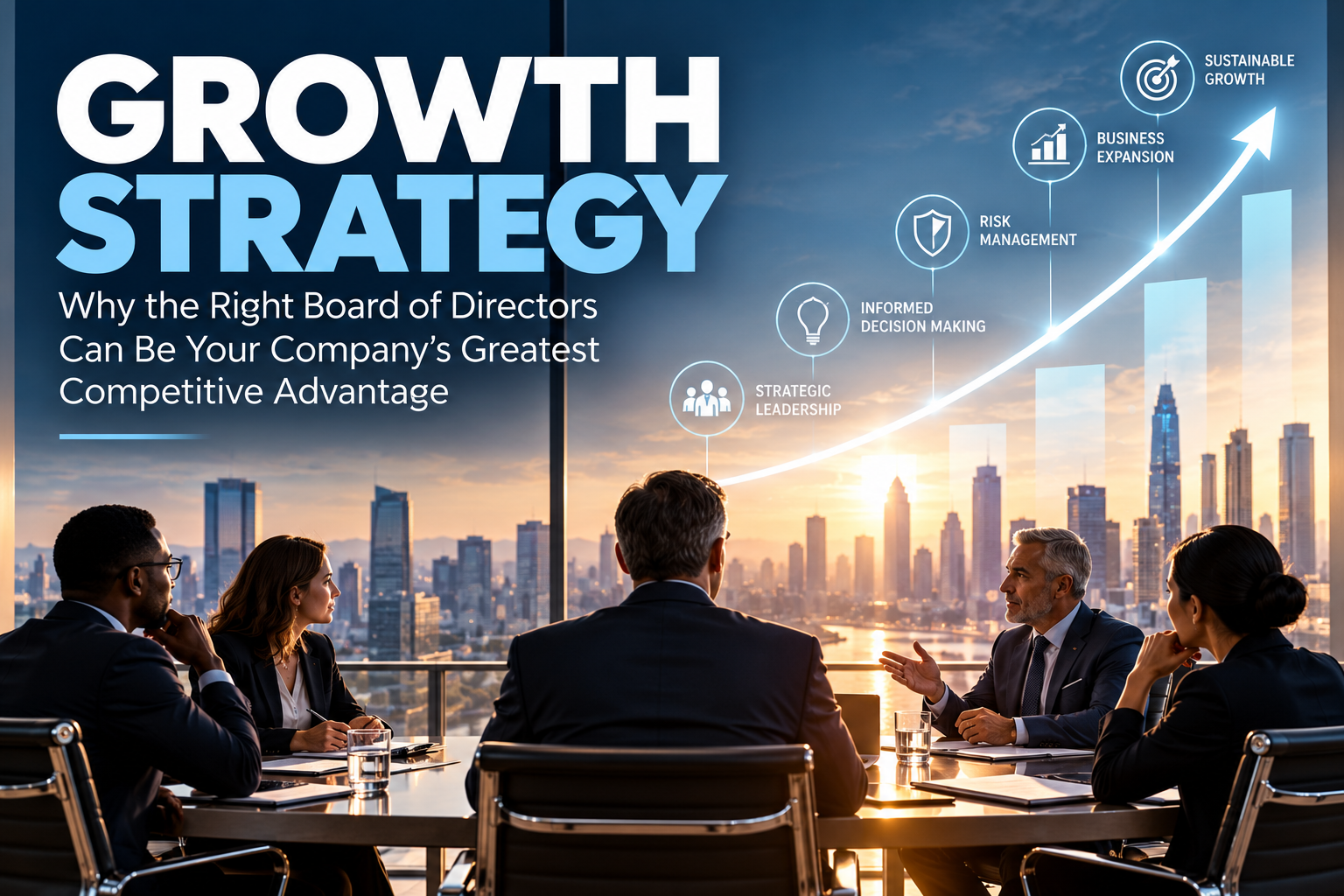
A well-composed board of directors can provide valuable strategic oversight, challenge management constructively, and contribute experience that extends beyond the executive team’s immediate operational responsibilities.
For growing companies, access to experienced board members and executive advisors can support more disciplined decision-making as organizational complexity increases.
However, diversity alone is not enough.
Leaders must establish decision-making processes that genuinely welcome informed disagreement and evaluate evidence objectively.
A room filled with experienced professionals creates limited value if everyone feels pressured to agree with the most senior voice.
Leadership takeaway: Strong leaders do not surround themselves exclusively with people who reinforce their thinking. They seek perspectives that improve it.
5. Lead Organizational Change With Clarity and Confidence
Change is an unavoidable part of organizational growth.
Companies introduce new technologies, restructure departments, enter unfamiliar markets, and redefine business models to remain competitive.
Yet successful organizational change requires more than announcing a new initiative.
It requires leadership that understands how change affects people.
Employees may resist change because they lack information, fear losing competence, question leadership intentions, or cannot see how the proposed direction benefits the organization.
Effective leaders address these concerns through communication, involvement, and consistent execution.
They explain the business reasons behind change, establish realistic expectations, and create opportunities for employees to participate in implementation.
They also recognize that organizational transformation rarely follows a perfectly predictable path.
Strategies may require adjustment as new information emerges.
The ability to adapt without abandoning the organization’s broader purpose is a defining characteristic of effective leadership.
Executives should establish measurable milestones, communicate progress transparently, and acknowledge setbacks when they occur.
Confidence in leadership does not require pretending that every decision is certain.
It requires demonstrating the judgment and discipline necessary to navigate uncertainty responsibly.
Leadership takeaway: Change becomes more manageable when people understand the destination, trust the leadership, and know how they contribute to progress.
6. Align Leadership Performance With Long-Term Business Value
Organizations often measure leadership effectiveness through revenue growth, profitability, productivity, and operational efficiency.
These metrics are essential, but they provide only part of the picture.
A company can deliver strong short-term financial results while simultaneously weakening its leadership pipeline, damaging employee trust, or overlooking emerging strategic risks.
Effective organizational leadership requires a broader understanding of performance.
Executives and boards should evaluate both immediate results and the organizational capabilities that support future success.
Relevant measures may include employee retention, succession readiness, customer satisfaction, innovation outcomes, leadership development progress, and strategic execution.
The specific indicators will vary by organization, industry, and growth stage.
What matters is establishing a balanced view of performance.
For example, a company experiencing rapid revenue growth should also consider whether its management structure, governance practices, and leadership capabilities can support the next stage of expansion.
Growth without leadership infrastructure can create operational strain and increase organizational risk.
Similarly, leaders should evaluate whether incentive structures encourage responsible long-term decisions or unintentionally reward short-term outcomes at the expense of future performance.
Leadership takeaway: Sustainable growth requires leaders to measure not only what the organization achieves today, but also what it is becoming capable of achieving tomorrow.
7. Connect Executive Leadership With Strong Board Governance
As organizations grow, leadership becomes increasingly interconnected with governance.
CEOs and executive teams are responsible for translating strategy into action, managing operations, and leading organizational performance.
Boards of directors provide oversight, evaluate significant risks, support accountability, and contribute to long-term strategic direction.
These responsibilities are distinct, but they should be complementary.
When executive leadership and board governance operate with clarity and mutual respect, organizations can benefit from stronger strategic discipline and more informed decision-making.
Effective board engagement involves more than periodic financial reviews.
It requires meaningful conversations about organizational resilience, leadership succession, competitive positioning, emerging risks, and future opportunities.
For companies entering new stages of growth, the composition of the board becomes especially important.
Board members with relevant experience in finance, technology, international expansion, governance, or industry-specific challenges can contribute valuable insight.
This is also where organizations must distinguish between the responsibilities of formal directors and those of advisory board members.
Directors carry governance and fiduciary responsibilities defined by applicable law and organizational structure. Advisors typically provide guidance without exercising the same formal authority.
Both roles can create value when expectations are clearly established.
Leadership takeaway: Strong governance does not replace executive leadership. It strengthens the environment in which executive leadership operates.
The Essential Organizational Leadership Skills Every Executive Should Develop
Although leadership approaches vary across industries and organizations, several capabilities consistently support effective organizational leadership.
| Leadership Skill | Organizational Value |
|---|---|
| Strategic thinking | Connects current decisions with long-term business objectives |
| Emotional intelligence | Supports communication, trust, and productive working relationships |
| Decision-making | Helps leaders evaluate risks, opportunities, and competing priorities |
| Change management | Enables organizations to navigate transitions effectively |
| Talent development | Builds stronger teams and future leadership capacity |
| Communication | Creates clarity, alignment, and shared understanding |
| Ethical judgment | Strengthens accountability and stakeholder confidence |
| Adaptability | Helps organizations respond to changing market conditions |
| Governance awareness | Connects executive action with oversight and long-term responsibility |
These capabilities are not developed through experience alone.
They require intentional practice, feedback, reflection, and exposure to challenging situations.
The most effective executives remain committed to learning even after reaching senior leadership positions.
They recognize that professional achievement does not eliminate the need for continued growth.
In fact, the greater the responsibility, the more important leadership development becomes.
How to Improve Organizational Leadership: A Practical Executive Framework
Improving organizational leadership begins with understanding the organization’s current capabilities and identifying the gaps that may limit future performance.
Executives can use a structured approach to strengthen leadership effectiveness.
Step 1: Evaluate leadership alignment. Determine whether executives, managers, and employees share a clear understanding of strategic priorities. Identify inconsistencies between stated goals and everyday decisions.
Step 2: Assess organizational culture. Examine whether employees experience trust, accountability, open communication, and opportunities for professional growth.
Step 3: Identify leadership capability gaps. Review succession plans, management development programs, and the skills required to execute future strategies.
Step 4: Strengthen decision-making processes. Clarify decision rights, improve access to relevant information, and encourage constructive challenges to established assumptions.
Step 5: Engage experienced external perspectives. Consider how qualified board members, independent directors, executive mentors, and strategic advisors could contribute to organizational development.
Step 6: Establish measurable leadership objectives. Connect leadership initiatives to meaningful business outcomes, including retention, operational performance, strategic execution, and organizational readiness.
Step 7: Review and refine continuously. Leadership development should be treated as an ongoing organizational discipline rather than a one-time initiative.
A useful starting point is to ask:
If our organization doubled in size over the next three years, would our current leadership capabilities allow us to succeed?
The answer can reveal whether the organization is building the infrastructure required for sustainable growth.
The Future of Organizational Leadership: From Individual Authority to Collective Capability
The next generation of successful organizations will require a different understanding of leadership.
Traditional models often emphasized hierarchy, individual authority, and centralized control.
While clear accountability remains essential, increasingly complex business environments demand greater collaboration, adaptability, and shared responsibility.
Artificial intelligence may accelerate analysis and automate routine decisions, but it does not eliminate the need for human judgment, ethical responsibility, or strategic direction.
As technology expands organizational capabilities, leadership must ensure that innovation serves meaningful business and human objectives.
Future-ready leaders will need to combine technological understanding with emotional intelligence, operational discipline with strategic imagination, and decisive action with intellectual humility.
They will also need to recognize that organizational success cannot depend exclusively on the abilities of one CEO or a small executive team.
Strong organizations develop systems that preserve institutional knowledge, encourage independent thinking, and prepare future generations of leadership.
This shift has important implications for corporate governance.
Boards must look beyond the qualifications of individual executives and consider the overall strength of the organization’s leadership architecture.
That includes succession planning, cultural resilience, executive development, and the capacity to navigate disruption.
Ultimately, the future of organizational leadership is not about concentrating more authority at the top.
It is about creating an organization capable of performing, adapting, and growing through the collective strength of its people.
Frequently Asked Questions About Organizational Leadership
What is organizational leadership?
Organizational leadership is the process of guiding people, aligning business priorities, shaping organizational culture, and developing capabilities that support long-term success. It combines strategic vision, effective communication, decision-making, and people development.
Why is organizational leadership important in business?
Organizational leadership helps businesses align employees with strategic objectives, navigate change, strengthen accountability, and develop future leaders. Effective leadership can also improve an organization’s ability to respond to competitive challenges and pursue sustainable growth.
What are the main characteristics of effective organizational leadership?
Important characteristics include strategic thinking, integrity, emotional intelligence, adaptability, accountability, clear communication, and a commitment to developing others.
What is the difference between organizational leadership and management?
Management focuses primarily on coordinating resources, processes, and operations to achieve established objectives. Organizational leadership focuses on setting direction, influencing people, shaping culture, and preparing the organization for future challenges. Effective businesses need both.
How can organizations improve leadership effectiveness?
Organizations can improve leadership effectiveness through executive coaching, mentoring, succession planning, leadership assessments, clearer strategic communication, stronger accountability systems, and meaningful engagement with experienced board members and advisors.
What role does a board of directors play in organizational leadership?
A board of directors provides governance oversight, monitors significant risks, evaluates executive performance, and contributes to long-term strategic accountability. Effective boards support organizational leadership by bringing independent judgment, relevant expertise, and a broader perspective to important decisions.
Final Thoughts: Great Organizational Leadership Builds Beyond the Leader
The ultimate measure of organizational leadership is not how much an individual executive accomplishes.
It is the strength of the organization that leadership helps create.
Successful leaders establish direction. Exceptional leaders develop the people, culture, and systems that allow an organization to sustain progress beyond any one individual’s tenure.
They understand that trust creates the foundation for collaboration, accountability turns strategy into performance, and leadership development builds the capacity for future growth.
For CEOs, founders, and board members, the opportunity is clear.
Invest in leadership before organizational challenges expose its weaknesses.
Build a culture where responsibility is shared, talent is developed, and strategic decisions benefit from diverse expertise.
And recognize that long-term success depends not only on having the right strategy, but also on having the right leadership to execute it.
Because the most enduring achievement of organizational leadership is not building an organization that depends on you. It is building one that continues to succeed because of the leaders you helped develop.
Strengthen Your Organization’s Leadership With Boardsi
Building a high-performing organization requires more than a compelling vision. It requires experienced leadership, strategic insight, and the right perspectives at critical moments.
Boardsi focuses on connecting executive talent with board and advisory opportunities, helping organizations explore access to experienced professionals who can contribute valuable strategic perspectives.
Whether your company is preparing for growth, strengthening its governance structure, or seeking experienced executive insight, the right leadership relationships can support more informed decisions and long-term organizational development.
Explore how Boardsi can help connect organizations and executives with board-level opportunities and expertise.
#OrganizationalLeadership, #LeadershipDevelopment, #ExecutiveLeadership, #StrategicLeadership, #BusinessLeadership, #CorporateGovernance, #BoardLeadership, #LeadershipStrategies, #BusinessGrowth, #OrganizationalCulture, #LeadershipSkills, #ExecutiveDevelopment, #BoardOfDirectors, #SustainableGrowth, #LeadershipExcellence, #BusinessStrategy, #FutureOfLeadership, #Boardsi