In boardrooms, succession planning is often treated like an insurance policy—important, but not urgent. That’s a mistake.
The organizations that endure don’t just manage transitions—they design them. They build leadership pipelines long before a vacancy appears, ensuring continuity, stability, and long-term value creation.
As John Maxwell puts it, “A leader’s lasting value is measured by succession.”
For boards and executives alike, succession planning is not a human resources exercise. It is a strategic leadership discipline.
What Is Succession Planning—And Why It Matters More Than Ever
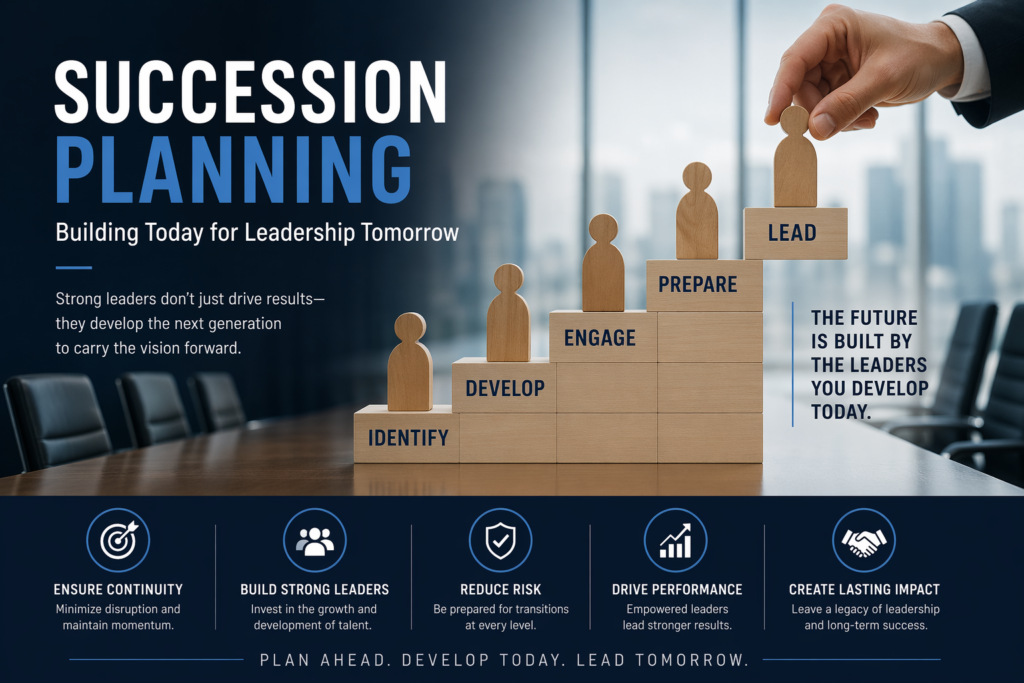
Succession planning is the intentional process of identifying, developing, and preparing future leaders to step into critical roles within an organization.
At its core, it answers one question:
“If a key leader left tomorrow, would we be ready?”
In today’s environment—marked by rapid change, aging leadership, and talent competition—the stakes are higher than ever:
- Leadership gaps can stall growth and erode investor confidence
- Poor transitions disrupt culture and strategic momentum
- High-potential talent leaves when they don’t see a path forward
Succession planning is no longer optional. It is a governance responsibility.
The Hidden Risk: Why Most Organizations Get It Wrong
Despite its importance, many organizations approach succession planning reactively:
- It’s triggered by retirement announcements or sudden exits
- It focuses only on the CEO, ignoring deeper leadership layers
- It prioritizes resumes over readiness
This creates a dangerous illusion of preparedness.
Leadership is not a position—it’s a process of influence and development.
Without intentional development, a successor may inherit the role—but not the capability.
The Strategic Value of Succession Planning
Done well, succession planning delivers far more than continuity. It becomes a competitive advantage.
1. Organizational Stability
Transitions become seamless rather than disruptive. Stakeholders maintain confidence.
2. Leadership Continuity
Vision, culture, and strategy carry forward without fragmentation.
3. Talent Retention
High-potential leaders stay when they see a future inside the organization.
4. Accelerated Growth
Prepared leaders make faster, better decisions—because they’ve been developed, not just appointed.
As Simon Sinek emphasizes, great leaders don’t just achieve results—they build environments where others can thrive and lead.
The Board’s Role in Succession Planning
For boards—especially advisory boards like those supported by Boardsi—succession planning is a critical oversight function.
Boards should:
- Ensure a formal succession strategy exists
- Evaluate leadership pipelines regularly
- Challenge assumptions about “ready now” candidates
- Align succession with long-term strategy—not short-term convenience
The most effective boards don’t wait for change. They prepare for it.
A Modern Framework for Effective Succession Planning
To move from reactive to strategic, organizations should adopt a structured approach:
1. Identify Critical Roles
Start beyond the CEO. Consider roles that drive revenue, innovation, and culture.
2. Define Future Leadership Needs
What will the business require in 3–5 years—not just today?
3. Assess Internal Talent
Evaluate both performance and potential. Not all top performers are future leaders.
4. Develop Leaders Intentionally
Leadership is built daily, not in a single moment.
Create development plans, mentorship, and stretch opportunities.
5. Create Multiple Successors
Avoid single-point dependency. Depth matters more than convenience.
6. Integrate External Perspective
Advisory boards and outside experts bring objectivity and strategic insight.
The Human Side of Succession: Culture, Trust, and Courage
Succession planning is not just structural—it’s deeply human.
It requires:
- Trust — Leaders must be willing to develop others, not protect their roles
- Vulnerability — Letting go of control to empower the next generation
- Clarity of purpose — Understanding not just who leads next, but why they lead
Organizations that succeed here create cultures where leadership is shared, not hoarded.
How Boardsi Supports Succession Planning
At Boardsi, succession planning is approached as a strategic partnership.
Through access to experienced executives and advisory board members, companies can:
- Gain objective evaluation of leadership pipelines
- Identify skill gaps at the executive level
- Build bench strength with seasoned advisors
- Align leadership development with long-term growth strategy
This external perspective ensures that succession planning is not limited by internal blind spots.
Final Thought: Leadership That Outlasts the Leader
Succession planning is the ultimate test of leadership maturity.
Anyone can lead in the present.
Great leaders build the future.
As Maxwell’s Law of Legacy reminds us, leadership is not measured by what you achieve—but by what continues after you’re gone.
The question isn’t whether succession planning is necessary.
The question is whether your organization will be ready when it matters most.
#SuccessionPlanning, #LeadershipDevelopment, #ExecutiveLeadership, #BoardGovernance, #BusinessStrategy, #LeadershipPipeline, #CorporateLeadership, #Boardsi, #BusinessGrowth, #CEO, #TalentManagement, #FutureLeaders, #OrganizationalSuccess, #AdvisoryBoard