
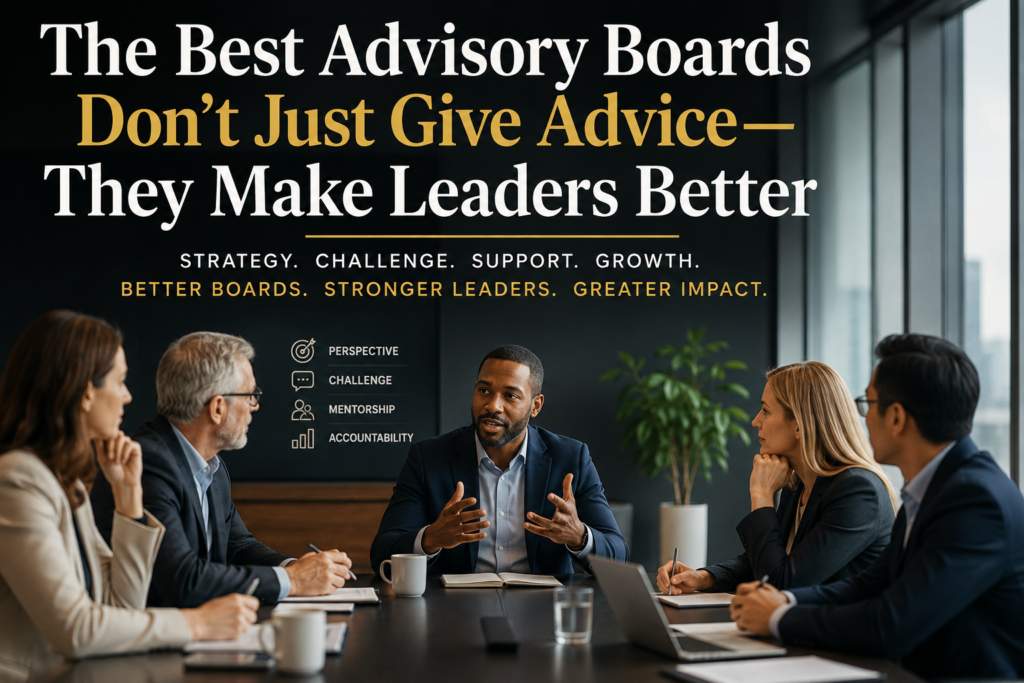
Many executives build advisory boards for the wrong reason.
They recruit accomplished people, schedule quarterly meetings, present polished updates and ask, “What do you think?”
Everyone has an intelligent conversation. Everyone leaves impressed.
And very little changes.
The problem usually isn’t the quality of the advisors. It’s the way the board is led.
An advisory board becomes valuable when independent expertise is converted into better decisions—and better decisions into organizational momentum. That requires leaders to think differently about the purpose of the board and their own role in leading it.
Unlike leading employees, advisory board leadership comes with limited positional authority. Advisors typically don’t report to the CEO. They are there because they believe their experience, relationships and perspective can contribute.
That makes an advisory board one of the clearest tests of a leader’s ability to influence without relying on authority.
Leadership author John C. Maxwell has long distinguished leadership from position, arguing that leadership ultimately depends on influence. His 5 Levels of Leadership similarly describes leadership as a process that develops beyond positional authority through relationships, results and the development of others.
For advisory board leaders, that distinction matters.
You cannot command your way to a great advisory board. You have to lead your way there.
1. Start With Purpose, Not Prestige
One of the easiest mistakes executives make is building an advisory board around résumés.
Who has the biggest name? Who has the strongest network? Who would look impressive on the company website?
Those aren’t necessarily bad questions. They’re simply not the first question.
The first question is: Why does this advisory board exist?
Simon Sinek’s Start With Why centers leadership around clarity of purpose—the reason an organization or leader acts in the first place.
The same principle applies here.
A board created to accelerate market expansion should look different from one designed to navigate regulation, strengthen innovation, prepare for succession or challenge a founder’s strategic assumptions.
Before recruiting anyone, leaders should be able to finish this sentence:
“This advisory board exists to help us ______.”
If the answer is vague, the board’s contribution probably will be too.
2. Recruit For Contribution, Not Credentials
Once the purpose is clear, composition becomes strategic.
The objective isn’t to assemble the most accomplished people available. It’s to assemble the combination of perspectives the organization needs.
That might include industry expertise, customer insight, operational experience, financial judgment, technological knowledge or access to relationships the organization does not currently possess.
But leaders should also recruit for something less comfortable: constructive disagreement.
A board filled with people who think like the CEO may produce pleasant meetings. It probably won’t produce enough challenging ones.
Strong advisors are willing to ask:
What assumption could be wrong?
What aren’t we seeing?
Where are we moving too slowly?
What decision are we avoiding because it’s uncomfortable?
If you were competing against us, where would you attack?
Those questions are often more valuable than another hour of presentations.
3. Make Candor Safe
Executives frequently say they want honest feedback.
The real test is what happens when they receive it.
If an advisor challenges the strategy and the CEO immediately becomes defensive, explains away the objection or spends 15 minutes proving management is right, everyone around the table learns something.
Not about the strategy.
About the leader.
They learn that disagreement carries a cost.
Over time, difficult questions disappear. Meetings become more comfortable—and less useful.
Brené Brown’s work on vulnerability frames courage as requiring engagement with uncertainty, risk and emotional exposure. For executives, receiving uncomfortable feedback without becoming defensive is a practical expression of that courage.
Sometimes the most powerful response a leader can give is:
“I hadn’t considered that. Tell me more.”
4. Use Meetings For Decisions, Not Updates
A weak advisory board meeting is primarily informational.
A strong one is strategic.
If executives spend most of a two-hour meeting presenting information advisors could have read beforehand, they are wasting a scarce resource: concentrated executive judgment.
Send operating updates in advance. Use meeting time for the questions where outside perspective could materially improve the outcome.
Instead of another 30-slide presentation, put two or three significant questions on the table:
We are entering this market. What are we underestimating?
Our growth is outpacing our leadership infrastructure. Where would you strengthen it first?
What should we stop doing?
Maxwell’s Law of Priorities makes a useful distinction: activity is not necessarily accomplishment. Advisory board meetings should reflect the same discipline.
The goal isn’t to discuss everything.
It’s to confront what matters most.
5. Close The Loop
There is another habit that can dramatically improve advisory board engagement: show advisors what happened after the meeting.
Imagine investing hours reviewing materials and offering recommendations, then hearing nothing about what management ultimately did.
Eventually, participation becomes ceremonial.
Instead, begin the next meeting with four questions:
What did we hear?
What did we decide?
What did we implement?
What happened as a result?
Leaders aren’t obligated to accept every recommendation. Advisors advise; management decides.
But advisors should know their thinking was seriously considered.
That creates a reinforcing cycle:
Contribution → Action → Results → Trust → Greater Contribution
6. Measure What Happens Between Meetings
The easiest way to measure an advisory board is to count meetings.
The better measure is impact.
Did the board improve a major decision?
Did an advisor identify a risk management had overlooked?
Did someone create an important relationship?
Did the board challenge an assumption before it became an expensive mistake?
Did the CEO become a better leader because of the conversations around the table?
Those outcomes tell you far more than attendance rates.
The Board Is Advising The Leader, Too
There is one final point executives shouldn’t overlook.
An advisory board may be established to strengthen the organization, but its greatest impact may ultimately be on the person leading it.
Good advisors expand a leader’s field of vision. They expose blind spots. They bring experience into decisions before the CEO has to acquire that experience through failure.
And occasionally, they say something nobody else is willing to say.
That requires humility from the person at the head of the table.
The strongest advisory board leaders don’t enter the room determined to demonstrate that they have all the answers.
They enter determined to discover the questions they haven’t considered.
That’s the paradox of advisory board leadership:
The more secure leaders become about not having every answer, the more valuable the people around them become.
Build an advisory board around prestige, and you may create an impressive list of names.
Build it around purpose, constructive disagreement, trust and disciplined action, and you create something much more powerful:
A group of leaders capable of helping one another see farther than any of them could see alone.
#AdvisoryBoardLeadership, #AdvisoryBoards, #Leadership, #ExecutiveLeadership, #StrategicLeadership, #BoardLeadership, #LeadershipDevelopment, #CEOLeadership, #BusinessStrategy, #OrganizationalLeadership, #LeadershipInfluence, #DecisionMaking, #ThoughtLeadership, #BusinessLeadership, #ExecutiveDevelopment