
In business, leadership conversations often center around CEOs, founders, and executive teams. Yet behind nearly every enduring organization is a force that quietly shapes strategy, safeguards accountability, and determines long-term direction: the board of directors.
The most effective boards do far more than oversee governance requirements or approve quarterly decisions. They serve as strategic architects of the organization’s future. In today’s increasingly volatile business environment, the board of directors has evolved from a ceremonial oversight body into one of the most critical drivers of organizational performance.
The companies that thrive over time are rarely led by strong executives alone. They are guided by strong boards.
Why Boards Matter More Than Ever
Modern organizations face a level of complexity few leaders could have anticipated a decade ago. Economic uncertainty, technological disruption, workforce transformation, cybersecurity risks, and heightened stakeholder expectations have fundamentally changed the role of leadership.
As a result, boards are no longer expected to simply review financial reports and manage compliance. They are expected to provide strategic insight, challenge assumptions, evaluate risk, and strengthen executive decision-making.
A high-performing board creates organizational clarity.
A weak board creates organizational friction.
The difference often determines whether a company scales successfully or struggles under the weight of poor alignment.
The Core Purpose of a Board of Directors
At its foundation, a board of directors exists to protect the long-term interests of the organization and its stakeholders. But the best boards understand that protection is not passive.
It is proactive leadership.
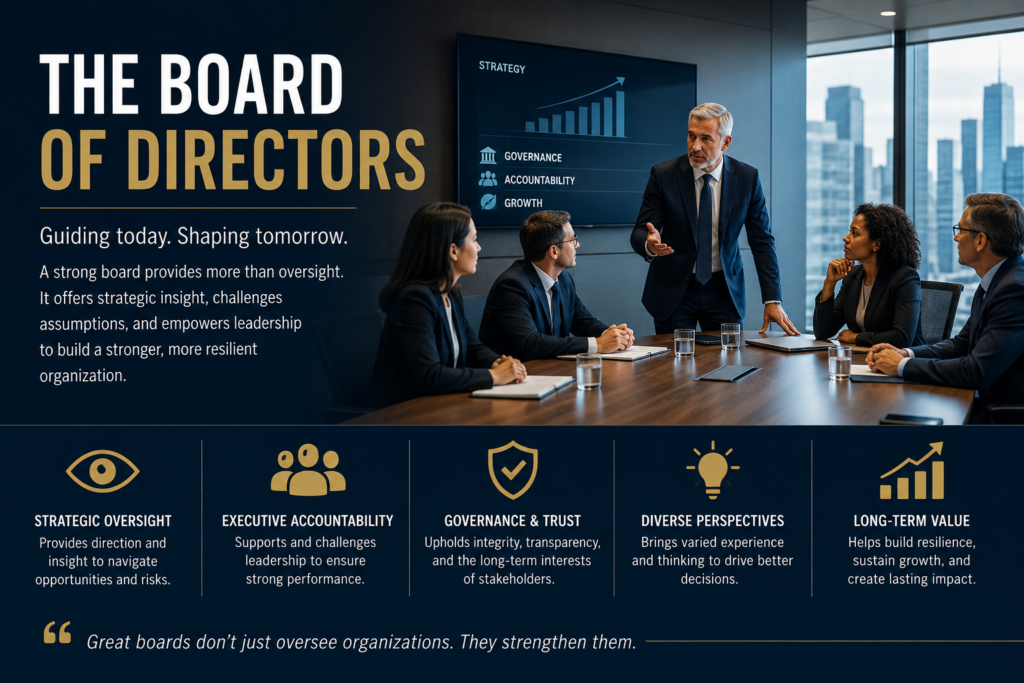
Strong boards focus on three essential responsibilities:
Strategic Oversight
Boards must help organizations stay aligned with long-term priorities. This includes evaluating growth opportunities, market positioning, innovation strategies, and operational risks.
Executive Accountability
One of the board’s most important responsibilities is ensuring leadership effectiveness. Great boards support executives while also holding them accountable to measurable outcomes.
Governance and Trust
Trust is the currency of leadership. Boards establish governance structures that reinforce transparency, ethical leadership, and organizational integrity.
When these three areas operate together, boards become strategic assets instead of administrative necessities.
The Difference Between Active and Passive Boards
Not all boards create value.
Some boards simply exist to fulfill structural requirements. Meetings become routine updates. Discussions remain surface level. Members avoid difficult conversations in favor of preserving comfort.
These boards often fail organizations when leadership challenges emerge.
In contrast, active boards engage deeply with the business. They ask difficult questions. They challenge assumptions respectfully. They bring diverse experience into strategic conversations.
Most importantly, they understand that their role is not to manage the company.
Their role is to strengthen leadership.
The strongest boards know when to guide, when to challenge, and when to step back.
Board Composition Determines Board Performance
An organization’s board is only as effective as the people sitting around the table.
Historically, many boards were built primarily through personal networks and familiarity. Today, that approach is no longer sufficient.
Modern boards require intentional diversity of expertise, perspective, and experience.
Effective boards often include leaders with backgrounds in:
Finance and capital markets
Operations and scaling
Technology and innovation
Human capital and culture
Industry-specific expertise
Risk management and governance
This diversity is not about optics. It is about strengthening decision-making quality.
The broader the perspective, the stronger the strategic conversation.
The CEO and Board Relationship
One of the most overlooked dynamics in business is the relationship between the CEO and the board of directors.
When this relationship is built on trust, clarity, and mutual accountability, organizations move faster and make better decisions.
When the relationship becomes adversarial or disconnected, organizations lose momentum.
The best boards do not operate as critics from a distance. They operate as strategic partners.
Likewise, strong CEOs do not view boards as obstacles to navigate. They leverage board expertise to sharpen thinking and strengthen execution.
Healthy tension between leadership and governance is not a problem.
It is often a sign of organizational maturity.
The Hidden Value of Strong Boards
The impact of a strong board rarely appears directly on a balance sheet, yet its influence is visible everywhere.
Strong boards help organizations:
Navigate uncertainty with greater confidence
Improve executive decision-making
Reduce governance risk
Strengthen investor credibility
Increase organizational accountability
Accelerate long-term growth
Perhaps most importantly, effective boards help organizations avoid preventable mistakes.
In many cases, corporate failure is not caused by a lack of talent or opportunity. It is caused by poor oversight, weak accountability, and strategic blind spots.
Strong boards reduce those vulnerabilities.
The Future of Board Leadership
The expectations placed on boards will continue to rise.
Stakeholders increasingly expect transparency. Employees expect ethical leadership. Investors expect strategic discipline. Markets demand adaptability.
This means boards must become more agile, informed, and engaged than ever before.
The future boardroom will belong to leaders who embrace continuous learning, strategic curiosity, and collaborative leadership.
Board service is no longer an honorary position.
It is a leadership responsibility.
Final Thought
The strength of an organization is often determined long before market results appear. It is shaped in boardrooms where strategic decisions are made, accountability is reinforced, and leadership direction is clarified.
Great boards do not simply protect organizations from failure.
They position organizations for significance.
Because while executives may drive the business forward, the board of directors ensures it moves in the right direction.
#BoardOfDirectors, #CorporateGovernance, #Leadership, #BusinessLeadership, #ExecutiveLeadership, #Governance, #BusinessStrategy, #StrategicLeadership, #LeadershipDevelopment, #BoardGovernance, #BusinessGrowth, #OrganizationalLeadership