
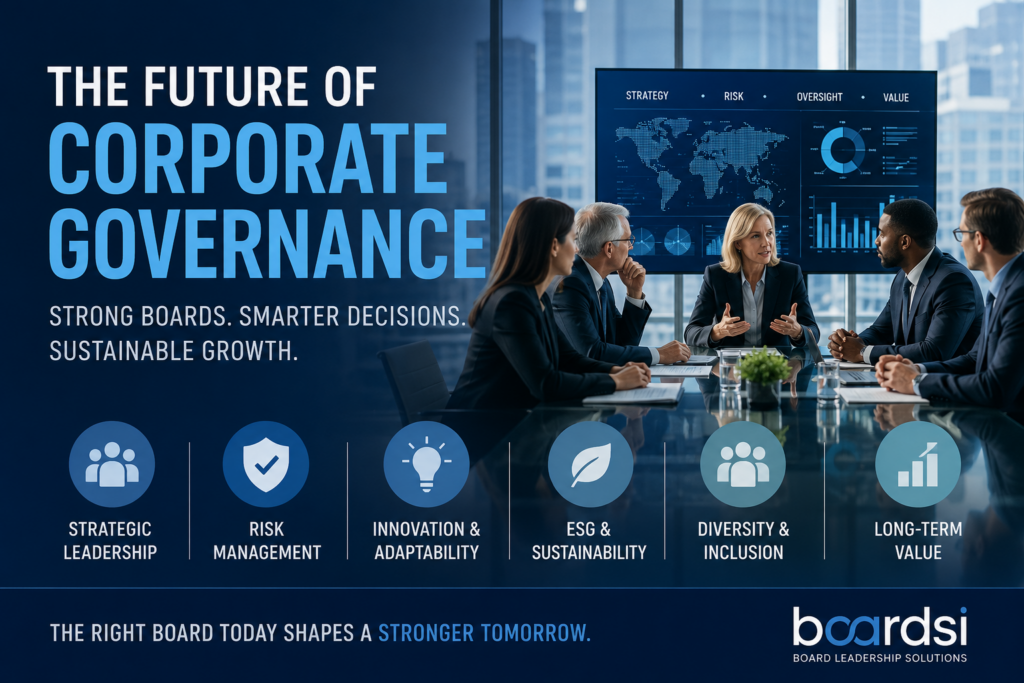
The future of corporate governance is no longer defined by compliance alone. As organizations face accelerating technological change, evolving regulations, cybersecurity threats, environmental concerns, and increasing stakeholder expectations, corporate boards are taking on a far more strategic role than ever before.
Today’s boards are expected to provide insight, anticipate risk, guide innovation, and help organizations remain resilient in an increasingly complex global economy. Governance has evolved from oversight to leadership, making the boardroom one of the most influential drivers of long-term business success.
Companies that embrace the future of corporate governance are building stronger organizations, attracting investor confidence, and positioning themselves for sustainable growth.
What Is Corporate Governance?
Corporate governance refers to the framework of policies, practices, and processes that direct and control an organization. It defines how decisions are made, how accountability is maintained, and how the interests of shareholders, employees, customers, and other stakeholders are balanced.
Traditionally, governance focused on financial oversight and regulatory compliance. While these responsibilities remain essential, modern governance now encompasses strategic planning, innovation, risk management, executive succession, sustainability, and organizational culture.
The future of corporate governance requires boards to become active strategic partners rather than passive supervisors.
Why Corporate Governance Is Rapidly Changing
Several forces are transforming governance worldwide.
Technology is advancing at an unprecedented pace, creating opportunities while introducing new risks. Artificial intelligence, automation, cybersecurity, and digital transformation require directors who understand emerging technologies and their impact on business strategy.
Global markets continue to evolve, requiring organizations to navigate geopolitical uncertainty, changing regulations, and supply chain disruptions.
Investors increasingly expect transparency regarding environmental, social, and governance (ESG) initiatives, executive compensation, diversity, ethics, and long-term value creation.
At the same time, employees and customers want organizations that demonstrate integrity, accountability, and responsible leadership.
These trends are fundamentally redefining what effective governance looks like.
The Board of the Future
Tomorrow’s boards will differ significantly from those of the past.
Rather than relying solely on executives with similar backgrounds, organizations are building boards with diverse experiences, specialized expertise, and broader perspectives.
Future boards are likely to include experts in:
- Artificial intelligence
- Cybersecurity
- Digital transformation
- Data privacy
- Sustainability
- Global business
- Healthcare
- Financial strategy
- Human capital management
- Risk management
This diversity of knowledge enables organizations to make more informed decisions while adapting quickly to changing business environments.
Governance Will Become More Strategic
The future of corporate governance places greater emphasis on strategic leadership.
Boards are becoming active participants in helping organizations:
- Evaluate market opportunities
- Prepare for disruption
- Guide mergers and acquisitions
- Support innovation
- Strengthen organizational resilience
- Develop long-term growth strategies
Rather than reviewing historical performance alone, directors increasingly focus on preparing organizations for future success.
This proactive approach creates greater value for both shareholders and stakeholders.
Technology Will Reshape Boardrooms
Technology is becoming central to governance.
Board meetings increasingly leverage digital collaboration platforms, real-time analytics, and predictive reporting that allow directors to make faster, better-informed decisions.
Artificial intelligence is expected to support boards by analyzing risk patterns, identifying operational trends, forecasting financial outcomes, and providing deeper strategic insights.
While AI can improve decision-making, experienced human judgment remains essential.
The future belongs to boards that combine technology with executive expertise.
Cybersecurity Will Remain a Top Priority
Few governance responsibilities have grown as rapidly as cybersecurity oversight.
Cyberattacks now represent one of the largest enterprise risks facing organizations across every industry.
Modern boards must understand:
- Cyber risk
- Data privacy
- Regulatory compliance
- Incident response planning
- Digital resilience
Organizations increasingly recruit directors with cybersecurity backgrounds to help strengthen oversight and reduce organizational risk.
Cyber governance is no longer an IT issue—it is a board-level responsibility.
ESG Will Continue to Influence Governance
Environmental, social, and governance initiatives continue to shape board priorities.
Investors increasingly evaluate companies based on:
- Sustainability initiatives
- Corporate ethics
- Diversity and inclusion
- Employee well-being
- Community impact
- Executive accountability
While ESG priorities continue to evolve, organizations that demonstrate responsible governance often enjoy stronger reputations, improved stakeholder trust, and greater long-term stability.
The future of corporate governance will emphasize balancing profitability with responsible leadership.
Diversity Will Drive Better Decisions
Research consistently shows that diverse leadership teams make stronger decisions.
Boards with varied professional backgrounds, industries, experiences, and perspectives are often better equipped to solve complex challenges.
Future governance emphasizes diversity across:
- Gender
- Industry expertise
- Functional leadership
- Geography
- Professional experience
- Age and generational perspectives
Diverse boards foster innovation while reducing blind spots that can hinder organizational growth.
Continuous Board Development Will Become Standard
Governance is no longer static.
The most effective boards invest in ongoing education that keeps directors informed about emerging regulations, industry trends, technology, cybersecurity, and governance best practices.
Future-focused organizations regularly evaluate board performance through assessments that identify opportunities for improvement.
Continuous learning ensures directors remain equipped to address evolving business challenges.
Executive Succession Will Receive Greater Attention
Leadership transitions represent one of the greatest responsibilities of any board.
The future of corporate governance requires organizations to maintain comprehensive succession plans for CEOs and senior executives.
Boards increasingly focus on:
- Leadership development
- Talent pipelines
- Emergency succession planning
- Executive coaching
- Organizational continuity
Strong succession planning minimizes disruption while ensuring leadership stability during periods of change.
How Boardsi Supports Modern Governance
As governance expectations continue to evolve, organizations require access to experienced leaders who bring specialized expertise to the boardroom.
Boardsi helps companies identify highly qualified executives whose backgrounds align with organizational strategy, governance needs, and long-term objectives.
Using advanced technology alongside strategic executive matching, Boardsi connects businesses with accomplished professionals across industries including finance, healthcare, technology, manufacturing, cybersecurity, operations, marketing, and more.
This modern approach expands candidate diversity while helping organizations build stronger, more effective boards prepared for tomorrow’s challenges.
Preparing for the Next Generation of Governance
Organizations that embrace the future of corporate governance gain significant competitive advantages.
They often experience:
- Better strategic decision-making
- Improved risk management
- Greater investor confidence
- Enhanced innovation
- Stronger executive accountability
- Increased organizational resilience
- Better long-term financial performance
As business environments become increasingly complex, governance will continue evolving into one of the organization’s most valuable strategic assets.
Final Thoughts
The future of corporate governance is centered on adaptability, innovation, accountability, and strategic leadership. Boards are no longer simply responsible for oversight; they are essential partners in shaping organizational success.
Companies that invest in diverse expertise, technology, continuous learning, and forward-thinking governance practices position themselves to thrive in an unpredictable business landscape.
At Boardsi, connecting organizations with accomplished executives helps build stronger boards capable of leading businesses confidently into the future. As governance continues to evolve, organizations with visionary boards will be the ones best prepared to seize new opportunities, manage emerging risks, and create lasting value for generations to come.
#FutureOfCorporateGovernance, #CorporateGovernance, #BoardLeadership, #BoardOfDirectors, #ExecutiveLeadership, #StrategicGovernance, #BusinessGrowth, #LeadershipDevelopment, #RiskManagement, #BoardRecruitment, #DigitalTransformation, #Cybersecurity, #ESG, #BoardDiversity, #Boardsi