
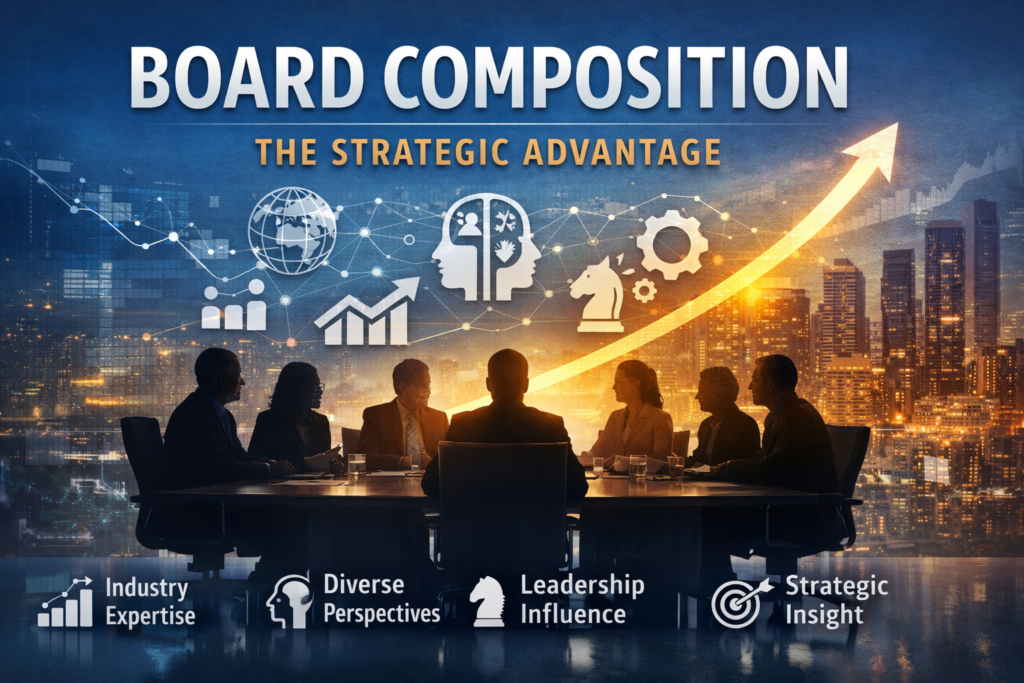
The Boardroom Is No Longer a Back Office Function
Corporate leadership has entered a decisive shift.
For years, board composition was treated as a matter of compliance—ensuring independence, meeting regulatory standards, and maintaining governance discipline. While those elements remain foundational, they no longer define high-performing organizations.
Today, board composition is a strategic lever.
The most effective companies are not just governed well. They are guided by boards intentionally built to shape strategy, influence markets, and elevate corporate leadership thought leadership. In an era defined by disruption, who sits at the table matters as much as what is decided at it.
What Board Composition Really Means Today
Board composition is no longer about filling seats. It is about curating perspective.
Modern boardrooms must reflect a balance of:
- Strategic foresight
- Industry relevance
- Technological understanding
- Global market awareness
- Leadership credibility
This shift aligns with a deeper truth in leadership: influence—not authority—is the true measure of effectiveness .
Boards that bring together diverse, high-caliber perspectives are better equipped to interpret change, challenge assumptions, and guide organizations through uncertainty.
Why Board Composition Drives Strategic Advantage
The connection between board composition and enterprise performance is becoming increasingly clear.
Organizations with thoughtfully constructed boards experience:
1. Stronger Strategic Direction
Directors with active industry experience and transformation expertise contribute insights that go beyond internal operations. They help leadership teams anticipate where markets are heading—not just react to them.
2. Enhanced Corporate Leadership Thought Leadership
Well-composed boards naturally elevate an organization’s voice. When directors bring credibility and clarity of perspective, companies become recognized contributors to industry dialogue.
3. Greater Investor Confidence
Investors are no longer evaluating companies solely on financial performance. They are assessing leadership quality. Board composition signals whether an organization is prepared for long-term value creation.
4. Improved Risk Navigation
From AI to cybersecurity to global volatility, modern risks require multidimensional thinking. Diverse board composition enables more nuanced decision-making.
The Evolution from Governance to Strategic Influence
Traditionally, boards operated as oversight bodies.
Today, they are expected to function as strategic partners.
This evolution requires a fundamental rethinking of board composition. Directors must not only understand governance—they must contribute
to:
- Digital transformation
- Innovation strategy
- Talent development
- ESG and sustainability initiatives
- Market positioning
Leadership, as research consistently shows, is not a position but a process of influence . The same is now true for boards.
The most effective boards are not passive reviewers of strategy. They are active contributors to its creation.
The Key Elements of High-Impact Board Composition
Not all boards are positioned to lead at this level. High-impact board composition typically includes five defining characteristics.
1. Industry-Relevant Expertise
Directors who are actively engaged in evolving markets bring real-time insight, not outdated experience.
2. Transformation Leadership
Experience in scaling, restructuring, or innovating organizations is critical in times of disruption.
3. Cognitive Diversity
Diversity of thought, background, and perspective strengthens decision-making and reduces blind spots.
4. Strategic Communication Ability
Board members must be able to articulate complex ideas clearly—both internally and externally.
5. Network Connectivity
Well-connected directors open doors to partnerships, capital, and innovation ecosystems.
Board composition is no longer static. It must evolve alongside the organization and its strategic priorities.
Board Composition and Thought Leadership: A Critical Connection
There is a growing link between board composition and corporate leadership thought leadership.
Organizations that shape industry conversations often have boards that:
- Encourage intellectual contribution
- Support executive visibility
- Engage in broader business ecosystems
This reflects a broader leadership principle: people follow those who inspire them, not those who simply hold authority .
When boards are composed of leaders who think, speak, and engage at a high level, the organization’s influence expands naturally.
Common Mistakes in Board Composition
Despite its importance, many organizations still approach board composition reactively.
Common pitfalls include:
- Selecting directors based solely on past titles
- Over-relying on legacy networks
- Prioritizing compliance over capability
- Failing to refresh board talent as strategy evolves
These approaches limit strategic potential.
High-performing organizations treat board composition as an ongoing, intentional process—not a one-time decision.
How Boardsi Elevates Board Composition
At Boardsi, we believe that exceptional board composition is the foundation of modern corporate leadership.
Our approach connects organizations with executives who bring:
- Current industry insight
- Strategic leadership experience
- Strong professional networks
- A commitment to thought leadership
We help companies move beyond traditional governance models to build boards that actively contribute to growth, innovation, and market influence.
Because in today’s environment, the right board composition does more than protect value.
It creates it.
The Future of Board Composition
The expectations placed on boards will continue to rise.
As industries evolve faster and complexity increases, board composition will become one of the most important strategic decisions an organization makes.
The future belongs to companies that understand this shift.
They will build boards not just for oversight—but for insight.
Not just for governance—but for guidance.
Not just for stability—but for strategic influence.
Final Thought
Board composition is no longer a background consideration. It is a leadership imperative.
The organizations that invest in building the right board today will be the ones shaping industries tomorrow.
And in a world where influence drives outcomes, that may be the ultimate competitive advantage.
#boardcomposition,#corporateleadership,#boardleadership,#corporategovernance,#executiveleadership,#strategicleadership,#boardstrategy,#leadershipinsights,#businessstrategy,#enterprisevalue,#innovationleadership