
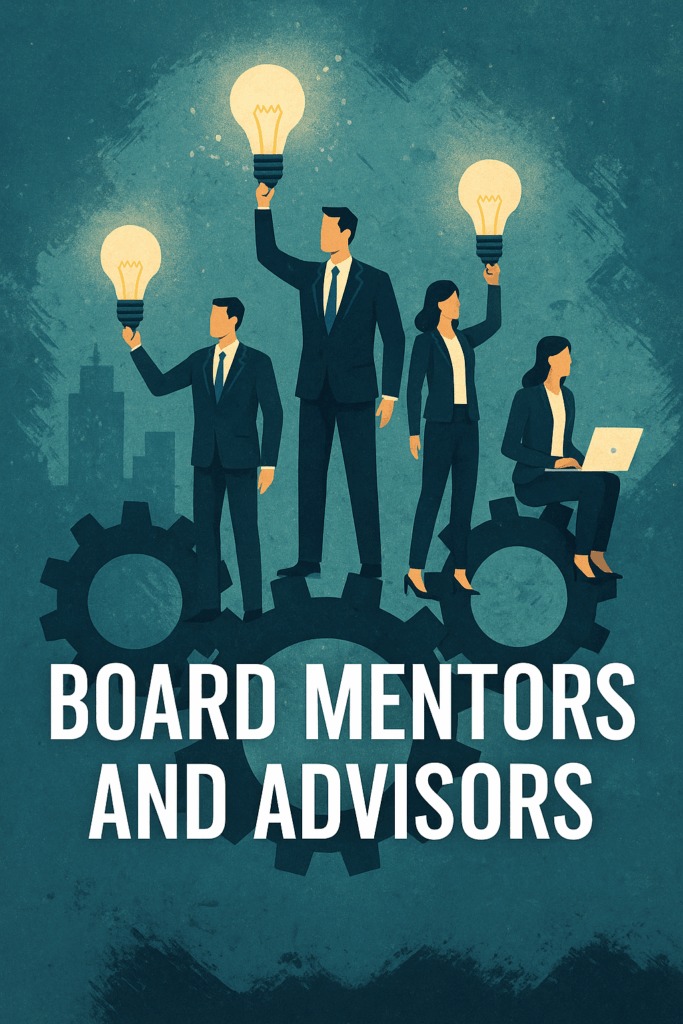
In today’s high-velocity business world, executive leadership is no longer a solo sport. While charisma and competence may open doors, sustainable impact and strategic clarity are shaped in conversation—with those who’ve walked the path before. This is where board mentors and advisors become not just helpful, but indispensable.
The Evolution of Executive Advisory
For decades, boards have focused on governance and oversight. But today, high-performing companies are expanding the role of board-level influence beyond compliance. They’re tapping into a new class of value-add advisors—strategic mentors who combine deep experience with a coach’s perspective.
These aren’t just names on a letterhead. They’re seasoned executives, former founders, industry veterans, and domain specialists who bring a blend of operational wisdom, market foresight, and executive empathy.
Why Mentorship at the Top Still Matters
The higher an executive rises, the lonelier the decisions can become. Board mentors bring something uniquely valuable to the C-suite: psychological safety paired with strategic challenge.
They’re not in the trenches—but they’ve been there.
They don’t micromanage—but they ask questions that pierce through ambiguity.
And most importantly, they help leaders see around corners—anticipating risks, refining vision, and tempering ego with insight.
In fact, research consistently shows that CEOs with active advisory relationships outperform their peers in adaptability, stakeholder communication, and long-term value creation.
Advisors vs. Mentors: Understanding the Distinction
While often used interchangeably, advisors and mentors play distinct roles:
Board Advisors contribute subject matter expertise. They might guide a go-to-market strategy, M&A negotiation, or digital transformation roadmap. Their value lies in knowledge and influence.
Board Mentors invest in the executive’s personal evolution. They challenge assumptions, encourage introspection, and help leaders develop presence, resilience, and long-term strategic clarity.
Both are critical. One helps you build the business. The other helps you grow as a leader worthy of what you’re building.
Building Your Board of Mentors
Whether you’re a founder scaling a Series B startup or a corporate executive pivoting into board roles, the process of building your personal board of mentors should be intentional:
Seek Diversity of Perspective – Find advisors who challenge your thinking, not just validate it. Industry outsiders often bring the most game-changing insights.
Prioritize Chemistry Over Credentials – A great mentor isn’t just impressive on paper—they need to understand your context and speak your leadership language.
Create Structure for Impact – Define engagement rhythms. Quarterly deep dives, monthly strategy check-ins, or real-time calls during inflection points.
Align Values, Not Just Vision – The best mentor relationships are built on shared principles. Vision can evolve. Values sustain alignment.
Boardsi: Where Mentorship Meets Momentum
At Boardsi, we’ve seen firsthand how mentorship accelerates both executive growth and organizational momentum. Our platform matches visionary leaders with curated board advisors and mentors who can elevate both performance and purpose.
More than placement, we facilitate alignment—connecting leaders not just to positions, but to people who unlock their highest potential.
Final Thought: Great Leaders Don’t Go It Alone
Every transformative leader—from Jobs to Sandberg—has stood on the shoulders of giants. Not because they lacked intelligence or ambition, but because they understood the power of perspective.
In an age of complexity, the smartest move a leader can make isn’t to go faster alone—but to go further with guidance.
So, who’s on your board of mentors?
#Leadership, #BoardMentors, #ExecutiveAdvisors, #Mentorship, #StrategicLeadership, #CLevel, #ExecutiveGrowth, #CorporateGovernance, #Boardsi, #LeadershipDevelopment