
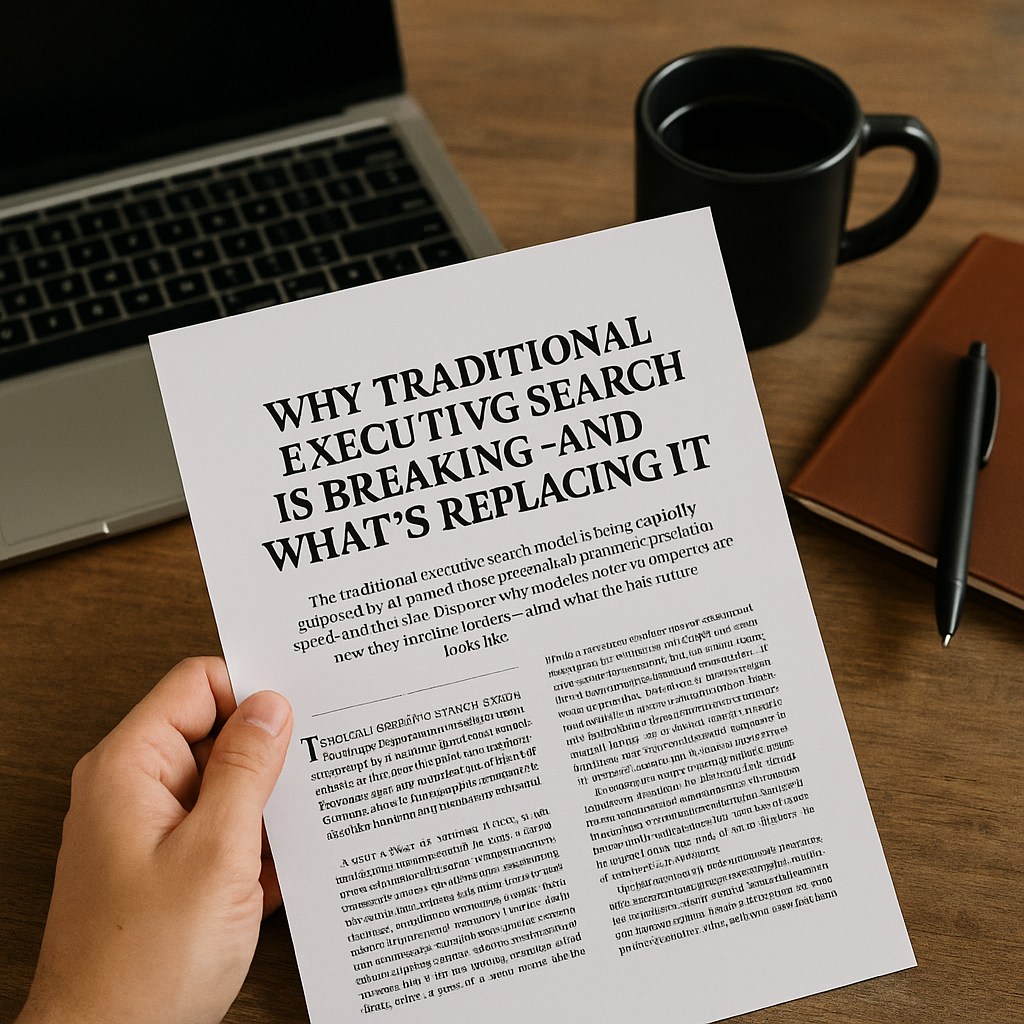
For decades, executive search has operated much like an exclusive club: heavily networked, relationship-driven, and largely opaque. While that model has served some companies well, it’s increasingly failing fast-moving organizations that need more agility, more diversity, and a more strategic view of leadership.
Today, we’re witnessing a decisive shift—one where algorithmic precision, platform thinking, and data-led intelligence are rapidly replacing the slow, linear, analog practices of yesterday’s search firms. In a world where leadership agility is a competitive advantage, the executive search industry is finally being disrupted.
The Old Model: Expensive, Exclusive, and Inefficient
Traditional executive search firms have long operated on retained models, charging six-figure fees and requiring 90 to 120 days (or more) to fill top roles. They rely heavily on partner networks, industry Rolodexes, and qualitative vetting. While thorough, the process is inherently narrow—and biased.
It’s not unusual for clients to see the same 20 candidates recycled across multiple searches. And it’s rare to see genuinely underrepresented candidates surface unless explicitly requested. The reason? Traditional search prioritizes familiarity over fit.
In a global economy defined by innovation, that’s a liability.
The Rise of Tech-Enabled Talent Platforms
Enter a new generation of AI-powered talent platforms that reimagine how companies find and evaluate executive leaders. Rather than starting with “Who do we know?” these platforms begin with “What do we need?”—then use machine learning to identify leaders with precisely the skills, experiences, and leadership traits required for success.
These platforms scan millions of data points across executive résumés, board roles, strategic track records, and even digital presence. They filter candidates based on real-time relevance—such as navigating similar market conditions or scaling businesses at similar inflection points.
The result? A faster, broader, and more inclusive candidate pool. Searches that once took months now take weeks. And leaders who would never have been on the radar in a traditional search rise to the top.
Boardroom Implications
One area seeing rapid adoption of these tools is the boardroom. AI-driven board matching platforms are helping public companies, private equity firms, and growth-stage startups identify directors who can bring operational insight, industry-specific knowledge, or strategic value.
This isn’t just about governance—it’s about growth. The right board leader can open investor doors, de-risk acquisitions, or bring critical geopolitical fluency. These are matches made not by chance or connection, but by design.
What This Means for CEOs and CHROs
If you’re still relying on a traditional search firm for every executive hire, you may be missing out on better talent—and losing time and momentum in the process.
A hybrid approach is emerging. Many leading organizations now combine retained search with data-driven sourcing platforms, internal succession mapping, and leadership analytics tools. They’re treating executive hiring as a strategic capability, not a one-off transaction.
The Bottom Line
Leadership hiring is too important to outsource blindly. As the pace of change accelerates, companies that evolve their search strategies will build more resilient, adaptive, and future-ready teams.
Executive search isn’t dead. But the future belongs to those who search smarter.
#ExecutiveSearch, #LeadershipHiring, #FutureOfWork, #AI, #TalentAcquisition, #BoardRecruitment, #CHRO, #RecruitmentTech, #HRInnovation, #CLevel