In the past, finding the right board member for a company was as much about who you knew as what you knew. Executive recruiters relied on networks, manual vetting, and months-long searches to identify candidates who could navigate complex markets and steer organizations toward growth. Today, artificial intelligence is rewriting those rules — and the result is a faster, smarter, and more strategic approach to building the boardroom.
From Rolodex to Algorithm
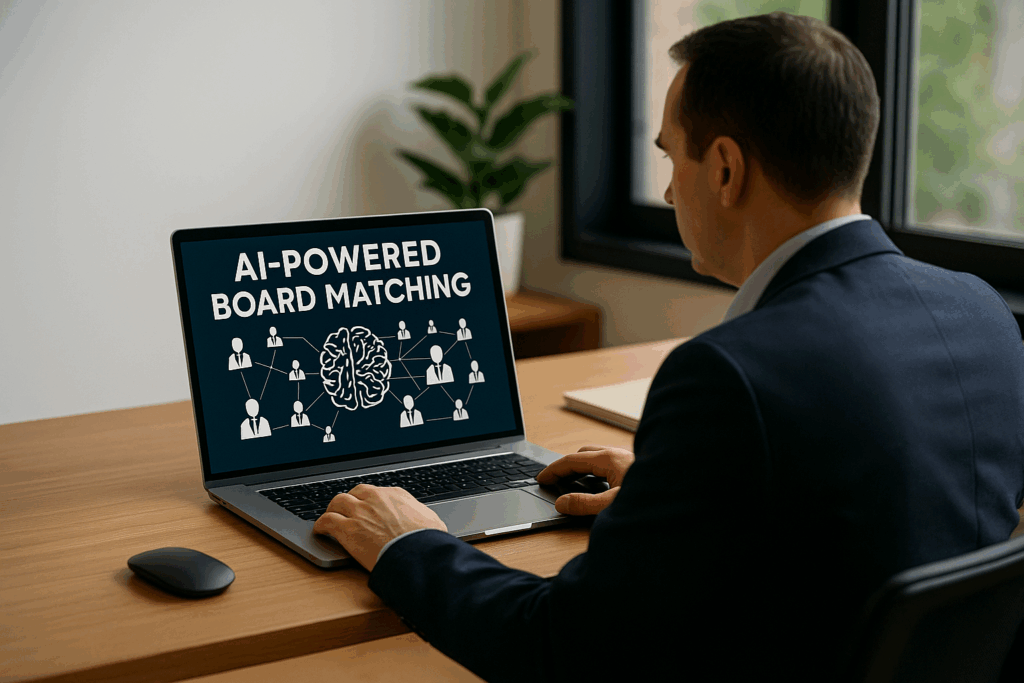
Traditional board searches often resembled high-stakes matchmaking: slow, opaque, and heavily relationship-driven. While personal networks will always matter, they are inherently limited. AI-powered board matching platforms remove those limits by scanning vast pools of executive talent and evaluating each candidate against a company’s unique needs — from industry expertise and financial acumen to diversity goals and cultural fit.
Instead of starting with “Who do we know?”, the process begins with “Who’s the best fit according to the data?”
How AI Transforms the Search
Modern AI-driven platforms leverage machine learning, natural language processing, and predictive analytics to evaluate thousands of data points on both companies and candidates. The technology can:
Analyze Multi-Dimensional Fit: Matching goes beyond résumé keywords to consider leadership style, strategic track record, and sector-specific performance.
Predict Boardroom Dynamics: Algorithms can model how a candidate’s skills and experiences will complement existing directors and management.
Accelerate Time-to-Placement: What once took months can be reduced to weeks — without sacrificing diligence.
Advance Diversity Goals: AI can surface high-caliber candidates from underrepresented backgrounds who might otherwise be overlooked.
Strategic Advantages for Companies
For growth-stage startups, private equity portfolio firms, and public corporations, the benefits are significant. The right AI-powered match can bring in a director who not only checks governance boxes but also actively drives strategic value — opening investor relationships, identifying acquisition targets, or navigating regulatory landscapes.
In fast-moving markets, speed is an advantage. An AI-driven process ensures companies aren’t waiting out a lengthy search while opportunities pass by or competitive threats emerge.
What It Means for Executives
For leaders aspiring to join boards, AI is creating more meritocratic pathways. Instead of relying solely on who’s in your network, your candidacy can be elevated based on skills, experience, and the measurable value you bring. That’s a seismic shift for talented executives who have historically been outside traditional board recruitment circles.
The Future of Board Composition
As AI continues to refine its predictive capabilities, board matching could move from filling current gaps to shaping long-term governance strategy. Imagine algorithms recommending candidates based not only on today’s needs but also on the leadership profile required to succeed in five or ten years.
The companies that adopt AI-powered board matching early will have an edge — building boards that are not just well-qualified, but future-ready. In an era where leadership decisions can make or break a business, that’s an advantage no board can afford to overlook.
#AI, #BoardMatching, #CorporateGovernance, #LeadershipInnovation, #BoardroomStrategy, #ExecutiveLeadership, #PredictiveAnalytics, #BoardDiversity