
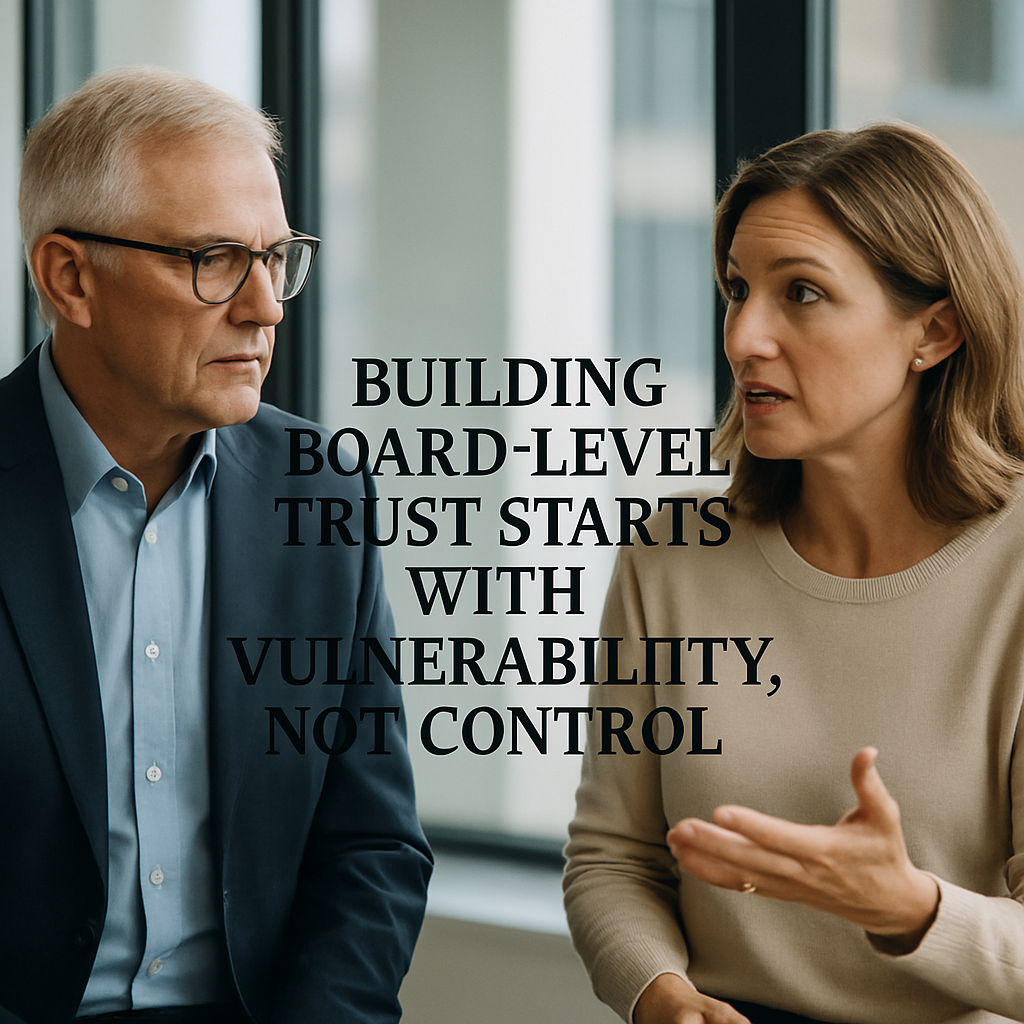
In high-stakes rooms where strategy meets scrutiny, trust isn’t a bonus—it’s the baseline.
In a recent board presentation, the metrics were clean, the recommendations sound. And yet, something vital was missing. The room was polished and professional, but the dialogue stayed surface-level. Behind the formality was a quiet fog: the absence of trust.
It’s a familiar dynamic. Boardrooms often prize expertise, composure, and decisiveness. But in reality, the most critical foundation for effective governance—especially in volatile times—is not control. It’s trust. And building it requires a level of leadership many still resist: vulnerability.
The Misunderstood Nature of Vulnerability
Vulnerability in leadership is not about emotional oversharing or passivity. It’s the willingness to risk being seen—uncertainty, missteps, doubts and all. It’s admitting, “We don’t have all the answers,” before a crisis forces transparency. It’s hearing dissent and allowing it to shape direction, not derail it.
At the board level, where reputations and decisions ripple across entire organizations, vulnerability is a trust accelerator. It signals safety. It builds coherence. It transforms compliance into commitment.
Five Practices that Build Board-Level Trust
Name the hard truths before you’re forced to.
When leaders speak candidly about challenges and unknowns, they reduce defensiveness and increase alignment. Trust is built not by managing perception, but by managing reality with integrity.Create space for debate without retaliation.
Effective boards invite principled dissent. The goal is not uniform agreement—it’s collective intelligence. When dissent is welcomed, trust deepens. When it’s punished, it withers.Honor the governance-execution boundary.
Many breakdowns in board-executive dynamics come from blurred roles. High-trust environments uphold clarity: boards govern; executives lead. Breaching that contract erodes confidence.Acknowledge the emotional currents in the room.
Every boardroom contains emotion—fear, excitement, frustration. Leaders who name and normalize these undercurrents foster psychological safety. Ignoring them creates invisible friction.Practice repair after relational rupture.
Trust isn’t built through perfection; it’s built through repair. When conflict arises—as it will—leaders who revisit conversations, clarify intent, and make amends signal maturity and credibility.
Why This Matters Now
In a climate of rapid disruption, organizations need more than adaptive strategy—they need adaptive leadership. The days of the untouchable, infallible board are over. What companies need are boards that are as aligned as they are accountable, as relationally intelligent as they are financially astute.
Boards that cultivate trust don’t just function better—they govern more bravely. They make decisions faster. They navigate crises with less drama. And they create cultures where transparency and performance coexist.
The Future of Governance Is Human
The corporate world often speaks of “getting a seat at the table.” But without trust, the table itself is unstable. Trust is the structure. It’s the architecture that supports everything from fiscal oversight to cultural integrity.
And the leaders who build that trust? They’re not the loudest, the most credentialed, or the most controlling. They’re the ones willing to go first—to name what’s hard, to receive what’s real, and to model what’s human.
That’s what earns influence in the boardroom now—not just presence, but presence with courage.
#Leadership, #BoardGovernance, #TrustInLeadership, #ExecutivePresence, #CorporateCulture, #Vulnerability, #StrategicLeadership, #PsychologicalSafety, #CourageToLead