
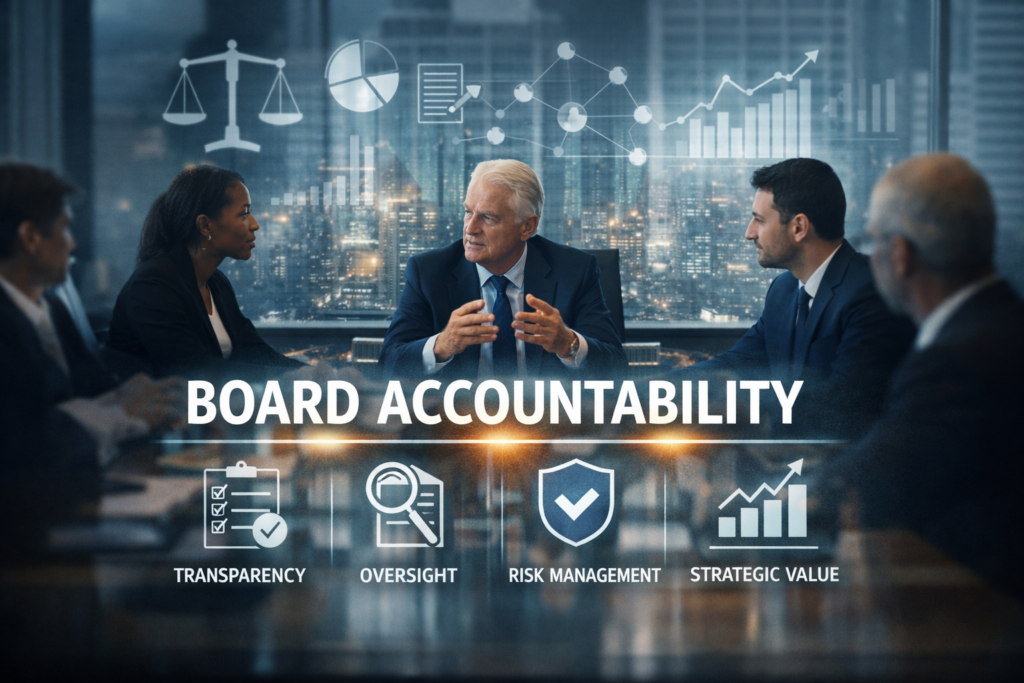
Board Accountability Insights: Strengthening Governance in the Modern Boardroom
Corporate boards today face unprecedented expectations. Investors, regulators, employees, and the public are demanding greater transparency, stronger governance, and measurable accountability from directors.
As organizations navigate digital disruption, ESG pressures, cybersecurity risks, and global economic uncertainty, boardrooms must evolve beyond traditional oversight models.
The most effective boards are embracing board accountability insights—data-driven perspectives and governance practices that enhance transparency, decision-making, and strategic stewardship.
Accountability in the boardroom is no longer optional. It is a defining factor in organizational resilience and long-term enterprise value.
The Growing Importance of Board Accountability
Historically, boards focused primarily on financial oversight and executive succession. While those responsibilities remain critical, modern governance requires far more comprehensive accountability.
Today’s boards must oversee:
Strategic direction and long-term value creation
Enterprise risk management
Cybersecurity and digital transformation
ESG and sustainability reporting
Corporate culture and ethics
Leadership development and succession planning
These responsibilities require directors to move beyond passive governance and toward active, informed oversight.
Board accountability insights allow directors to evaluate performance, identify governance gaps, and ensure that decisions align with the organization’s long-term mission.
What Are Board Accountability Insights?
Board accountability insights refer to the structured information, governance metrics, and strategic perspectives that enable boards to evaluate their effectiveness and fulfill fiduciary responsibilities.
These insights typically include:
Governance performance data
Boards increasingly rely on governance assessments and board evaluations to understand how effectively they operate.
Risk oversight visibility
Directors must maintain clear visibility into emerging risks including cybersecurity, regulatory shifts, and geopolitical uncertainty.
Strategic alignment analysis
Boards must confirm that leadership initiatives align with long-term organizational strategy and stakeholder expectations.
Committee effectiveness
Audit, compensation, and governance committees must operate with clear accountability and measurable outcomes.
Stakeholder impact reporting
Investors and stakeholders expect transparency regarding environmental, social, and governance initiatives.
Together, these elements create a framework for stronger governance and informed boardroom decision-making.
Key Areas Where Board Accountability Matters Most
Modern boards generate the most value when accountability is embedded into five critical governance areas.
Strategic Oversight
Directors must ensure that leadership teams are focused on sustainable long-term growth rather than short-term performance.
Effective boards ask:
Are strategic priorities aligned with market realities?
Is the company positioned for technological disruption?
Are capital allocation decisions supporting future growth?
Board accountability insights help directors maintain this strategic perspective.
Risk and Compliance Oversight
Organizations face a growing list of enterprise risks including cyber threats, regulatory compliance challenges, and operational vulnerabilities.
Boards must ensure that:
Risk frameworks are actively monitored
Compliance programs are robust
Management communicates emerging threats quickly
Accountability ensures risks are addressed proactively rather than reactively.
ESG and Sustainability Governance
Environmental, social, and governance considerations have become central to boardroom accountability.
Institutional investors increasingly evaluate companies based on:
Environmental impact
Workforce policies
Supply chain ethics
Board diversity and governance standards
Boards that embrace ESG accountability insights are better positioned to build long-term trust with stakeholders.
CEO and Leadership Oversight
One of the board’s most important responsibilities is evaluating executive leadership.
Accountable boards ensure:
CEO performance is measured objectively
Leadership succession plans are in place
Executive compensation aligns with long-term value creation
Transparent leadership oversight strengthens organizational credibility.
Board Effectiveness and Self-Governance
Strong boards evaluate their own performance regularly.
Best practices include:
Annual board performance assessments
Skills matrix analysis to identify capability gaps
Ongoing governance education for directors
Accountability begins with the board itself.
How Technology Is Improving Board Accountability
Technology is playing an increasingly important role in modern governance.
Digital governance platforms now allow boards to track:
Risk dashboards
ESG metrics
Compliance reporting
Strategic performance indicators
These tools generate actionable board accountability insights that help directors make faster and more informed decisions.
Technology also improves transparency and documentation, which strengthens governance integrity.
The Role of Independent Directors in Accountability
Independent directors are essential for maintaining objective governance.
They provide:
Independent oversight of management decisions
External industry expertise
Diverse strategic perspectives
Unbiased risk assessment
Organizations that recruit independent directors with strong governance backgrounds often achieve higher levels of board accountability and performance.
Platforms like Boardsi help companies connect with experienced executives who bring the strategic insight and governance expertise required in today’s boardrooms.
Building a Culture of Accountability in the Boardroom
Accountability is not created through policy alone. It requires a culture that encourages transparency, open dialogue, and continuous improvement.
High-performing boards demonstrate several key behaviors:
Directors challenge assumptions respectfully
Data informs board discussions
Diverse perspectives are welcomed
Governance education remains ongoing
Strategic discussions dominate agendas rather than operational details
These cultural elements transform accountability from compliance into leadership.
Why Board Accountability Drives Enterprise Value
Organizations with accountable boards consistently outperform their peers.
Research shows that strong governance leads to:
Better risk management
Greater investor confidence
Stronger strategic execution
Improved organizational resilience
Ultimately, board accountability insights enable directors to protect enterprise value while guiding companies toward sustainable growth.
How Boardsi Supports Accountable Governance
Boardsi connects organizations with highly qualified executives ready to contribute at the governance level.
Through strategic board matching and access to experienced leadership talent, Boardsi helps companies strengthen:
Strategic oversight
Governance diversity
Industry expertise
Boardroom perspective
Executives who join boards through Boardsi bring fresh insights, specialized knowledge, and accountability-focused leadership to modern governance.
Final Thoughts
The expectations placed on corporate boards will only continue to grow.
Directors must operate with clarity, discipline, and transparency while guiding organizations through an increasingly complex global environment.
By leveraging board accountability insights, boards can improve oversight, strengthen governance, and ensure that organizations remain resilient and strategically aligned.
In today’s boardroom, accountability is not simply a governance requirement.
It is a leadership responsibility.
#BoardAccountabilityInsights, #CorporateGovernance, #BoardLeadership, #BoardOfDirectors, #GovernanceStrategy, #BoardOversight, #ExecutiveLeadership, #ESGGovernance, #StrategicLeadership, #BoardEffectiveness