
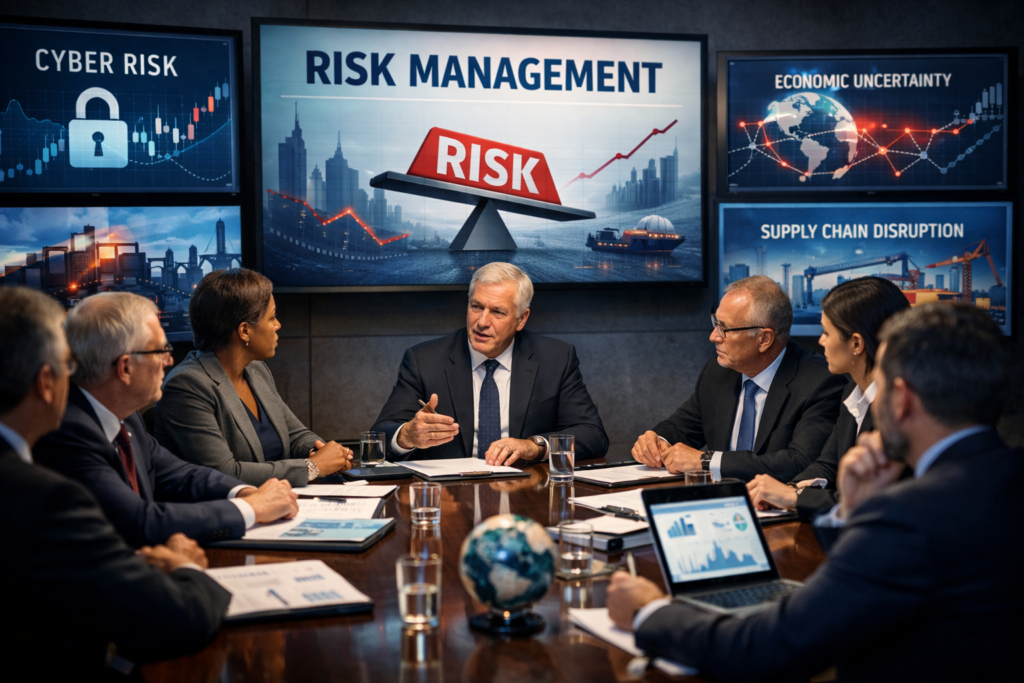
In today’s business environment, risk is no longer a line item on an agenda. It is the agenda.
From cybersecurity threats to geopolitical instability, from regulatory scrutiny to rapid technological disruption, the modern boardroom sits at the intersection of uncertainty and accountability. And yet, the organizations that navigate these pressures most effectively are not the ones avoiding risk—they are the ones reframing it.
The question is no longer, How do we minimize risk?
It is, How do we govern it intelligently?
The Shift From Oversight to Ownership
Traditionally, boards approached risk as a compliance exercise. Review the reports. Ask a few questions. Ensure controls are in place. Move on.
That model is no longer sufficient.
Today’s high-performing boards recognize that risk management is not a periodic review—it is a continuous leadership discipline. Directors are expected to move beyond passive oversight and into active ownership of risk conversations.
This requires a fundamental mindset shift.
Management identifies and executes.
Boards challenge, contextualize, and anticipate.
The most effective directors do not simply ask, “Are we protected?”
They ask, “Are we prepared?”
Risk as a Strategic Lever, Not a Constraint
One of the most overlooked truths in governance is that risk and strategy are inseparable.
Every strategic decision carries embedded risk. Entering a new market. Adopting emerging technologies. Restructuring operations. These are not just growth initiatives—they are calculated bets.
Boards that treat risk as a constraint often slow organizations down. Boards that treat risk as a strategic lever enable smarter, faster decision-making.
This is where boardroom leadership becomes decisive.
Great directors help management answer questions like:
What risks are we willing to take to achieve our strategy?
Which risks are we unintentionally ignoring?
Where does our risk tolerance no longer align with our ambition?
Risk management, at its highest level, is not about avoidance. It is about alignment.
The New Risk Landscape Requires New Competencies
The complexity of modern risk has outpaced the traditional composition of many boards.
Financial literacy is no longer enough.
Today’s boardrooms require fluency in areas such as:
Cybersecurity and data privacy
Digital transformation and AI risk
ESG and reputational exposure
Global regulatory environments
Supply chain resilience
This does not mean every director must be an expert in every domain. It means the board, collectively, must possess the capability to ask informed, forward-looking questions.
Because in governance, the quality of oversight is directly tied to the quality of inquiry.
Culture: The Hidden Driver of Risk
While frameworks and dashboards matter, the most significant risk factor in any organization is cultural.
A company can have robust controls and still fail if its culture discourages transparency, suppresses dissent, or rewards short-term gains over long-term integrity.
Boards that excel in risk management understand this.
They look beyond metrics and examine behaviors:
Do leaders surface problems early, or conceal them?
Is accountability consistent, or selective?
Are incentives aligned with sustainable performance?
In many cases, the greatest risk is not what is visible on a report—it is what never gets reported at all.
From Reporting to Dialogue
Too many boardrooms still rely on static risk reports that summarize what has already happened.
But effective governance is not retrospective. It is anticipatory.
Leading boards are transforming risk discussions from presentations into dialogue. They are creating space for scenario planning, stress testing, and strategic debate.
Instead of asking, “What went wrong?”
They ask, “What could go wrong next—and are we ready?”
This shift turns risk management from a compliance exercise into a strategic advantage.
The Courage to Challenge
At its core, boardroom risk management is not about processes. It is about people.
It requires directors who are willing to:
Challenge assumptions without undermining management
Ask difficult questions without creating defensiveness
Hold long-term value above short-term comfort
This balance is not easy. It demands independence, judgment, and what Brené Brown would call the courage to stay “in the arena”—to engage fully, even when the answers are unclear.
Because the role of a director is not to eliminate uncertainty.
It is to lead through it.
A Final Thought: Risk Is Where Leadership Reveals Itself
John Maxwell famously wrote that leadership develops daily, not in a day .
The same is true of risk management.
It is not defined by how an organization performs when conditions are stable. It is revealed in moments of pressure, ambiguity, and disruption.
Boards that treat risk as a static function will always be reactive.
Boards that treat it as a leadership discipline will shape outcomes before they unfold.
In the end, effective governance is not about controlling the future.
It is about preparing leaders to meet it with clarity, confidence, and conviction.
#BoardLeadership, #RiskManagement, #CorporateGovernance, #ExecutiveLeadership, #BoardroomStrategy, #EnterpriseRisk, #LeadershipDevelopment, #Governance, #StrategicLeadership, #BoardEffectiveness