
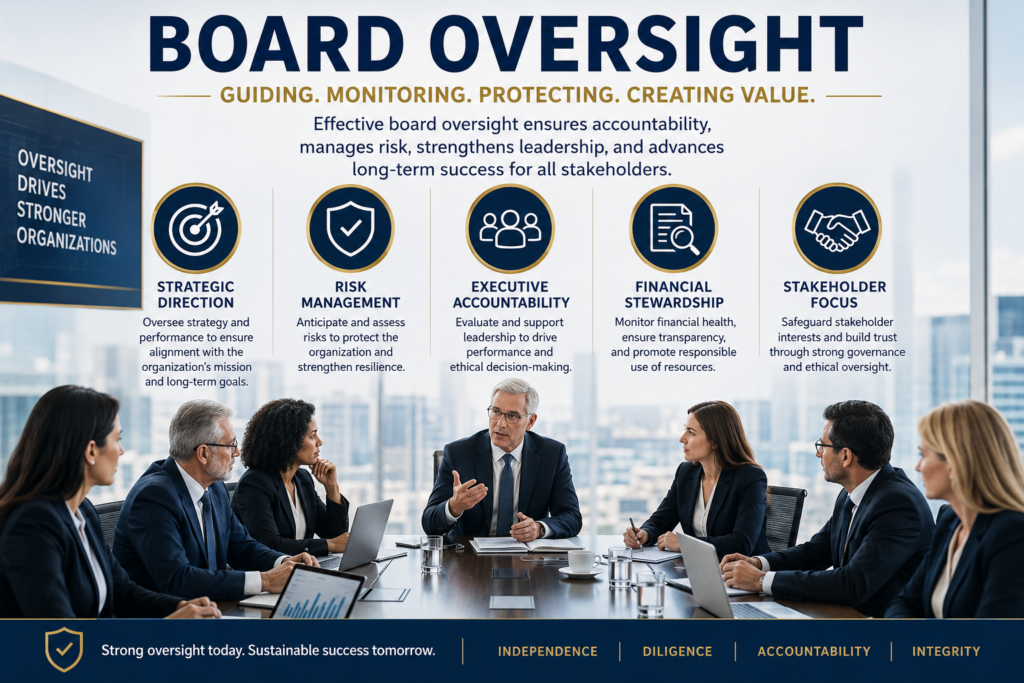
In today’s increasingly complex business environment, board oversight has become one of the most critical responsibilities of corporate governance. Once viewed primarily as a compliance function, effective board oversight now plays a central role in risk management, strategic decision-making, executive accountability, and long-term value creation.
Organizations face mounting challenges ranging from cybersecurity threats and regulatory changes to economic uncertainty and stakeholder expectations. As a result, boards of directors are being called upon to provide stronger guidance, deeper insights, and more proactive oversight than ever before.
The question is no longer whether board oversight matters. The question is whether boards are equipped to perform it effectively.
What Is Board Oversight?
Board oversight refers to the responsibility of a board of directors to monitor, guide, and evaluate an organization’s activities, leadership, risks, and strategic direction. While executives manage the day-to-day operations of a company, the board provides independent oversight to ensure decisions align with the organization’s mission, objectives, and fiduciary responsibilities.
Effective board oversight includes:
- Strategic planning and execution
- Financial performance monitoring
- Risk management oversight
- Executive leadership evaluation
- Regulatory and compliance supervision
- Governance and ethical accountability
- Stakeholder value protection
Strong oversight creates a system of checks and balances that helps organizations remain accountable, resilient, and focused on sustainable growth.
Why Board Oversight Is More Important Than Ever
Modern organizations operate in an environment defined by rapid change. Technological disruption, evolving regulations, environmental concerns, and shifting workforce expectations require leadership teams to make decisions faster than ever.
Without effective board oversight, organizations risk becoming reactive rather than strategic.
Strong boards help organizations:
Identify Emerging Risks
Board members bring diverse perspectives and experiences that allow them to identify risks executives may overlook. Whether addressing cybersecurity vulnerabilities, reputational concerns, or market disruptions, proactive oversight enables organizations to prepare before challenges become crises.
Strengthen Leadership Accountability
One of the primary functions of board oversight is ensuring executive leadership remains accountable to organizational goals and stakeholder interests.
Effective boards ask difficult questions, evaluate performance objectively, and ensure leadership decisions support long-term value creation rather than short-term gains.
Improve Strategic Decision-Making
High-performing boards contribute valuable expertise that enhances strategic planning. Through constructive dialogue and independent evaluation, boards help leadership teams assess opportunities, challenge assumptions, and make better-informed decisions.
Build Investor and Stakeholder Confidence
Investors, customers, employees, and regulators increasingly evaluate organizations based on governance practices.
Strong board oversight signals that an organization is committed to transparency, accountability, and responsible leadership. This confidence can strengthen reputation, attract investment, and support sustainable growth.
The Key Components of Effective Board Oversight
Not all oversight is created equal. Effective board oversight requires more than reviewing reports and attending quarterly meetings.
The most successful boards focus on several critical areas.
Strategic Oversight
Boards must ensure the organization’s strategy aligns with its mission, market realities, and long-term objectives.
This involves:
- Reviewing strategic initiatives
- Monitoring organizational performance
- Evaluating growth opportunities
- Assessing competitive positioning
trategic oversight allows boards to guide leadership without interfering in operational management.
Financial Oversight
Financial stewardship remains a cornerstone of board responsibility.
Boards should regularly review:
- Financial statements
- Budget performance
- Revenue trends
- Capital allocation decisions
- Audit findings
Strong financial oversight helps protect organizational assets while supporting responsible growth.
Risk Oversight
Risk management has evolved into one of the most important aspects of board governance.
Today’s boards must oversee:
- Cybersecurity risks
- Regulatory compliance
- Operational vulnerabilities
- Supply chain disruptions
- Reputation management
- ESG-related risks
Organizations that embed risk oversight into board discussions are often better positioned to navigate uncertainty.
Executive Performance Oversight
Boards are responsible for evaluating executive leadership performance and succession planning.
This includes:
- CEO evaluations
- Leadership development
- Succession readiness
- Executive compensation alignment
Strong oversight ensures leadership remains accountable while preparing the organization for future transitions.
Common Challenges in Board Oversight
Despite its importance, many boards struggle to provide effective oversight.
Common obstacles include:
Information Overload
Board members often receive large volumes of data without sufficient context. Effective oversight requires meaningful insights rather than excessive reporting.
Lack of Diverse Expertise
Modern challenges require expertise in technology, cybersecurity, finance, human capital, governance, and strategy. Boards lacking diverse professional backgrounds may struggle to evaluate complex issues effectively.
Insufficient Independence
Oversight becomes less effective when boards fail to maintain independence from executive leadership. Healthy governance requires constructive challenge and objective evaluation.
Reactive Governance
Many boards focus on reviewing past performance instead of anticipating future risks and opportunities. Forward-looking oversight is essential in today’s business landscape.
Building a Stronger Board Through Diverse Leadership
One of the most effective ways to strengthen board oversight is by expanding the diversity of perspectives represented in the boardroom.
Organizations benefit from directors who bring expertise across industries, disciplines, and leadership experiences. Boards that include executives, entrepreneurs, technology leaders, financial experts, and governance professionals often make more informed decisions and identify risks more effectively.
Platforms like Boardsi help organizations connect with highly qualified board candidates who can contribute valuable oversight, strategic guidance, and leadership expertise.
By broadening board composition, organizations can improve governance while enhancing their ability to address emerging challenges.
The Future of Board Oversight
The role of the board will continue to evolve as organizations face increasing complexity and stakeholder scrutiny.
Future-focused boards will place greater emphasis on:
- Digital transformation oversight
- Artificial intelligence governance
- Cybersecurity resilience
- ESG accountability
- Workforce and culture oversight
- Stakeholder trust and transparency
Board oversight is no longer limited to reviewing financial performance. It has become a strategic leadership function that influences every aspect of organizational success.
Final Thoughts
Effective board oversight serves as the foundation of strong governance and sustainable organizational performance.
The most successful boards do more than monitor compliance. They provide strategic guidance, strengthen accountability, manage risk, and help organizations navigate uncertainty with confidence.
As business challenges become more complex, organizations that prioritize strong board oversight will be better positioned to protect stakeholder interests, build trust, and create long-term value.
In the modern business landscape, effective oversight is not simply a governance responsibility. It is a competitive advantage.
#BoardOversight, #CorporateGovernance, #BoardOfDirectors, #BoardLeadership, #Governance, #ExecutiveLeadership, #RiskManagement, #BoardGovernance, #Leadership, #BusinessStrategy, #OrganizationalLeadership, #ExecutiveAccountability, #BoardEffectiveness, #StakeholderTrust, #GovernanceFrameworks, #LeadershipDevelopment, #BusinessGrowth, #CorporateLeadership, #Boardsi, #StrategicLeadership