
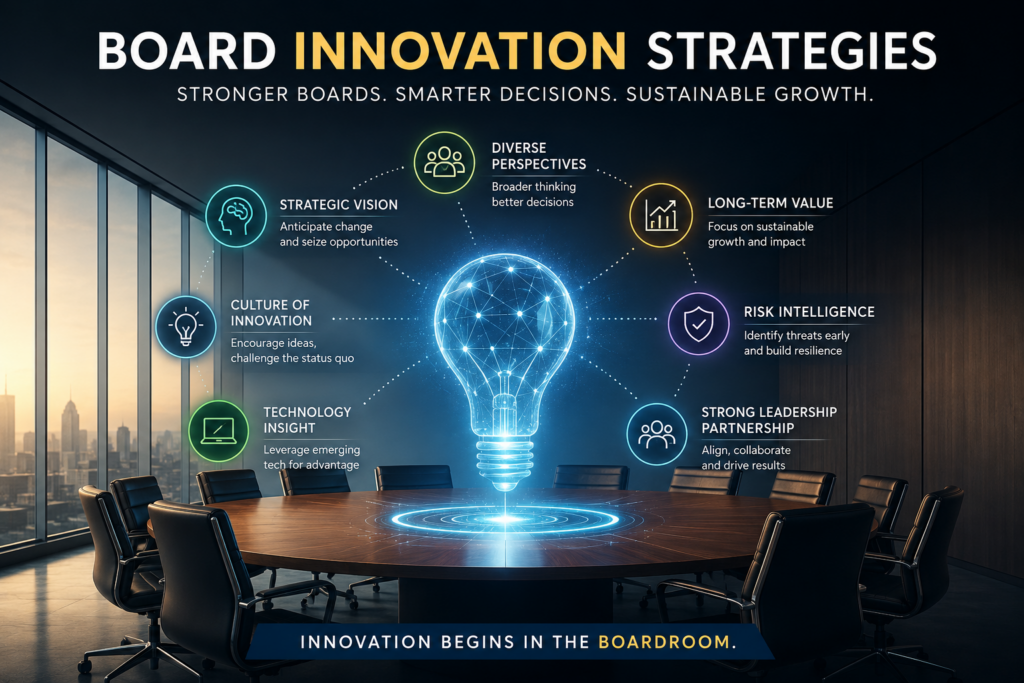
Innovation has long been associated with product development, technology, and entrepreneurship.
Yet one of the most overlooked drivers of innovation exists where many organizations make their most important decisions: the boardroom.
As markets become increasingly competitive and disruption accelerates across nearly every industry, organizations can no longer rely solely on executive leadership to identify emerging opportunities. Boards of directors have become strategic partners responsible for helping organizations anticipate change, challenge assumptions, and guide long-term growth.
This shift has elevated the importance of board innovation strategies.
Organizations that intentionally develop innovative boards position themselves to respond faster to market disruption, improve governance, strengthen strategic planning, and create lasting competitive advantages.
What Are Board Innovation Strategies?
Board innovation strategies are intentional approaches that help boards improve decision-making, governance, strategic oversight, and organizational growth through fresh thinking, diverse expertise, and continuous adaptation.
Innovation at the board level extends far beyond adopting new technology.
It includes rethinking how boards:
- Evaluate risk
- Support executive leadership
- Plan for future markets
- Recruit directors
- Improve governance
- Encourage strategic discussions
- Measure long-term success
Rather than simply reviewing historical performance, innovative boards spend significant time preparing organizations for the future.
Why Board Innovation Strategies Matter
Business environments are evolving faster than ever.
Artificial intelligence, cybersecurity, digital transformation, workforce changes, shifting consumer behavior, global competition, and economic uncertainty continue reshaping industries.
Organizations governed by traditional, reactive boards often struggle to keep pace.
Boards that embrace innovation are better equipped to:
- Identify emerging opportunities
- Strengthen organizational resilience
- Improve strategic decision-making
- Support executive leadership
- Increase investor confidence
- Enhance governance
- Foster sustainable growth
Innovation is no longer optional.
It has become an essential responsibility of modern boards.
Shift From Oversight to Strategic Leadership
Historically, boards primarily focused on compliance, financial oversight, and governance.
While those responsibilities remain essential, today’s highest-performing boards contribute much more.
Modern boards actively participate in discussions involving:
- Market expansion
- Innovation initiatives
- Emerging technologies
- Competitive positioning
- Leadership succession
- Talent development
- Organizational culture
This strategic involvement allows companies to identify opportunities before competitors recognize them.
Build a Diverse Board
Innovation thrives when multiple perspectives are represented.
One of the most effective board innovation strategies is intentionally building diverse boards with directors who bring different experiences, industries, backgrounds, and expertise.
Diversity extends beyond demographics.
Strong boards benefit from diversity in:
- Professional experience
- Industry knowledge
- Functional expertise
- International markets
- Technology
- Finance
- Marketing
- Operations
- Entrepreneurship
When directors approach challenges from different perspectives, discussions become more thoughtful, balanced, and innovative.
Better conversations lead to better decisions.
Encourage Constructive Challenge
Healthy disagreement strengthens governance.
Innovative boards avoid environments where every member quickly agrees with management or fellow directors.
Instead, they encourage respectful debate.
Effective boards regularly ask:
- What assumptions are we making?
- What risks have we overlooked?
- What opportunities are emerging?
- What could disrupt our industry?
- How would a startup approach this challenge?
Constructive questioning improves strategic thinking while reducing blind spots.
The strongest boards challenge ideas—not people.
Make Innovation a Standing Agenda Item
Innovation should not appear only during annual strategic planning sessions.
Forward-thinking boards make innovation part of every meeting.
Agenda topics may include:
- Technology trends
- Customer expectations
- Competitive intelligence
- AI adoption
- Cybersecurity developments
- Regulatory changes
- Market disruption
- New revenue opportunities
Consistent discussions help boards remain proactive instead of reactive.
Strengthen Digital Expertise
Technology now influences every organization regardless of industry.
Boards lacking digital expertise may struggle to evaluate opportunities and risks effectively.
One of today’s most valuable board innovation strategies involves recruiting directors with experience in:
- Artificial intelligence
- Cybersecurity
- Data analytics
- Cloud computing
- Digital transformation
- Information security
- Software development
Technology experts help boards ask better questions while supporting informed strategic decisions.
Focus on Long-Term Value Creation
Innovative boards balance short-term performance with long-term sustainability.
While quarterly financial results remain important, effective boards also evaluate:
- Leadership development
- Employee engagement
- Innovation pipelines
- Customer loyalty
- Brand reputation
- ESG initiatives
- Operational resilience
- Strategic investments
Organizations that prioritize long-term value often outperform those focused solely on short-term financial metrics.
Invest in Continuous Board Education
Industries evolve rapidly.
Board members should evolve with them.
Continuous education allows directors to remain informed about changing markets, governance practices, and emerging technologies.
Leading organizations encourage directors to participate in:
- Governance conferences
- Executive education
- Industry forums
- Cybersecurity briefings
- AI workshops
- Regulatory updates
- Leadership development programs
Lifelong learning strengthens board effectiveness.
Improve Board Evaluations
Innovation requires continuous improvement.
Annual board evaluations provide valuable insight into governance effectiveness.
Assessments should examine:
- Meeting quality
- Strategic contributions
- Director engagement
- Committee effectiveness
- Diversity of perspectives
- Decision-making processes
- Leadership succession planning
Boards committed to self-improvement consistently deliver greater organizational value.
Strengthen Executive Partnerships
Successful innovation depends on collaboration between boards and executive leadership.
Boards should challenge management while remaining trusted strategic advisors.
Strong partnerships encourage:
- Honest communication
- Early identification of risks
- Faster decision-making
- Better resource allocation
- Greater organizational alignment
When boards and executives operate as strategic partners, innovation accelerates.
Use Data to Improve Decisions
Modern governance increasingly depends on quality data.
Board innovation strategies should include improved access to meaningful business intelligence.
Boards benefit from dashboards measuring:
- Financial performance
- Customer satisfaction
- Market trends
- Operational efficiency
- Employee engagement
- Innovation investments
- Risk exposure
- Competitive positioning
Data-informed governance reduces uncertainty while supporting stronger decisions.
Develop Future Board Leadership
Innovation requires succession planning.
Organizations should continuously identify future board leaders capable of navigating increasingly complex business environments.
Future-focused boards intentionally recruit directors with expertise in:
- Emerging technologies
- Global business
- Strategic growth
- Innovation management
- Risk oversight
- Organizational transformation
Succession planning ensures continuity while introducing fresh perspectives.
Common Obstacles to Board Innovation
Despite good intentions, many organizations struggle to modernize board governance.
Common barriers include:
- Resistance to change
- Lack of board diversity
- Outdated governance practices
- Limited technology expertise
- Ineffective meeting structures
- Short-term thinking
- Weak strategic discussions
Recognizing these obstacles is the first step toward overcoming them.
Measuring the Success of Board Innovation Strategies
Innovation should produce measurable outcomes.
Organizations often evaluate board effectiveness using metrics such as:
- Revenue growth
- Strategic initiative success
- Executive performance
- Innovation adoption
- Market expansion
- Customer retention
- Risk management outcomes
- Board engagement
- Governance improvements
Regular measurement helps boards refine their approach while supporting continuous improvement.
The Future of Board Innovation
The role of directors will continue evolving.
Tomorrow’s boards must guide organizations through:
- Artificial intelligence integration
- Digital transformation
- Cybersecurity threats
- Workforce evolution
- Global competition
- Economic uncertainty
- Sustainability initiatives
- Regulatory complexity
Boards that embrace innovation today will be significantly better prepared for tomorrow’s challenges.
Organizations that wait may find themselves reacting while competitors lead.
Final Thoughts
Strong governance has always mattered.
Today, however, governance alone is no longer enough.
Organizations need boards that think strategically, embrace innovation, encourage diverse perspectives, and prepare companies for an uncertain future.
Effective board innovation strategies help organizations strengthen leadership, improve governance, identify emerging opportunities, and create sustainable long-term growth.
The companies that thrive over the next decade will not necessarily be the largest or the oldest.
They will be the ones guided by boards willing to challenge conventional thinking, embrace continuous learning, and lead with vision.
Innovation begins in the boardroom.
Call to Action
At Boardsi, we connect organizations with accomplished executives, industry experts, and experienced board members who bring fresh perspectives, strategic insight, and innovative leadership to boardrooms across a wide range of industries. Whether you’re building your first advisory board or strengthening an existing board of directors, Boardsi helps companies find the leadership talent needed to drive innovation, improve governance, and accelerate long-term business growth.
#BoardInnovation, #BoardInnovationStrategies, #BoardOfDirectors, #CorporateGovernance, #AdvisoryBoard, #BusinessGrowth, #BusinessStrategy, #Leadership, #ExecutiveLeadership, #Innovation, #BoardLeadership, #StrategicPlanning, #Governance, #DigitalTransformation, #BusinessInnovation, #LeadershipDevelopment, #Boardsi