
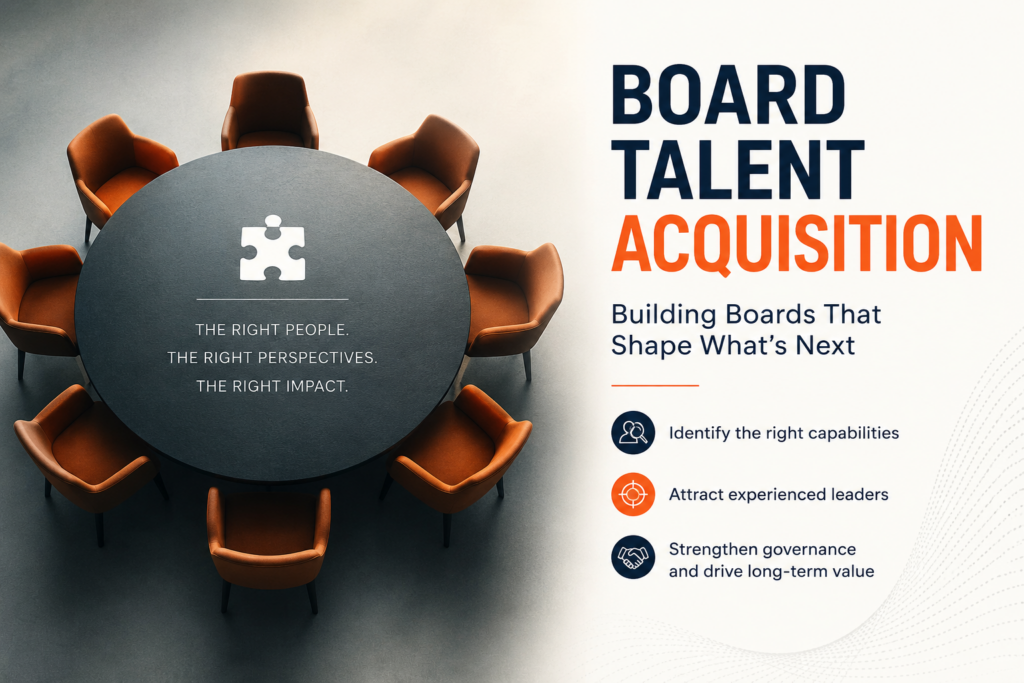
A company can have the right strategy, the right market opportunity, and the right executive team and still find itself limited by one critical factor: the people sitting around the boardroom table.
Boards influence some of the most consequential decisions an organization makes. They help evaluate strategy, oversee risk, advise executive leadership, assess major investments, navigate transformation, and prepare the organization for what comes next.
That makes board talent acquisition more than a recruiting exercise.
It is a strategic leadership decision.
As businesses confront artificial intelligence, cybersecurity threats, shifting capital markets, regulatory complexity, changing workforce expectations, and increasingly global competition, organizations need board members whose experience aligns not only with today’s challenges but also with tomorrow’s opportunities.
The question is no longer simply, “Who should join our board?”
A better question is:
What capabilities does our organization need around the table to succeed in its next chapter?
What Is Board Talent Acquisition?
Board talent acquisition is the process of identifying, evaluating, attracting, and engaging qualified executives and professionals for board of directors and advisory board positions.
Depending on the organization, this may include recruiting
candidates for:
- Corporate boards
- Private company boards
- Advisory boards
- Startup boards
- Private equity portfolio company boards
- Growth stage companies
- Nonprofit boards
- Industry advisory councils
Although board recruiting shares some characteristics with executive recruiting, the two should not be treated as identical.
Executive hiring generally focuses on finding someone capable of operating within the organization.
Board talent acquisition focuses on finding people capable of strengthening the organization’s governance, strategic thinking, oversight, and leadership perspective.
The distinction matters.
A successful executive may possess an impressive résumé without necessarily being the right director for a particular organization. Effective board recruitment requires matching an individual’s capabilities with the specific strategic needs of the company.
Why Board Talent Acquisition Has Become More Important
The responsibilities facing modern boards continue to expand.
Traditional board competencies such as finance, governance, strategy, operations, and executive leadership remain important. But many organizations now need additional expertise around issues that were far less prominent a decade ago.
Boards may need deeper understanding of:
- Artificial intelligence
- Cybersecurity
- Digital transformation
- Data privacy
- International expansion
- Regulatory change
- Human capital strategy
- Mergers and acquisitions
- Capital markets
- Organizational culture
- Succession planning
- Emerging technologies
No single director will possess expertise in every area.
That is precisely why board composition matters.
A strong board should function as a collection of complementary capabilities rather than a collection of impressive biographies.
The objective of board talent acquisition is therefore not simply to recruit accomplished people. It is to assemble the combination of judgment, experience, perspective, and expertise the organization needs.
Start With the Company’s Strategic Needs
One of the most common mistakes in board recruitment is beginning with candidates instead of capabilities.
An organization hears about a respected CEO, investor, entrepreneur, or industry leader and immediately begins considering that individual for a board position.
A stronger process begins somewhere else.
Start with strategy.
Where is the organization going during the next three to five years?
What could prevent it from getting there?
What expertise is currently missing from the board?
Consider a company preparing for international expansion. An executive who has successfully entered multiple international markets could bring tremendous value.
A business undergoing digital transformation might benefit from a director with technology and transformation experience.
A rapidly scaling startup might need someone who has built executive teams, raised institutional capital, established governance structures, or guided a company through significant growth.
The strategic destination should help determine the boardroom capabilities required for the journey.
Build a Board Skills Matrix
Once an organization understands its strategic priorities, it can evaluate the capabilities already represented on the board.
A board skills matrix can help identify strengths and gaps across areas
such as:
- Industry knowledge
- Financial expertise
- Technology
- Operations
- Governance
- Risk management
- Human capital
- M&A
- International business
- Sales and marketing
- Capital raising
- Regulatory experience
- Entrepreneurship
- Executive leadership
This process can reveal an important distinction between having experience represented and having enough of the right experience for future priorities.
For example, a board may have extensive financial and operational expertise but limited exposure to cybersecurity or artificial intelligence.
That does not mean existing directors are ineffective.
It means the organization’s needs are evolving.
Board composition should evolve with them.
Look Beyond Titles
Titles provide useful context, but they should not become shortcuts for evaluating board talent.
A former CEO may bring valuable enterprise leadership experience. A CFO may contribute financial sophistication. A technology executive may offer digital expertise.
But the title alone does not reveal how someone thinks.
Effective board members need more than accomplishments.
They need judgment.
Organizations should evaluate whether candidates can ask thoughtful questions, challenge assumptions constructively, listen to opposing perspectives, understand complex information, maintain confidentiality, and contribute without crossing unnecessarily into management.
Leadership ultimately depends on influence rather than title alone, a principle also emphasized in established leadership literature.
The best board candidate is not necessarily the person with the most prestigious résumé.
It is the person whose experience and leadership style can create meaningful value for that particular board.
Recruit for Complementary Perspective
Great boards do not need directors who think exactly alike.
They need directors who can think well together.
That difference is significant.
When every board member comes from similar professional backgrounds, industries, networks, and experiences, the board may unintentionally develop blind spots.
Strong board talent acquisition expands the range of relevant perspectives available when important decisions are being considered.
This does not mean assembling disagreement for the sake of disagreement.
It means creating a board capable of examining important issues from multiple informed perspectives while remaining aligned around the organization’s long term success.
Constructive challenge can strengthen decision making.
The goal is not consensus at all costs.
The goal is better judgment.
Evaluate Influence, Not Just Experience
Board members rarely create value through authority alone.
Their contribution often comes through questions, relationships, credibility, judgment, and influence.
That makes interpersonal leadership particularly important.
Board candidates should be capable of developing productive relationships with fellow directors and executive leadership while maintaining the independence necessary to fulfill their responsibilities.
Leadership research and frameworks frequently distinguish positional authority from genuine influence. John Maxwell’s leadership framework, for example, describes leadership as a process that extends beyond holding a position.
This distinction becomes especially important in the boardroom.
Directors are not there to become another management layer.
They are there to strengthen the quality of thinking surrounding the organization’s most important decisions.
Assess Character and Trust
Expertise may earn someone consideration for a board seat.
Character determines whether that expertise can be trusted.
Boards regularly encounter sensitive information involving financial performance, executive succession, acquisitions, legal issues, employees, investors, competitive strategy, and organizational risk.
Trust is therefore fundamental.
Organizations evaluating board candidates should consider qualities such as integrity, discretion, accountability, independence, preparation, humility, and willingness to engage in difficult conversations.
Strong leadership is inseparable from character. Leadership literature consistently treats trust and character as foundational rather than optional qualities.
A director’s reputation also becomes connected to the reputation of the organization.
Board talent acquisition should therefore evaluate who the candidate is, not simply what the candidate has accomplished.
Expand the Board Candidate Pipeline
Traditional board recruiting has often relied heavily on personal and professional networks.
Relationships remain valuable.
But relying exclusively on familiar networks can significantly restrict the candidate pool.
If every director searches primarily among people they already know, organizations may repeatedly encounter candidates with similar experiences and professional backgrounds.
Modern board talent acquisition can take a broader approach.
Organizations can identify potential candidates through executive networks, industry associations, professional communities, board recruitment platforms, specialized search organizations, leadership events, investor networks, and targeted outreach.
Technology can further expand this process by helping organizations identify executives whose backgrounds correspond with specific board requirements.
The objective is not to eliminate relationships from board recruiting.
It is to prevent existing relationships from defining the entire available talent market.
Make the Board Opportunity Compelling
Board recruitment works in both directions.
Companies evaluate candidates, but accomplished executives are also evaluating companies.
Highly qualified board candidates may have multiple opportunities competing for their attention.
Organizations should therefore communicate clearly why the board opportunity matters.
Candidates will want to understand the company’s mission, strategy, leadership team, growth opportunity, board dynamics, expectations, time commitment, risks, compensation structure, and potential contribution.
Purpose can be particularly powerful.
Experienced leaders often reach a stage in their careers when they are thinking not only about what they can achieve but also about where their experience can create meaningful impact.
A compelling board opportunity gives them a clear answer.
Conduct Serious Due Diligence
Board appointments should never be treated casually.
Companies should conduct appropriate evaluation and due diligence before making a final decision.
Depending on the organization and nature of the board, the process may include:
- Professional background verification
- Reference checks
- Conflict of interest evaluation
- Reputation assessment
- Governance experience
- Financial sophistication
- Industry relevance
- Legal or regulatory considerations
- Availability and commitment
- Cultural alignment
Candidates should conduct their own due diligence as well.
A healthy board relationship begins when both sides understand what they are committing to.
Clarity at the beginning can prevent significant problems later.
Think About Board Talent as a Long Term Pipeline
The best time to begin looking for a future board member is not necessarily when a seat suddenly becomes vacant.
Organizations can benefit from developing a board talent pipeline before the need becomes urgent.
Strategic priorities change.
Directors retire.
Companies enter new markets.
Technologies disrupt industries.
Ownership structures evolve.
Leadership transitions occur.
Maintaining relationships with potential board candidates allows organizations to respond more intentionally when those changes create new boardroom needs.
This turns board recruiting from a reactive event into an ongoing strategic capability.
Board Talent Acquisition and the Future of Governance
The board of the future may require a different combination of capabilities than the board of the past.
Artificial intelligence alone illustrates the challenge.
AI can affect strategy, operations, workforce planning, cybersecurity, customer experience, intellectual property, investment priorities, and risk. Boards do not necessarily need every director to become a technologist, but they may need enough relevant expertise to ask informed questions and evaluate management’s assumptions.
The same principle applies to other emerging challenges.
As business changes, boards must continue learning.
The strongest board talent acquisition strategies will therefore look beyond what candidates accomplished yesterday and consider how their experience can help organizations navigate tomorrow.
How Boardsi Supports Board Talent Acquisition
Finding qualified board candidates can be challenging, particularly when organizations rely on limited networks or traditional recruiting channels.
Boardsi helps companies connect with executives interested in board and advisory opportunities.
Through a technology enabled approach to executive matching, Boardsi can help organizations expand their access to professionals with leadership experience across industries, functions, and business situations.
Rather than treating board recruitment as a search for another impressive résumé, the objective is stronger alignment between organizational needs and executive capabilities.
Companies can identify the expertise they need.
Executives can communicate the experience they bring.
Better alignment can create more productive boardroom relationships.
For organizations navigating growth, transformation, succession, emerging technology, or changing markets, expanding access to qualified board talent can be an important strategic advantage.
Build the Board Your Future Requires
Organizations spend enormous amounts of time identifying the right employees, executives, technologies, markets, and strategies.
The people helping oversee those decisions deserve the same intentionality.
Effective board talent acquisition begins by understanding where the company is going, identifying the capabilities needed to get there, evaluating existing boardroom gaps, and building a broader pipeline of qualified leaders.
The goal is not to fill a chair.
It is to strengthen the table.
Because when the right combination of experience, judgment, character, and perspective comes together in the boardroom, the impact can extend far beyond a single meeting.
It can influence the direction of the entire organization.
#BoardTalentAcquisition, #BoardRecruitment, #BoardMembers, #BoardOfDirectors, #BoardLeadership, #CorporateGovernance, #ExecutiveLeadership, #AdvisoryBoard, #BoardService, #Boardsi