
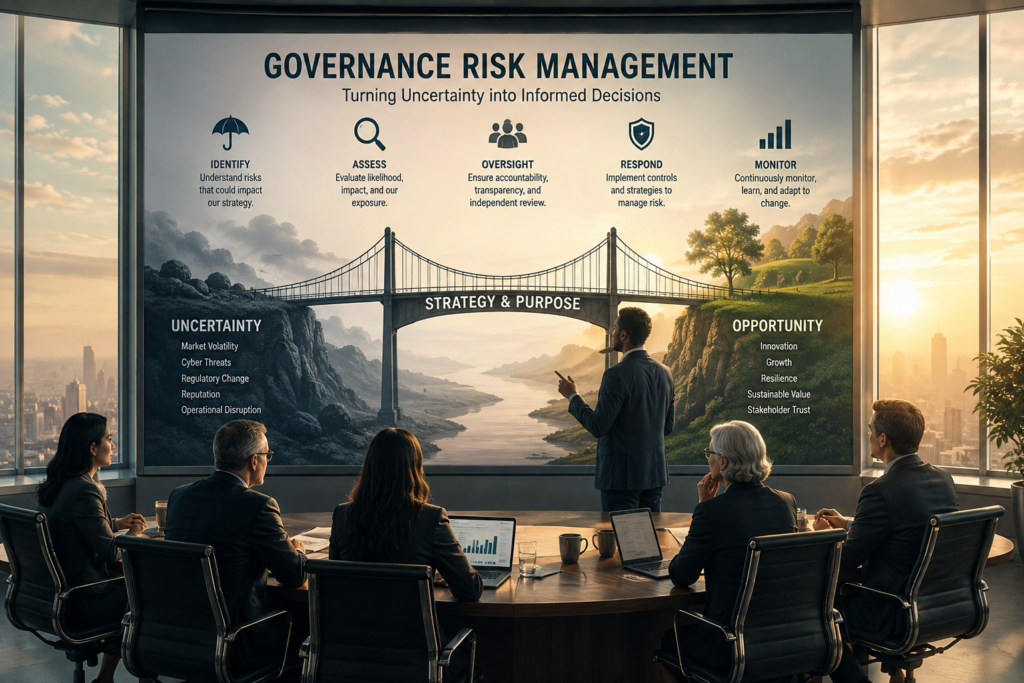
Risk has always been part of business. What has changed is its speed, complexity, and interconnectedness.
A cybersecurity incident can become a reputational crisis within hours. A regulatory change can reshape an operating model. Artificial intelligence can create extraordinary opportunities while introducing entirely new questions around privacy, ethics, accountability, and oversight. Economic uncertainty, geopolitical instability, workforce disruption, and succession challenges can quickly move from operational concerns to board level priorities.
This is why governance risk management has become increasingly important.
For boards and executive teams, managing risk is no longer simply about preventing something from going wrong. It is about understanding uncertainty well enough to make stronger decisions about where the organization should go next.
The organizations that understand this distinction can turn governance risk management from a defensive exercise into a strategic leadership capability.
What Is Governance Risk Management?
Governance risk management is the process through which boards and organizational leaders establish oversight, accountability, decision making structures, and strategic processes for identifying and addressing risks that could affect the organization.
Traditional risk management often concentrates on specific threats such as financial exposure, legal liability, compliance, cybersecurity, or operational disruption.
Governance brings a broader leadership perspective.
It asks questions such as:
What risks could prevent us from achieving our strategy?
Which emerging risks are we underestimating?
Who owns each significant risk?
What information should reach the board?
How much risk are we prepared to accept in pursuit of growth?
Where could today’s opportunity become tomorrow’s vulnerability?
These questions move risk management beyond a checklist. They connect risk directly to strategy.
Why Governance Risk Management Has Become a Board Priority
Boards operate in an environment where yesterday’s assumptions can quickly become outdated.
Consider artificial intelligence. Organizations are rapidly adopting AI to increase productivity, improve customer experiences, analyze information, and create new products. Yet those same technologies can introduce concerns involving data security, intellectual property, bias, regulatory compliance, and reputation.
The appropriate board response is not simply to avoid AI because it introduces risk.
Nor is it to pursue AI without adequate oversight.
The responsibility of governance is to help the organization understand both sides of the equation and make informed decisions.
That principle applies far beyond technology.
Effective governance risk management helps boards evaluate uncertainty while maintaining the organization’s ability to innovate, compete, and grow.
Risk Oversight Should Begin With Strategy
One of the most important shifts boards can make is to stop treating risk as a separate conversation from strategy.
Every meaningful strategy contains risk.
Entering a new market creates risk. Acquiring another company creates risk. Launching a new product creates risk. Changing leadership creates risk. Investing in emerging technology creates risk.
But refusing to make those decisions creates risks of its own.
A company that becomes excessively risk averse may protect itself from short term uncertainty while gradually losing relevance, talent, customers, or competitive position.
This is why effective boards consider risk and opportunity together.
When discussing a major strategic initiative, directors should understand not only what could go wrong but also what assumptions must prove correct for the strategy to succeed.
That creates a more sophisticated conversation.
Instead of asking only, “What are the risks?”
Boards can ask, “What risks are worth taking to achieve our objectives, and how will we manage them responsibly?”
The Board’s Role in Governance Risk Management
The board’s responsibility is oversight, not operational management.
Management identifies, assesses, monitors, and responds to many risks every day. The board provides another level of perspective and accountability.
That distinction matters.
Directors should understand whether significant risks have appropriate ownership, whether management has adequate systems for monitoring them, and whether the organization is operating within an acceptable level of risk.
Strong boards also look beyond the information placed directly in front of them.
They challenge assumptions.
They explore scenarios.
They ask what leadership might be missing.
They consider whether incentives encourage inappropriate risk taking.
They evaluate whether management is communicating problems early enough.
The goal is not for directors to become another layer of management. It is to ensure management benefits from informed, independent oversight.
Five Elements of Effective Governance Risk Management
Organizations can strengthen governance risk management by concentrating on several fundamental areas.
1. Clear Risk Ownership
Ambiguity creates vulnerability.
Significant risks should have clear ownership within management, while the board and appropriate committees should understand their respective oversight responsibilities.
Everyone should know who monitors the risk, who has authority to respond, and when an issue should be escalated.
Clear accountability becomes especially important during a crisis, when uncertainty can slow decisions.
2. The Right Expertise in the Boardroom
Risk evolves with strategy.
A board built for yesterday’s organization may not have all the expertise required for tomorrow’s challenges.
For example, an organization pursuing significant digital transformation may benefit from directors with experience in technology, cybersecurity, artificial intelligence, or digital business models. A company preparing for international expansion may need different expertise.
Board composition should therefore reflect where the organization is going, not simply where it has been.
The objective is not to have a specialist for every conceivable risk. It is to create a board with enough diversity of experience and perspective to recognize important questions and challenge management constructively.
3. Better Information
Boards cannot oversee risks they cannot see.
Yet receiving more information does not necessarily create better oversight.
Lengthy reports can sometimes bury the issues that deserve the greatest attention. Effective board reporting should help directors quickly understand what has changed, why it matters, what management is doing, and where board input is required.
The quality of governance often depends less on the volume of information directors receive and more on whether they receive the right information at the right time.
4. Constructive Challenge
Healthy governance requires directors who are willing to ask difficult questions.
This does not mean creating unnecessary conflict between management and the board. Constructive challenge should strengthen decisions rather than undermine leadership.
Management should be able to present an idea and know directors will test its assumptions.
Directors should be able to express concerns without turning disagreement into dysfunction.
When trust and independence coexist, disagreement becomes an organizational asset.
5. Continuous Monitoring
Risk management cannot be confined to an annual board exercise.
The environment changes too quickly.
Boards should periodically reassess major risks, emerging threats, strategic assumptions, and the organization’s capacity to respond.
A risk that appeared insignificant six months ago may become critical today. Another that once demanded considerable attention may have diminished.
Effective governance risk management is therefore dynamic rather than static.
Governance, Risk Management, and Organizational Culture
Some of the most consequential risks never appear neatly on a risk register.
Culture is one example.
Employees may recognize problems long before senior leadership or the board does. But if the culture discourages people from raising concerns, those early warnings may never reach decision makers.
Boards should pay attention to whether organizational culture supports transparency, ethical decision making, accountability, and responsible escalation.
They should also consider what leadership behavior is being rewarded.
An organization can have sophisticated policies and still create substantial risk if its incentives encourage people to pursue results at any cost.
Culture determines what happens when the policy manual is not in the room.
That makes culture a governance issue.
The CEO and Board Relationship Matters
Strong governance risk management also depends on the relationship between the board and CEO.
The CEO needs a board that understands the business, respects management’s responsibilities, and provides useful strategic perspective.
The board needs leadership that communicates candidly, particularly when circumstances become difficult.
Problems arise when either side weakens that relationship.
If directors become too passive, risks may go insufficiently challenged. If directors become overly operational, they can undermine management accountability.
The strongest relationship combines trust with independence.
A CEO should be able to bring uncertainty into the boardroom without believing every difficult issue will be interpreted as a leadership failure. At the same time, directors must remain willing to challenge management when necessary.
That balance is central to effective governance.
Common Governance Risk Management Mistakes
Even experienced organizations can weaken risk oversight through seemingly reasonable practices.
One mistake is concentrating almost exclusively on risks that are easiest to quantify. Financial risks often receive considerable attention because organizations can assign numbers to them. Strategic, cultural, technological, and reputational risks can be harder to measure but potentially just as consequential.
Another mistake is looking primarily backward.
Historical indicators matter, but boards also need forward looking information. Governance should help leadership identify what might happen next, not merely explain what already happened.
A third mistake is assuming that avoiding risk is the objective.
Business requires risk.
The goal is not zero risk. The goal is intelligent risk taking supported by effective oversight.
From Risk Protection to Strategic Advantage
The most mature boards recognize something important: risk management and opportunity management are often two sides of the same decision.
Organizations that understand risk more clearly can sometimes move faster, not slower.
They can invest with greater confidence because they understand their exposure. They can pursue innovation because appropriate guardrails exist. They can enter new markets because leadership has considered different scenarios.
This is where governance risk management becomes strategically valuable.
Good governance does not exist to make organizations afraid of uncertainty.
It helps them navigate uncertainty intelligently.
Questions Boards Should Be Asking
Boards seeking to strengthen governance risk management can begin with a few important questions:
- What are the most significant risks to achieving our strategic priorities?
- Which emerging risks could become materially important over the next several years?
- Do we have the right expertise on the board to oversee our changing risk environment?
- Are directors receiving useful information early enough to provide meaningful oversight?
- Is accountability for major risks clearly defined?
- Does our culture encourage people to surface problems before they become crises?
- Are we spending enough time discussing future risks rather than only reviewing historical performance?
- What risks are we deliberately accepting in pursuit of growth?
These questions can transform the board’s risk conversation from compliance reporting into strategic dialogue.
Governance Risk Management Is Ultimately About Leadership
Policies matter. Controls matter. Reporting systems matter.
But governance risk management ultimately depends on leadership.
It requires directors who can think beyond the next quarter, executives who are willing to communicate uncertainty, and organizations capable of learning before circumstances force them to change.
The best boards do not attempt to eliminate uncertainty.
They help organizations become better prepared to lead through it.
As technology accelerates, regulations evolve, markets shift, and stakeholder expectations increase, that capability will become increasingly valuable.
Organizations that treat governance merely as oversight may continue asking whether they are adequately protected.
#GovernanceRiskManagement, #CorporateGovernance, #RiskManagement, #BoardGovernance, #RiskGovernance, #BoardLeadership, #BoardEffectiveness, #StrategicRiskManagement, #ExecutiveLeadership, #GovernanceStrategy, #BoardOfDirectors, #StrategicLeadership