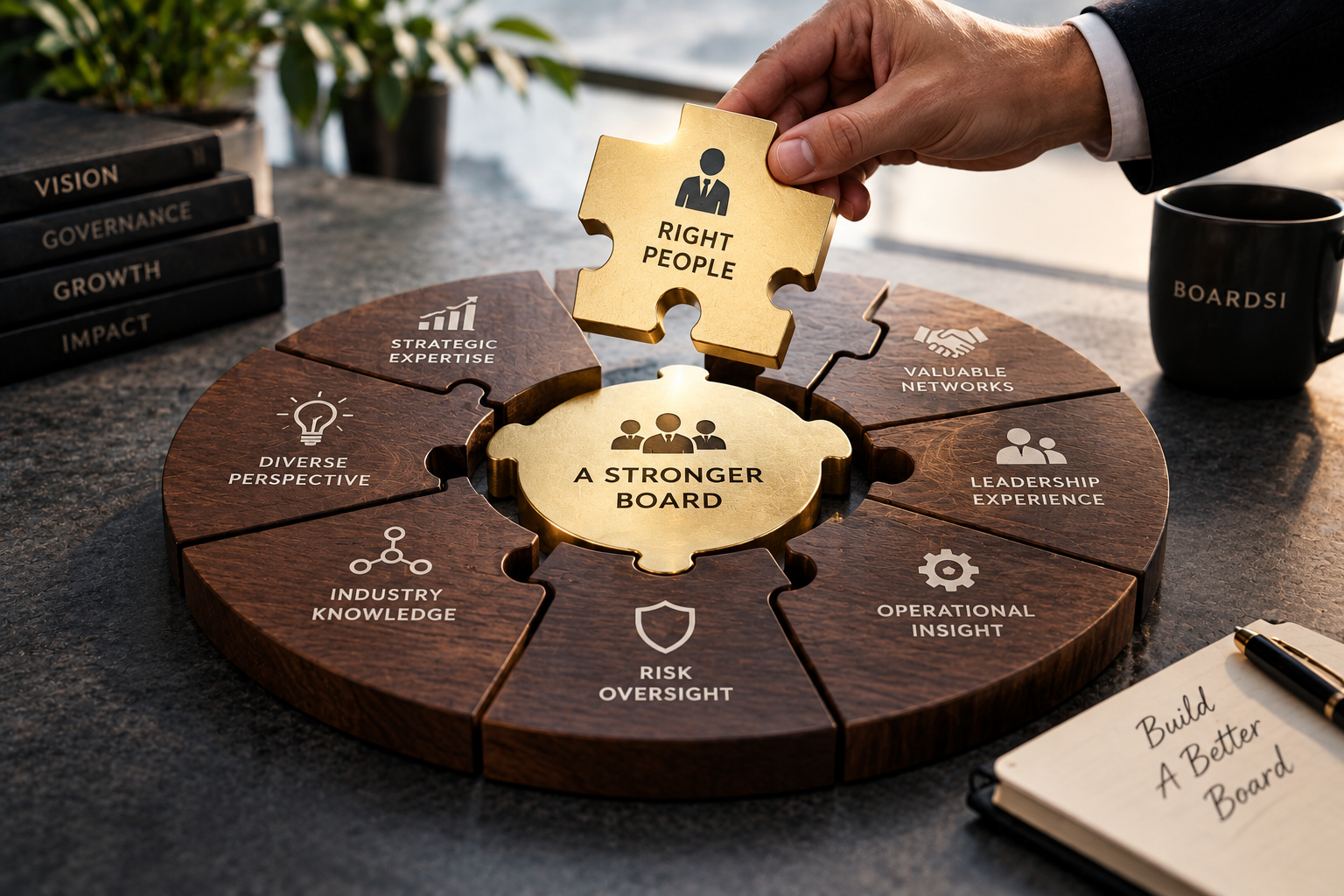

A board can be filled with accomplished people and still fail to perform.
Impressive résumés do not automatically create effective governance. Industry experience does not guarantee productive debate. And putting talented executives around the same table does not mean they will make better decisions together.
High performing boards are intentionally built.
They have the right people, but they also have the right culture, expectations, information, relationships and discipline. Their directors understand that governance is not simply about attending meetings and reviewing reports. It is about helping an organization make better decisions while protecting its long term interests.
For CEOs, founders, investors and board chairs, the question is not simply, “Who should be on our board?”
The better question is, “What kind of board does this organization need to succeed in its next chapter?”
Start With the Company’s Future
One of the biggest mistakes organizations make is building a board around where the company has been rather than where it is going.
A company entering a period of rapid growth may need directors with experience scaling operations, developing leadership teams, managing capital and entering new markets. A mature company facing disruption may need expertise in technology, transformation, cybersecurity or business model innovation.
The board should reflect the challenges the organization is likely to face over the next several years.
That requires periodically asking:
What strategic capabilities will the company need?
Where are the greatest risks?
What markets or technologies could reshape the business?
What expertise is missing from the current board?
What leadership challenges are likely to emerge?
Board composition should follow strategy.
When strategy changes, the capabilities around the boardroom table may need to change with it.
Build for Contribution, Not Prestige
There is a natural temptation to recruit directors because of their titles, reputations or networks.
Those qualities can be valuable, but prestige alone does not create a high performing board.
The strongest directors contribute.
They prepare. They ask thoughtful questions. They understand the business. They challenge assumptions without turning every disagreement into a confrontation. They recognize when to speak and when to listen.
Most importantly, they understand the difference between governance and management.
A director’s role is not to run the company from the boardroom. It is to provide oversight, judgment and perspective while holding leadership accountable for results.
That distinction is essential.
When directors become too operational, management can become constrained. When directors become too passive, accountability disappears.
High performing boards operate between those extremes.
Create Constructive Tension
Healthy boards are not always comfortable.
There should be disagreement.
The question is whether that disagreement produces better decisions or simply creates dysfunction.
High performing boards create an environment where directors can challenge ideas without attacking people. They encourage difficult questions and expect management to defend important assumptions.
A board where everyone agrees immediately may appear efficient, but it can also be dangerous.
Strategic decisions deserve examination.
The chair plays an especially important role in establishing this culture. Strong chairs make room for different perspectives, prevent dominant personalities from controlling the discussion and ensure disagreement remains focused on the issue rather than the individual.
The goal is not consensus at all costs.
The goal is better judgment.
Make Trust a Governance Advantage
Boards operate differently when trust exists.
Directors become more willing to raise concerns. CEOs become more comfortable discussing problems before they become crises. Difficult conversations happen earlier.
Without trust, information becomes guarded and conversations become political.
Trust, however, should never mean avoiding accountability.
The healthiest boards combine strong relationships with rigorous expectations.
Directors can respect the CEO while questioning strategy. They can support management while demanding stronger performance. They can disagree with one another without damaging the relationships required to govern effectively.
That combination of trust and accountability creates an environment where difficult issues can be addressed before they become organizational problems.
Give the Board the Information It Needs
Even exceptional directors cannot make strong decisions with weak information.
Boards need information that helps them understand what is happening, why it matters and where their attention is required.
That does not mean providing hundreds of pages before every meeting.
More information is not always better information.
Effective board materials prioritize strategic questions, financial performance, significant risks, competitive developments, leadership issues and decisions requiring board attention.
Directors should be able to distinguish quickly between information they need to know and information they are expected to act upon.
The quality of board discussion often begins with the quality of board information.
Keep Strategy at the Center
Boards can easily become consumed by reports, approvals and compliance.
Those responsibilities matter, but they should not crowd strategy out of the agenda.
High performing boards spend meaningful time looking forward.
They discuss competitive threats, customer changes, emerging technologies, talent, capital allocation, succession and the assumptions behind the company’s strategy.
One useful question can change the quality of a board conversation:
“What would have to change for our current strategy to stop working?”
Questions like this force directors and management to examine assumptions rather than simply review performance.
The board should not create strategy independently from management, but it should test whether the strategy is credible, sufficiently ambitious and responsive to changing conditions.
Make CEO and Leadership Succession a Priority
Few responsibilities matter more than ensuring the organization has capable leadership.
Yet succession planning is often postponed until it becomes urgent.
That is too late.
High performing boards discuss leadership development before a vacancy exists. They understand the organization’s leadership pipeline, identify potential successors and evaluate whether the company is developing the capabilities its future strategy will require.
CEO succession should be treated as an ongoing governance responsibility rather than an emergency process.
The same principle applies to other critical leadership roles.
Organizations become more resilient when leadership continuity is planned rather than improvised.
Evaluate the Board Itself
Boards routinely evaluate management.
High performing boards are also willing to evaluate themselves.
Are meetings focused on the right issues?
Are directors sufficiently prepared?
Does the board have the expertise the company needs?
Are difficult questions being asked?
Do committees remain effective?
Are individual directors continuing to contribute?
These conversations can be uncomfortable, but avoiding them creates a larger problem.
Board seats should not become permanent honors.
They are positions of responsibility.
As the organization evolves, the board must be willing to evolve with it.
Build the Board Before You Need It
The strongest boards are rarely created during a crisis.
They are built years earlier through deliberate recruitment, thoughtful succession, clear expectations and disciplined governance.
That is why building a high performing board should never be treated as an administrative exercise.
It is a strategic responsibility.
The quality of the board influences the quality of questions leaders are asked, the assumptions that are challenged, the risks that are recognized and ultimately the decisions that shape the organization’s future.
A high performing board does more than oversee a company.
It strengthens the organization’s capacity to make good decisions when those decisions matter most.
And that may be one of the most valuable competitive advantages a leadership team can build.
#BoardLeadership, #BoardOfDirectors, #CorporateGovernance, #BoardGovernance, #HighPerformingBoards, #ExecutiveLeadership, #BoardEffectiveness, #BoardComposition, #LeadershipStrategy, #BoardDevelopment