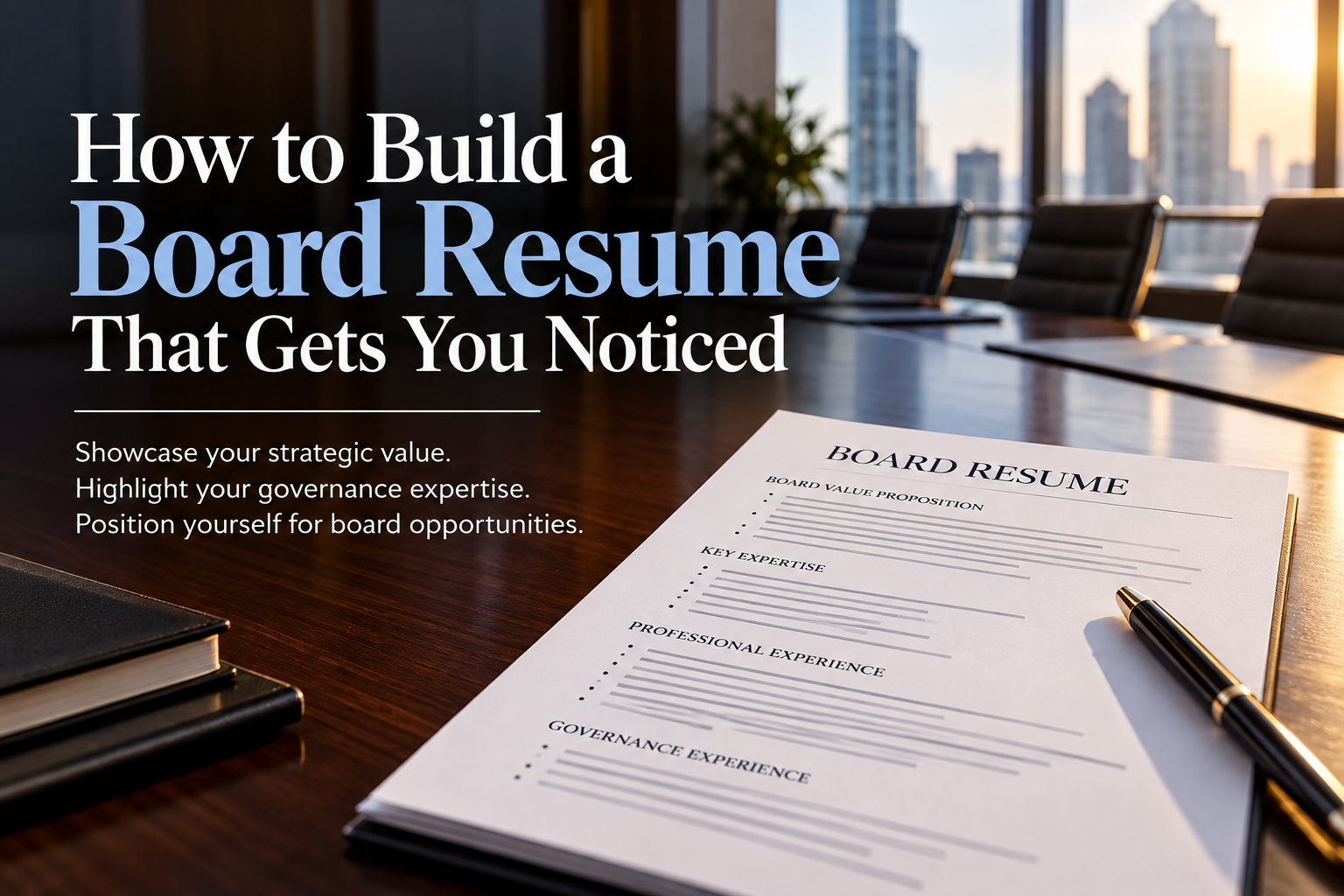

Landing your first board seat requires more than an impressive executive résumé. Discover how to build boardroom credibility, position your expertise, expand your network, and create opportunities to serve on a board of directors.
For many accomplished executives, serving on a board of directors represents the next meaningful chapter in their professional journey. It offers the opportunity to influence organizational strategy, guide leadership decisions, and contribute to the long-term success of a business.
Yet one question continues to challenge even the most experienced leaders:
How do you land your first board seat when you have never served on a corporate board before?
It is a familiar dilemma. Organizations often prefer directors with previous board experience, but aspiring directors need an opportunity to gain that experience.
The solution is not simply to apply for more board positions. It is to become the kind of candidate organizations recognize as capable of strengthening their boardroom.
That requires a deliberate combination of strategic positioning, governance knowledge, professional visibility, relationship building, and a clear understanding of the value you bring.
Whether you are a CEO, CFO, entrepreneur, senior executive, or industry expert, the following ten strategies can help you prepare for your first board appointment.
1. Understand What Boards Actually Look for in Directors
Before pursuing your first board seat, understand why organizations recruit new directors.
Boards are responsible for overseeing organizational performance, providing strategic guidance, monitoring risk, and holding senior leadership accountable.
When identifying prospective directors, organizations evaluate the capabilities needed to support those responsibilities.
Depending on the company’s industry, size, ownership structure, and strategic priorities, boards may seek experience in:
- Corporate strategy and business transformation
- Financial management and capital allocation
- Cybersecurity, artificial intelligence, and technology
- Risk management and regulatory oversight
- Mergers, acquisitions, and business expansion
- Human capital management and executive succession
- International markets and industry-specific operations
- Corporate governance and organizational leadership
The key is recognizing that boards recruit to address specific needs, not simply to recognize professional achievement.
A successful executive may possess many valuable qualifications. However, a compelling board candidate knows how to connect those qualifications to the challenges an organization faces.
Your first board seat becomes more attainable when you stop presenting yourself as someone seeking an opportunity and start demonstrating how you can help an organization succeed.
2. Define Your Unique Board Value Proposition
One of the most important steps in learning how to land your first board seat is developing a clear board value proposition.
Your board value proposition explains the expertise, perspective, and strategic judgment you would bring to a board of directors.
It should answer three questions:
- What specialized knowledge or experience do you possess?
- What organizational challenges are you qualified to address?
- Why would a board benefit from having your perspective?
For example, an executive might describe their background as 20 years of experience managing operations and leading teams.
That demonstrates professional longevity, but it does not necessarily communicate boardroom value.
A stronger positioning statement might be:
“I help organizations navigate complex growth strategies, improve operational performance, and manage the risks associated with business expansion.”
This statement translates executive experience into strategic contribution.
Aspiring directors should identify two or three areas of expertise that distinguish them from other candidates.
Your goal is not to position yourself as the right director for every organization. It is to become a highly relevant candidate for boards that need your specific capabilities.
3. Build a Board-Ready Executive Résumé and Biography
A traditional executive résumé and a board résumé serve different purposes.
An executive résumé emphasizes leadership responsibilities, operational accomplishments, and career progression.
A board résumé should emphasize strategic oversight, enterprise-level decision-making, governance experience, financial understanding, and the ability to contribute to long-term organizational performance.
When preparing your board materials, highlight accomplishments such as leading organizational transformations, overseeing major investments, managing enterprise risks, advising senior leadership, or contributing to strategic planning.
Your board biography should provide a concise, compelling narrative of your professional background and the value you offer prospective boards.
It should communicate your industry expertise, leadership accomplishments, strategic competencies, and relevant governance experience.
Avoid relying exclusively on job titles.
A board wants to understand what your experience enables you to contribute, not simply where you have worked.
A well-developed board résumé and biography make it easier for nominating committees, executive recruiters, and professional connections to recognize your qualifications.
4. Strengthen Your Corporate Governance Knowledge
One of the biggest differences between executive leadership and board service is the nature of the responsibility.
Executives manage organizations.
Directors oversee management, evaluate strategy, monitor risk, and exercise independent judgment.
This distinction is especially important for first-time board candidates.
To prepare for board service, develop a working understanding of corporate governance principles, including fiduciary duties, board committee responsibilities, financial oversight, executive compensation, succession planning, and conflicts of interest.
Directors must also understand the legal and ethical obligations associated with their positions, which vary by jurisdiction and organization type.
Governance education can help demonstrate your commitment to understanding these responsibilities.
Consider participating in director education programs, attending governance conferences, and studying the responsibilities of audit, compensation, and nominating committees.
You can also strengthen your knowledge by reviewing public company annual reports, proxy statements, and governance disclosures.
Board readiness is not determined solely by how successfully you have managed a business. It is also determined by how effectively you understand the responsibility of overseeing one.
5. Optimize Your LinkedIn Profile for Board Opportunities
Professional visibility plays an important role in board recruitment.
A strong LinkedIn presence can help executive search professionals, board members, investors, and other decision-makers understand your expertise.
However, many aspiring directors make the mistake of presenting themselves exclusively through the lens of their current executive position.
Your LinkedIn profile should communicate both your executive accomplishments and your readiness to contribute at the board level.
Start with a headline that reflects your professional expertise and strategic strengths.
For example:
“Growth Strategy Executive | Business Transformation | Corporate Governance | Board Candidate”
Your About section should explain the business challenges you have helped solve and the perspectives you bring to strategic decision-making.
Highlight experience involving enterprise leadership, financial oversight, organizational growth, risk management, and industry transformation.
You should also consider publishing thoughtful content on issues relevant to boards.
Articles and posts about corporate strategy, leadership succession, emerging technologies, governance, and market disruption can help demonstrate your ability to think beyond day-to-day operations.
The objective is not simply to increase your visibility.
It is to build a professional reputation associated with insight, credibility, and boardroom relevance.
6. Expand Your Network Beyond Traditional Executive Circles
Relationships are an important part of the board recruitment process.
Many board opportunities emerge through referrals, professional recommendations, executive search relationships, and existing director networks.
For aspiring directors, this means intentionally building connections with individuals who understand board recruitment and governance.
These may include current board directors, board chairs, corporate governance professionals, investors, executive recruiters, and senior business leaders.
However, effective networking requires more than announcing that you are interested in a board position.
Approach conversations with curiosity and a desire to contribute.
Ask experienced directors what makes someone effective in the boardroom. Learn how organizations identify potential candidates. Understand the strategic challenges different boards face.
Participate in professional associations, governance events, leadership forums, and industry conferences where directors and decision-makers gather.
Over time, these relationships can increase your awareness of opportunities and help others understand the value you offer.
A strong network does not guarantee a board appointment.
But it can significantly improve your access to conversations that might otherwise never take place.
7. Consider Advisory Boards and Nonprofit Board Service
One practical way to build experience before landing your first corporate board seat is to explore advisory boards, nonprofit boards, and other governance-related opportunities.
These roles can provide valuable exposure to strategic discussions, organizational oversight, and collaborative decision-making.
Nonprofit board service, in particular, may offer experience with financial stewardship, organizational strategy, executive accountability, and governance responsibilities.
Advisory boards can also provide opportunities to contribute specialized expertise to companies seeking outside perspectives.
However, it is important to recognize that advisory board positions and fiduciary board directorships are not the same.
An advisory board generally provides recommendations without holding the same legal responsibilities as a formal board of directors.
Both experiences can be valuable, but aspiring directors should understand the distinction and represent their experience accurately.
The most useful opportunities are those where you can make a meaningful contribution while developing capabilities relevant to future board service.
8. Target Boards That Align With Your Expertise
When pursuing your first board appointment, a focused strategy is usually more effective than applying indiscriminately.
Begin by identifying organizations where your experience could address specific strategic needs.
Consider factors such as industry, company size, ownership structure, growth stage, and business challenges.
For example, a technology executive with cybersecurity expertise may be particularly relevant to organizations facing increasing digital risks.
A former CFO with experience in acquisitions may be well positioned for businesses pursuing expansion or restructuring.
An executive who has successfully scaled a company may bring valuable insight to a growing private business.
Aspiring directors should also consider opportunities with private companies, family-owned businesses, venture-backed organizations, and nonprofits, depending on their interests and qualifications.
Not every organization has the same board recruitment process or governance requirements.
Before pursuing any appointment, conduct due diligence on the organization’s financial condition, leadership, governance practices, potential liabilities, and expectations of directors.
Landing your first board seat should not come at the expense of sound judgment.
The right opportunity is one where your experience aligns with the organization’s needs and you can fulfill the responsibilities of the position.
9. Prepare for the Board Interview Differently
A board interview is not the same as an executive job interview.
Executive interviews often focus on what you have accomplished, how you lead teams, and how you would manage business operations.
Board interviews are more likely to explore how you evaluate strategic decisions, exercise independent judgment, understand governance responsibilities, and work collaboratively with other directors.
Be prepared to discuss questions such as:
- What unique perspective would you bring to our board?
- How would you approach a disagreement with the CEO?
- How do you evaluate organizational risk?
- What is your understanding of a director’s fiduciary responsibilities?
- How would you balance short-term business pressures with long-term value creation?
- What experience prepares you to contribute to our strategic priorities?
Strong candidates demonstrate confidence without appearing inflexible.
They show that they can challenge assumptions constructively, listen carefully, maintain confidentiality, and distinguish oversight from operational management.
A board is not simply evaluating whether you are accomplished.
It is evaluating whether you can contribute to a group responsible for making consequential decisions.
10. Create a Consistent Board Search Strategy
Landing your first board seat rarely happens through a single application or networking conversation.
For many aspiring directors, it requires a sustained effort over time.
Rather than approaching board recruitment casually, develop a structured plan with specific activities and measurable progress.
<escape>A practical 90-day board readiness plan</escape>
Days 1–30: Establish your positioning
Define your board value proposition, identify target industries, assess governance knowledge, and develop your board résumé and biography.
Days 31–60: Expand your visibility
Update your LinkedIn profile, publish relevant thought leadership, engage with governance professionals, and begin conversations with experienced directors and executive search contacts.
Days 61–90: Pursue aligned opportunities
Research organizations that may benefit from your expertise, explore suitable board and advisory opportunities, practice board interviews, and continue building relationships with decision-makers.
This plan will not guarantee a board appointment within 90 days. Its purpose is to establish the foundation for a disciplined, long-term search.
Consistency matters because professional credibility and trusted relationships develop over time.
The executives who position themselves effectively are often those who begin preparing before an opportunity becomes available.
How Long Does It Take to Land Your First Board Seat?
There is no universal timeline for securing a first board appointment.
The process depends on several factors, including your professional experience, industry expertise, governance knowledge, network, target organizations, and availability of suitable openings.
Some executives enter board service through existing business relationships or previous advisory experience. Others spend considerable time building their visibility and developing relationships with nominating committees and search professionals.
Instead of focusing exclusively on how quickly you can secure a position, concentrate on improving the factors within your control.
Strengthen your qualifications. Clarify your value. Build relationships. Pursue opportunities that fit your expertise.
The goal is not simply to obtain a board title.
It is to secure an appointment where you can make a meaningful contribution.
Frequently Asked Questions About Landing Your First Board Seat
Can you get a board seat without previous board experience?
Yes. Organizations may appoint first-time directors when their executive experience, specialized expertise, judgment, and strategic perspective align with the board’s needs. Governance education and relevant advisory experience can also help demonstrate readiness.
Do you need to be a CEO to serve on a board of directors?
No. Although CEO experience can be valuable, boards also recruit executives and specialists with backgrounds in finance, technology, cybersecurity, operations, human resources, marketing, risk management, and other areas relevant to their strategic priorities.
How do you find board of directors opportunities?
Board opportunities may be identified through professional networks, executive search firms, director associations, governance events, referrals, and platforms that connect qualified professionals with organizations seeking board talent.
What qualifications do you need for your first board seat?
Qualifications vary by organization. Boards typically evaluate relevant professional expertise, strategic judgment, financial literacy, leadership experience, integrity, and the ability to fulfill governance responsibilities. Some positions may require specific industry, regulatory, or technical expertise.
Should you join a nonprofit board before a corporate board?
Nonprofit board service can provide valuable governance experience, but it is not a mandatory prerequisite for corporate board service. The relevance of that experience depends on your responsibilities and the types of corporate boards you intend to pursue.
How can Boardsi help aspiring board directors?
Boardsi focuses on connecting executives and business leaders with board and advisory opportunities while supporting professional positioning and board readiness. Aspiring directors should evaluate available services, the types of opportunities offered, and how those services align with their professional objectives.
Final Thoughts: Your First Board Seat Begins With Strategic Positioning
For ambitious executives, the desire to serve on a board of directors is understandable.
Board service offers an opportunity to apply years of professional experience in a different leadership capacity, contribute to important organizational decisions, and influence long-term business outcomes.
But securing your first appointment requires more than ambition.
It requires the ability to demonstrate why your perspective matters.
The strongest candidates understand what boards need, communicate their expertise clearly, build governance knowledge, develop trusted professional relationships, and pursue opportunities aligned with their capabilities.
They recognize that board service is not simply another step up the corporate ladder.
It is a different form of leadership, one defined by oversight, accountability, collaboration, and long-term stewardship.
Your executive career demonstrates what you have accomplished. Your board readiness demonstrates what you are prepared to contribute next.
If you are ready to take the next step toward board service, explore the executive networking, board positioning, and board opportunity resources available through Boardsi.
Because landing your first board seat is not just about getting a place at the table.
It is about becoming someone whose presence makes the table stronger.
#BoardOpportunities, #FirstBoardSeat, #BoardOfDirectors, #BoardLeadership, #BoardReadiness, #CorporateGovernance, #BoardRecruitment, #ExecutiveLeadership, #BoardService, #LeadershipDevelopment, #CorporateBoards, #Boardsi