- Martin Rowinski
- Business
AI is no longer something boards can treat as a technology update buried in the back half of a meeting packet. It is now a strategy issue, a risk issue, a talent issue, a reputation issue, and in many cases, a fiduciary issue.
Where are boards today? I would say most are somewhere between awareness and true maturity. They know AI matters. They know management is experimenting with it. But many still do not have a clear view of where AI is being used, who owns it, what data is feeding it, what risks it creates, or how success is being measured.
That is where the real work begins.
The biggest misconception I still see is that AI governance means slowing down innovation. It should be the opposite. Good governance gives a company the confidence to move faster because the guardrails are clear. The goal is not to make executives afraid of AI. The goal is to make sure AI is being used in a way that aligns with the company’s values, vision, mission, customer promise, and risk appetite.
A board does not need every director to be a technologist. But the board does need enough AI fluency to ask better questions. What AI tools are being used today? Which ones are material to the business? Where could bias, privacy, cybersecurity, misinformation, intellectual property, or regulatory exposure show up? Who is accountable if an AI-driven decision creates harm?
That last question matters. Accountability cannot sit with “the algorithm.” AI does not remove human responsibility. If an AI initiative fails, produces unintended consequences, or damages trust, the board should expect management to know who approved it, who tested it, who monitored it, and who had authority to stop it. There must be a clear owner.
I believe the most mature boards will begin to look at AI through a few practical benchmarks:
Does the company have an inventory of AI use cases?
Are AI initiatives tied to business strategy, not just experimentation?
Is there a responsible-use policy employees understand?
Are high-risk use cases reviewed before deployment?
Is there human oversight where decisions affect people, customers, pricing, credit, hiring, safety, or reputation?
Is management tracking both ROI and risk?
Is the board receiving regular, clear reporting?
That is where standards are beginning to matter. Frameworks like the NIST AI Risk Management Framework, NIST’s Generative AI Profile, and ISO/IEC 42001 give boards a more structured way to think about AI governance. The EU AI Act is also pushing companies toward more discipline, especially around high-risk systems, transparency, and general-purpose AI obligations. In the U.S., even without one comprehensive federal AI law, boards need to pay attention to disclosure, “AI washing,” cybersecurity, privacy, employment, IP, and sector-specific rules.
The compensation committee also has a role to play. AI transformation is not just a technology project. It changes jobs, productivity, customer experience, innovation cycles, and leadership expectations. Compensation committees should be asking whether executive incentives encourage responsible adoption, not reckless adoption.
I would be cautious about rewarding leaders simply for launching AI pilots or cutting costs through automation. Better metrics would include responsible deployment, measurable business value, workforce training, risk controls, customer outcomes, and innovation tied to long-term strategy. If AI is important enough to be in the strategic plan, it is important enough to be discussed in executive performance.
Governance structure will vary by company. Some boards will use the audit committee because of controls, compliance, cyber, and disclosure. Some will use a risk or technology committee. Some will keep AI at the full board level because of its strategic importance. The best answer may be a combination: full board oversight of strategy, committee-level oversight of risk, and a management-level AI governance council that reports up regularly.
Boards should also bring the right people to the table. That may mean recruiting directors with AI, data, cybersecurity, digital transformation, or technology experience. It may also mean bringing in outside advisors. I have always believed a strong board is a mastermind group. You do not need one person with every answer. You need the right mix of people who can see around corners together.
Over the next few years, I expect AI oversight to become standard board practice in the same way cybersecurity did. Boards will expect AI inventories, AI risk dashboards, executive accountability, third-party review for high-risk systems, director education, incident reporting, and clearer disclosure. AI fluency will become part of board composition planning.
The companies that win with AI will not be the ones that chase every new tool. They will be the ones that build trust while they innovate.
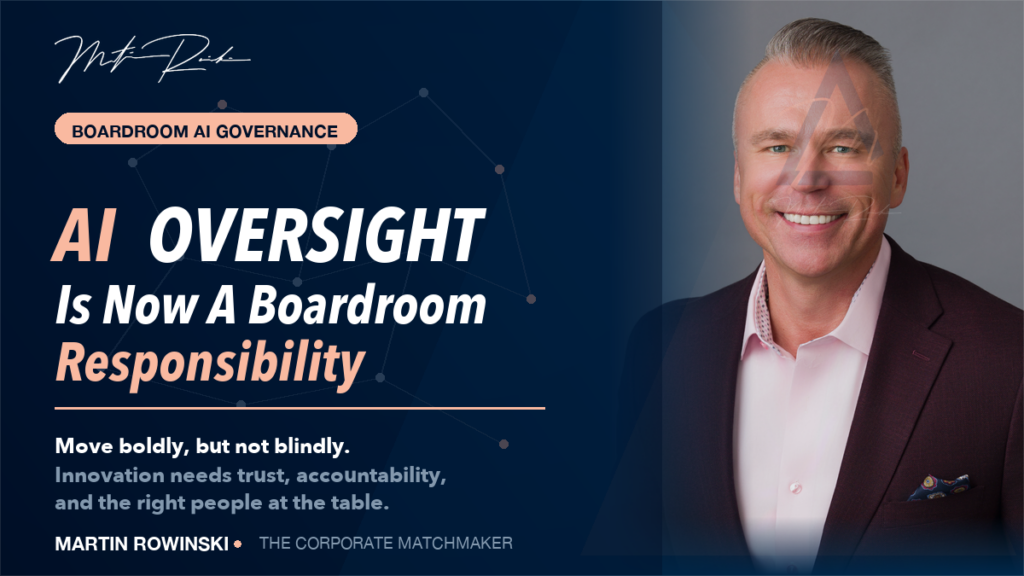
That is the real challenge for boards: help management move boldly, but not blindly.
AI can create incredible value. But only if leaders put ego aside, ask the right questions, and build the right governance around it. The companies that do that well will not just adopt AI. They will lead with it.
#ArtificialIntelligence, #AIGovernance, #BoardGovernance, #CorporateGovernance, #BoardLeadership, #AIRiskManagement, #DigitalTransformation, #ExecutiveLeadership, #CorporateStrategy, #ResponsibleAI, #TechnologyGovernance, #Cybersecurity, #AIEthics, #InnovationLeadership, #RiskManagement, #BoardroomLeadership, #BusinessStrategy, #CorporateLeadership, #GovernanceFrameworks, #FutureOfWork
Sources used for current context:
KPMG Board Leadership Center survey