
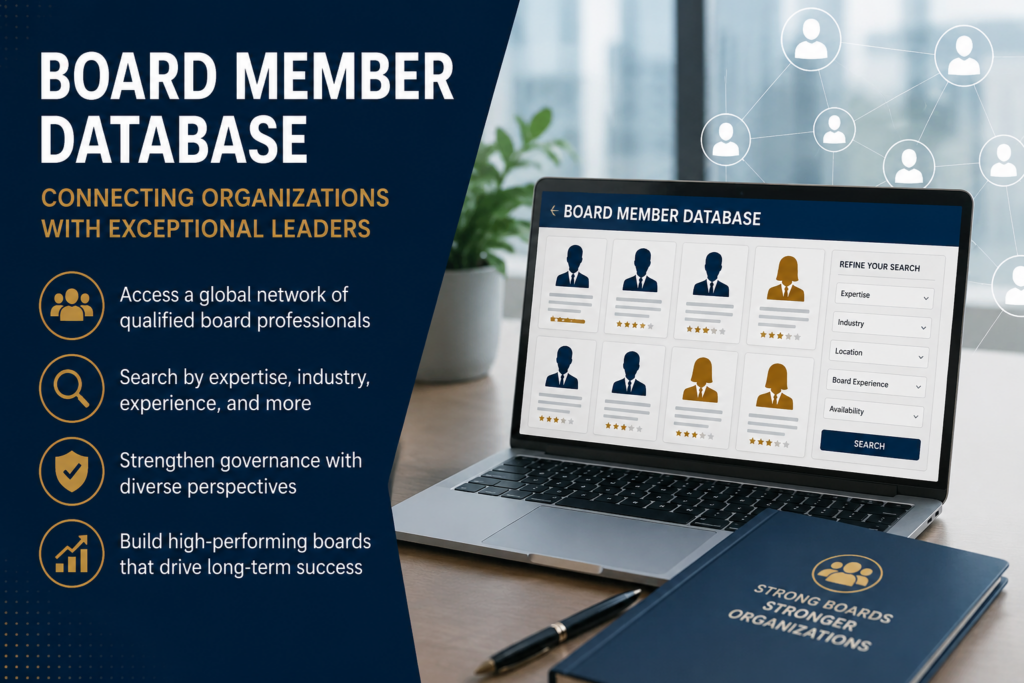
Building an effective board of directors has never been more important. As organizations face increasing complexity, regulatory demands, technological disruption, and heightened stakeholder expectations, the quality of board leadership often determines long-term success.
Yet one of the biggest challenges companies face is finding qualified board candidates.
This is where a board member database becomes a powerful strategic resource.
A well-developed board member database provides organizations with access to experienced executives, entrepreneurs, industry specialists, financial experts, and governance professionals who are actively seeking board opportunities. Instead of relying solely on personal networks and referrals, organizations can leverage a broader talent pool to identify candidates who bring the skills, perspectives, and leadership experience needed to strengthen governance.
What Is a Board Member Database?
A board member database is a centralized collection of qualified professionals interested in serving on corporate, advisory, nonprofit, or private company boards.
These databases typically include detailed information such as:
- Executive experience
- Industry expertise
- Functional specialties
- Board experience
- Education and certifications
- Geographic location
- Governance training
- Leadership achievements
Organizations use these databases to streamline board recruitment and identify candidates who align with their strategic goals and governance requirements.
As board recruitment becomes increasingly competitive, access to a comprehensive board member database can significantly improve the quality and speed of the selection process.
The Challenges of Traditional Board Recruitment
Historically, board appointments often came through personal relationships and professional networks. While referrals can still be valuable, relying exclusively on existing connections creates limitations.
Common challenges include:
Limited Candidate Pools
Boards frequently recruit from the same circles, reducing opportunities to discover highly qualified candidates with fresh perspectives.
Lack of Diversity
Traditional recruitment methods can unintentionally limit diversity in experience, industry background, age, gender, and leadership style.
Extended Search Timelines
Finding the right board member often requires months of networking, vetting, and interviewing candidates.
Skill Gaps
Organizations may struggle to identify candidates with expertise in emerging areas such as cybersecurity, artificial intelligence, ESG oversight, digital transformation, and risk management.
A robust board member database helps solve these challenges by expanding access to qualified talent.
How a Board Member Database Strengthens Governance
The effectiveness of a board depends on having the right mix of expertise and perspectives.
Using a board member database allows organizations to:
Identify Specialized Expertise
Modern boards require expertise beyond traditional finance and operations. Organizations increasingly seek directors with backgrounds in:
- Technology
- Cybersecurity
- Digital transformation
- Human capital management
- Marketing
- Regulatory compliance
- Risk management
- ESG initiatives
A searchable database helps companies quickly locate candidates with the specific knowledge they need.
Improve Board Diversity
Research consistently shows that diverse boards make better decisions and generate stronger organizational outcomes.
A board member database expands access to candidates from different industries, demographics, leadership experiences, and professional backgrounds.
Accelerate Recruitment
Instead of starting each search from scratch, organizations can leverage pre-qualified candidate profiles, significantly reducing recruitment time.
Support Strategic Growth
As organizations evolve, their board needs often change. A board member database allows leadership teams to identify directors whose experience aligns with future growth objectives.
What Organizations Should Look for in a Board Member Database
Not all board databases are created equal.
When evaluating a board member database, organizations should consider several factors:
Candidate Quality
The value of a database depends on the qualifications and experience of its members.
Look for candidates with:
- Senior leadership experience
- Operational expertise
- Governance knowledge
- Strategic planning capabilities
- Industry-specific insights
Search Functionality
Advanced filtering tools allow organizations to search candidates based on:
- Industry
- Skills
- Geography
- Board experience
- Functional expertise
Efficient search capabilities save time and improve candidate matching.
Candidate Engagement
An effective database contains professionals who are actively interested in board service rather than passive listings.
Ongoing Growth
The strongest databases continually expand with new executive talent and emerging leaders.
The Growing Demand for Board Talent
The demand for qualified board members continues to increase.
Organizations are seeking directors who can help address challenges such as:
- Cybersecurity threats
- Artificial intelligence governance
- Workforce transformation
- Regulatory complexity
- Global market uncertainty
- Stakeholder expectations
As a result, companies need broader access to leadership talent than ever before.
A comprehensive board member database provides organizations with a competitive advantage by helping them identify and recruit leaders who can contribute meaningful strategic oversight.
How Boardsi Connects Organizations with Qualified Board Candidates
Boardsi has transformed the board recruitment process by connecting organizations with highly qualified executives seeking board opportunities.
Through its extensive board member database, Boardsi helps companies identify candidates whose expertise aligns with their governance needs and strategic objectives.
Whether organizations are searching for experienced CEOs, financial executives, technology leaders, entrepreneurs, or industry specialists, Boardsi provides access to a diverse network of accomplished professionals.
This modern approach to board recruitment enables organizations to strengthen governance, improve oversight, and build boards capable of navigating today’s rapidly evolving business environment.
The Future of Board Recruitment
The future of board recruitment will be increasingly data-driven, strategic, and inclusive.
Organizations that leverage a board member database gain access to broader talent pools, specialized expertise, and diverse leadership perspectives that can enhance board performance.
As governance expectations continue to evolve, the ability to identify the right board talent quickly and efficiently will become a critical organizational advantage.
Final Thoughts
A board member database is no longer simply a recruitment tool. It has become a strategic asset for organizations seeking stronger governance, improved oversight, and sustainable growth.
The most effective boards are built with intention, combining diverse expertise, independent thinking, and leadership experience that supports long-term success.
By leveraging a high-quality board member database, organizations can move beyond traditional recruitment methods and build boards equipped to lead confidently into the future.
#BoardMemberDatabase, #BoardRecruitment, #CorporateGovernance, #BoardOfDirectors, #BoardLeadership, #ExecutiveLeadership, #Governance, #BoardCandidates, #BoardDiversity, #BoardEffectiveness, #StrategicLeadership, #BusinessGrowth, #LeadershipDevelopment, #ExecutiveSearch, #Boardsi