
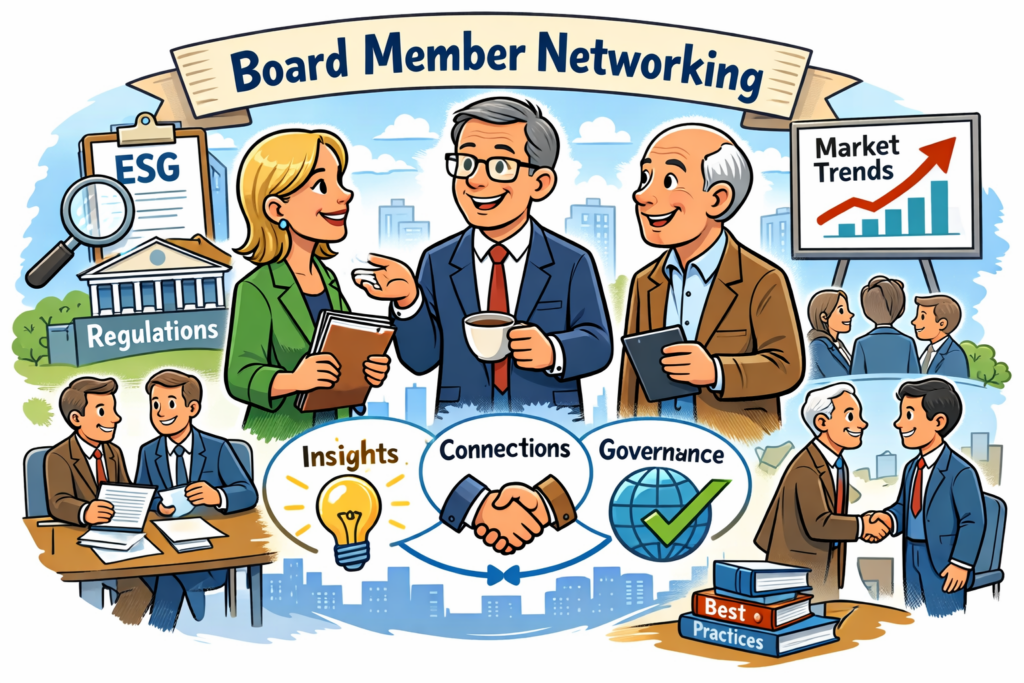
By the time most professionals reach the boardroom, they’ve already mastered the art of networking. Or so they think.
Yet board member networking is not an extension of executive networking. It is an entirely different discipline—quieter, more strategic, and far more consequential. When done well, it becomes one of a director’s most powerful assets. When neglected, it quietly erodes influence and opportunity.
In today’s governance environment—marked by ESG scrutiny, regulatory shifts, activist investors, and rapid technological disruption—no director can afford to operate in isolation. The most effective board members understand that networking is not about visibility. It is about perspective, preparedness, and value creation.
Here is how high-impact directors approach networking differently.
Networking Is Not About You—It’s About Governance Intelligence
Executives network to advance careers. Board members network to strengthen governance.
The best directors cultivate relationships across industries, sectors, and disciplines to stay ahead of emerging risks and opportunities. They engage with regulators, investors, academics, policy experts, and fellow directors—not to collect contacts, but to gather insight.
Why?
Because boards are expected to anticipate, not react.
A well-networked director hears about regulatory shifts before they become mandates. They understand ESG reporting trends before they hit proxy statements. They see cultural shifts and geopolitical risks forming before they escalate into shareholder questions.
Networking, at the board level, is strategic intelligence gathering.
Your Reputation Is Your Currency
In the board ecosystem, reputation travels faster than résumés.
Unlike executive hiring, board recruitment often happens through trusted referrals. Nominating committees rely heavily on peer recommendations. A single credible endorsement from a respected director carries more weight than a dozen polished biographies.
This makes networking less about self-promotion and more about consistent credibility.
High-performing board members are known for:
Thoughtful contribution, not dominance
Sound judgment under pressure
Integrity and discretion
Long-term perspective
When your name surfaces in a boardroom conversation, the question is not “What has this person accomplished?” It is “How will this person behave in the room?”
Your network amplifies—or diminishes—that perception.
The Power of the Peer Circle
The most sophisticated directors cultivate what might be called a “personal advisory board.”
They maintain relationships with other board members across industries to exchange perspectives on governance challenges. These conversations are not transactional. They are reflective.
Topics often include:
CEO succession strategy
ESG integration
Compensation alignment
Cybersecurity oversight
Board culture and dynamics
These peer exchanges serve as a sounding board for complex governance dilemmas. They also provide something equally important: calibration.
Is our board behind? Are we overreacting? Are we aligned with best practice or lagging the market?
In a role where directors are legally accountable yet operationally removed, having trusted peers outside the boardroom is not a luxury. It is a safeguard.
Visibility Without Vanity
Many executives struggle with the transition to board-level networking because they associate visibility with self-promotion.
Board member networking requires a different posture.
It is less about speaking on every panel and more about participating in the right conversations. Less about social media presence and more about thoughtful presence in governance forums.
High-impact directors invest in:
Governance-focused conferences
Private director roundtables
Industry working groups
Thought leadership aligned with their expertise
The goal is not to be everywhere. It is to be credible where it matters.
Directors who maintain quiet authority are often the ones most sought after.
Networking as Fiduciary Responsibility
There is a deeper reason board member networking matters.
Directors have a fiduciary duty to act in the best interest of the company and its shareholders. That duty requires informed oversight.
Informed oversight demands continuous learning.
Continuous learning is accelerated through strategic relationships.
A director who remains disconnected from broader governance conversations risks becoming outdated. And in a rapidly evolving regulatory and stakeholder environment, outdated oversight is not just ineffective—it is risky.
Networking, in this context, becomes an extension of fiduciary diligence.
From Connection to Contribution
The most respected board members approach networking with one guiding principle: contribution before extraction.
They ask:
How can I add perspective to this discussion?
How can I connect two people who should know each other?
How can I mentor emerging directors?
This mindset compounds over time.
Directors who consistently contribute become trusted voices. Trusted voices are invited into more meaningful conversations. Those conversations lead to greater impact—and often, future board opportunities.
The Long Game
Board careers are marathons, not sprints.
Unlike executive roles, board positions are fewer, tenure is longer, and reputations are built over decades. Networking at this level is not about immediate gain. It is about sustained relevance.
The directors who remain in demand are those who:
Stay intellectually curious
Build cross-sector relationships
Maintain credibility across economic cycles
Continue learning long after they’ve “arrived”
In the end, board member networking is not about expanding a contact list. It is about expanding perspective.
And perspective is the currency of effective governance.
Final Thought
In an era where boards are under unprecedented scrutiny, directors cannot afford insularity.
The most effective board members understand that influence is built long before it is needed. They invest in relationships not for status, but for stewardship.
Because in the boardroom, your greatest asset is not your résumé.
It is the insight, trust, and perspective your network quietly provides.
#BoardGovernance, #BoardLeadership, #CorporateGovernance, #BoardEffectiveness, #DirectorDevelopment, #FiduciaryDuty, #GovernanceStrategy, #Boardroom, #Leadership, #ExecutiveLeadership, #BoardRecruitment, #Governance, #StrategicLeadership