
Why High-Performing Boards Create High-Performing Organizations
In today’s rapidly evolving business landscape, organizations face increasing pressure to navigate economic uncertainty, technological disruption, regulatory complexity, and shifting stakeholder expectations. While executive leadership often receives the spotlight, the true foundation of long-term success begins in the boardroom.
This is where board performance optimization becomes a critical competitive advantage.
Organizations with high-performing boards consistently make better strategic decisions, manage risk more effectively, support executive leadership, and create greater long-term value. In contrast, underperforming boards can slow innovation, create governance gaps, and limit organizational growth.
As businesses face increasingly complex challenges, optimizing board performance is no longer optional. It is essential.
What Is Board Performance Optimization?
Board performance optimization is the process of improving the effectiveness, efficiency, and strategic impact of a board of directors or advisory board.
It involves evaluating and enhancing how board members contribute to governance, oversight, decision-making, leadership development, and organizational strategy.
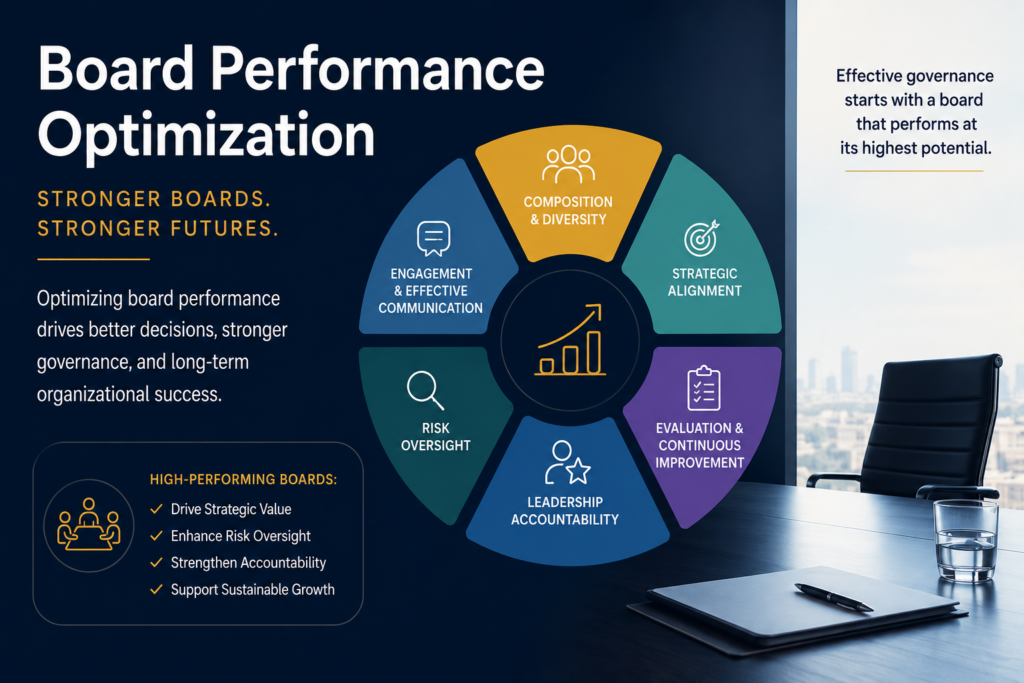
Effective board performance optimization focuses on:
- Board composition and diversity
- Strategic alignment
- Governance effectiveness
- Leadership accountability
- Board engagement
- Risk oversight
- Succession planning
- Continuous board development
The goal is to ensure that the board delivers maximum value to the organization while supporting sustainable growth and long-term success.
Why Board Performance Matters More Than Ever
The role of boards has evolved significantly over the last decade.
Historically, boards primarily focused on compliance and financial oversight. Today, boards are expected to serve as strategic partners that help organizations anticipate change, identify opportunities, and navigate uncertainty.
Modern boards play a critical role in:
Strategic planning
- Risk management
- Cybersecurity oversight
- ESG initiatives
- Executive leadership development
- Innovation strategy
- Mergers and acquisitions
- Organizational transformation
As responsibilities increase, so does the need for optimized board performance.
Organizations that invest in strengthening their boards are often better positioned to adapt, compete, and thrive.
The Benefits of Board Performance Optimization
Improved Strategic Decision-Making
High-performing boards provide valuable perspectives that strengthen executive decision-making.
When boards bring diverse expertise, industry knowledge, and independent viewpoints to discussions, leadership teams gain access to broader insights that improve strategic outcomes.
Effective board performance optimization ensures that directors contribute meaningfully to organizational planning and growth initiatives.
Stronger Risk Management
Today’s organizations face a growing range of risks, including:
- Cybersecurity threats
- Regulatory changes
- Economic volatility
- Operational disruptions
- Reputational risks
- Artificial intelligence governance challenges
Optimized boards proactively assess risks and help organizations prepare for potential disruptions before they become crises.
Greater Leadership Accountability
Strong governance requires clear accountability structures.
Board performance optimization helps establish measurable expectations for executive leadership while ensuring appropriate oversight and support.
The most effective boards balance accountability with collaboration, creating an environment that promotes both performance and trust.
Enhanced Organizational Agility
Organizations must adapt quickly to changing market conditions.
Boards that operate effectively can help organizations identify emerging trends, evaluate opportunities, and respond faster to industry shifts.
Optimized boards contribute to a culture of strategic agility and forward-thinking leadership.
Key Components of Board Performance Optimization
Board Composition and Diversity
One of the most important aspects of board performance optimization is ensuring the right mix of skills, experiences, and perspectives.
High-performing boards include members with expertise in areas such as:
- Finance
- Technology
- Operations
- Marketing
- Human resources
- Legal and compliance
- Industry-specific knowledge
Diversity of thought, background, gender, ethnicity, and experience often leads to stronger decision-making and more effective governance.
Board Evaluations
Regular board assessments help identify strengths, weaknesses, and opportunities for improvement.
Effective evaluations examine:
- Board effectiveness
- Committee performance
- Director engagement
- Strategic contributions
- Governance processes
Continuous evaluation ensures that boards remain aligned with organizational needs and evolving business environments.
Clear Roles and Responsibilities
Board performance suffers when responsibilities are unclear.
Organizations should establish well-defined expectations for:
- Board members
- Committee chairs
- Board leadership
- Executive management
Clear accountability improves efficiency and reduces governance confusion.
Ongoing Education and Development
Business landscapes change rapidly.
Board members must stay informed about:
- Emerging technologies
- Industry trends
- Regulatory updates
- Governance best practices
- Cybersecurity risks
- AI and digital transformation
Investing in board education helps directors provide more relevant and strategic guidance.
The Role of Advisory Boards in Performance Optimization
Many organizations are leveraging advisory boards to strengthen leadership and governance capabilities.
Unlike boards of directors, advisory boards do not have fiduciary responsibilities. Instead, they provide expertise, mentorship, and strategic insights.
Advisory boards can support board performance optimization by offering:
- Specialized industry knowledge
- Executive coaching
- Growth strategies
- Market intelligence
- External perspectives
- Expanded professional networks
For growing businesses, advisory boards can be a powerful tool for accelerating organizational development while complementing formal governance structures.
Common Obstacles to Board Effectiveness
Despite good intentions, many boards face challenges that limit performance.
Reactive Governance
Boards often spend too much time reviewing historical performance and not enough time discussing future opportunities.
High-performing boards allocate significant time to strategic planning and innovation.
Skill Gaps
A lack of expertise in key areas such as technology, cybersecurity, or digital transformation can create blind spots.
Board performance optimization involves identifying and filling these gaps through recruitment and development.
Limited Engagement
Board members who are disengaged or underprepared can reduce the effectiveness of governance discussions.
Organizations should foster active participation and accountability among directors.
Poor Communication
Strong relationships between boards and executive teams are essential.
Clear communication improves trust, alignment, and decision-making quality.
Best Practices for Optimizing Board Performance
Organizations seeking stronger governance should focus on several proven strategies:
Recruit Strategically
Select board members based on organizational needs rather than personal networks alone.
The best boards prioritize expertise, independence, and strategic thinking.
Encourage Constructive Debate
Healthy disagreement often leads to better decisions.
Boards should foster a culture where diverse viewpoints are welcomed and respected.
Focus on Long-Term Value Creation
Effective boards look beyond quarterly performance.
They prioritize sustainable growth, innovation, and organizational resilience.
Leverage Technology
Modern board management platforms improve communication, document sharing, collaboration, and governance efficiency.
Technology can help boards operate more effectively while enhancing transparency.
Measure Performance Regularly
Continuous improvement requires ongoing evaluation.
Organizations should establish performance metrics and review board effectiveness annually.
The Future of Board Performance Optimization
As organizations face increasing complexity, board performance optimization will become even more important.
Boards are no longer simply oversight bodies. They are strategic assets that help organizations navigate uncertainty, drive innovation, and achieve sustainable growth.
Companies that prioritize board effectiveness today will be better equipped to compete tomorrow.
The future belongs to organizations with boards that embrace continuous improvement, strategic leadership, and governance excellence.
Because ultimately, organizational success is not determined solely by the quality of executive leadership.
It is determined by the strength of leadership in the boardroom.
#BoardPerformanceOptimization, #BoardEffectiveness, #BoardGovernance, #CorporateGovernance, #BoardLeadership, #BoardOfDirectors, #StrategicLeadership, #ExecutiveLeadership, #Governance, #RiskManagement, #LeadershipDevelopment, #BoardEvaluation, #BusinessGrowth, #OrganizationalLeadership, #GovernanceStrategy, #AdvisoryBoards, #Leadership, #BusinessStrategy, #CorporateLeadership, #OrganizationalSuccess