In today’s increasingly complex business environment, organizations face challenges that extend far beyond operational performance. Economic uncertainty, technological disruption, regulatory changes, cybersecurity risks, and evolving stakeholder expectations have transformed the role of the boardroom.
As a result, boardroom strategy and governance have become essential drivers of sustainable growth, organizational resilience, and long-term value creation.
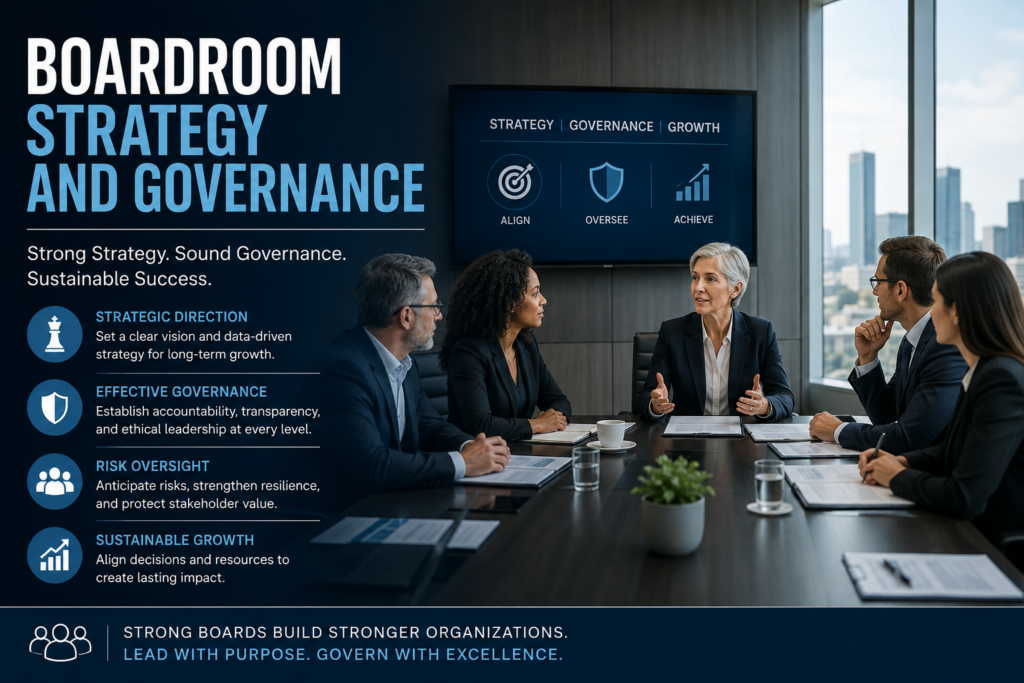
Companies that thrive in today’s competitive landscape understand that effective governance is not simply about compliance. It is about creating strategic alignment, improving decision-making, managing risk, and ensuring leadership accountability.
The strongest organizations recognize that success begins in the boardroom.
What Is Boardroom Strategy and Governance?
Boardroom strategy and governance refer to the processes, structures, and leadership practices that guide organizational direction while ensuring accountability, transparency, and ethical oversight.
Boardroom strategy focuses on:
- Long-term organizational vision
- Competitive positioning
- Growth initiatives
- Innovation planning
- Risk management
- Executive leadership development
Governance focuses on:
- Board effectiveness
- Regulatory compliance
- Ethical decision-making
- Fiduciary responsibility
- Stakeholder accountability
- Organizational oversight
Together, strategy and governance create the framework that allows businesses to grow responsibly while adapting to changing market conditions.
Without both elements working in harmony, organizations often struggle with inconsistent leadership, reactive decision-making, and long-term sustainability challenges.
Why Boardroom Strategy Matters More Than Ever
The pace of business change has accelerated dramatically.
Leaders are expected to make decisions faster while navigating greater uncertainty than ever before. Market disruptions can emerge overnight. Customer expectations evolve rapidly. Competitive threats can come from entirely new industries.
In this environment, boards must move beyond traditional oversight functions and become active strategic partners.
Effective boardroom strategy helps organizations:
Improve Decision-Making
Boards provide diverse perspectives that help executives evaluate opportunities and risks more effectively.
When experienced board members contribute strategic insight, leadership teams gain access to broader expertise and deeper analysis.
Anticipate Future Challenges
Strong boards focus on long-term sustainability rather than short-term performance.
They help organizations identify emerging trends, assess market shifts, and prepare for future disruptions before they become crises.
Support Executive Leadership
Even the most capable CEOs benefit from strategic guidance.
Boards provide accountability, mentorship, and objective feedback that help executives lead with greater clarity and confidence.
Create Competitive Advantage
Organizations with strategic, engaged boards often outperform competitors because they make more informed decisions and adapt more effectively to change.
The Governance Imperative
While strategy drives growth, governance protects the organization.
Strong governance establishes trust among investors, employees, customers, and stakeholders by ensuring transparency, accountability, and ethical leadership.
Effective governance helps organizations:
- Strengthen risk management practices
- Improve compliance and regulatory readiness
- Enhance stakeholder confidence
- Protect organizational reputation
- Support sustainable decision-making
- Promote ethical leadership cultures
Poor governance can create significant vulnerabilities, even in organizations with strong products, talented teams, and healthy revenue growth.
History consistently shows that governance failures often precede major organizational crises.
Key Elements of Effective Boardroom Governance
Successful governance requires more than board meetings and policy reviews.
High-performing boards focus on several critical areas:
Strategic Alignment
Every board decision should support the organization’s mission, vision, and long-term objectives.
When governance and strategy operate independently, organizational effectiveness suffers.
Board Diversity
Diverse boards bring broader perspectives, experiences, and expertise.
Diversity of thought often leads to better decision-making, stronger innovation, and more effective risk assessment.
Leadership Accountability
Boards must establish clear performance expectations for executive leadership while providing the support necessary for success.
Accountability and partnership should coexist.
Risk Oversight
Modern governance requires proactive risk management.
Boards should regularly assess:
- Financial risks
- Cybersecurity threats
- Regulatory changes
- Operational vulnerabilities
- Reputational risks
- Market disruptions
Continuous Evaluation
Effective boards evaluate their own performance regularly.
Continuous improvement strengthens board effectiveness and ensures governance practices evolve alongside organizational needs.
The Growing Importance of Advisory Boards
Many organizations are expanding their governance capabilities through advisory boards.
Unlike boards of directors, advisory boards typically provide strategic expertise without formal governance authority.
Advisory boards offer:
- Industry expertise
- Market insights
- Executive mentorship
- Specialized knowledge
- Strategic guidance
- Expanded professional networks
For growing companies, advisory boards can significantly strengthen boardroom strategy and governance by providing leadership teams with valuable external perspectives.
Organizations that leverage advisory boards effectively often accelerate growth while avoiding common leadership blind spots.
Common Challenges in Boardroom Strategy and Governance
Despite its importance, many organizations struggle to maximize board effectiveness.
Common challenges include:
Reactive Leadership
Boards often spend too much time reviewing past performance and not enough time planning for future opportunities.
Limited Expertise
Boards lacking diverse experience may overlook critical risks or emerging trends.
Poor Communication
Misalignment between executives and board members can create confusion, slow decision-making, and reduce organizational effectiveness.
Governance Without Strategy
Compliance alone does not create growth.
Boards must balance oversight responsibilities with strategic leadership contributions.
Strategy Without Governance
Conversely, organizations focused solely on growth may expose themselves to unnecessary risks if governance structures are weak.
Sustainable success requires both.
Building a High-Performance Boardroom
Organizations seeking stronger boardroom strategy and governance should focus on several key principles:
Recruit Strategic Thinkers
Board members should bring relevant expertise, independent perspectives, and a commitment to long-term organizational success.
Prioritize Leadership Development
Strong boards invest in leadership growth at every level of the organization.
Encourage Constructive Challenge
Healthy debate improves decision quality.
Effective boards create environments where diverse viewpoints are welcomed and respected.
Focus on the Future
While oversight remains important, boards must dedicate significant time to discussing long-term strategy, innovation, and emerging opportunities.
Foster a Culture of Accountability
Accountability should extend throughout the organization, beginning in the boardroom itself.
The Future of Boardroom Strategy and Governance
The role of the board is evolving.
As organizations face increasingly complex challenges, boards are becoming more engaged, more strategic, and more influential than ever before.
The future belongs to organizations that view governance as a competitive advantage rather than a compliance requirement.
Strong boardroom strategy and governance provide the leadership framework necessary to navigate uncertainty, seize opportunities, and create sustainable growth.
The companies that excel tomorrow will be led by boards that embrace both responsibility and vision.
Because ultimately, great governance is not about controlling organizations.
It is about helping them achieve their highest potential.
#BoardroomStrategyAndGovernance, #BoardGovernance, #CorporateGovernance, #BoardroomLeadership, #BusinessStrategy, #AdvisoryBoard, #BoardOfDirectors, #ExecutiveLeadership, #RiskManagement, #StrategicPlanning, #BusinessGrowth, #LeadershipDevelopment, #OrganizationalLeadership, #CorporateStrategy, #BoardEffectiveness, #CEO, #BusinessConsulting, #Boardsi