Growth is rarely accidental.
Behind every organization that consistently expands its market share, adapts to change, and creates lasting value is one defining factor: business growth leadership.
While products, technology, and market opportunities certainly matter, leadership ultimately determines whether organizations capitalize on opportunities or fall behind competitors. Companies that experience sustained growth are guided by leaders who think strategically, empower people, embrace innovation, and continuously adapt to changing business environments.
In today’s rapidly evolving economy, business growth leadership has become one of the most important competitive advantages any organization can develop.
What Is Business Growth Leadership?
Business growth leadership is the ability to guide an organization toward sustainable expansion by aligning people, strategy, innovation, and execution around long-term objectives.
Unlike traditional management, which often focuses on maintaining operations, business growth leadership is centered on creating future opportunities.
Growth leaders ask questions such as:
- Where is our industry heading?
- What emerging trends should we prepare for?
- How can we create more value for customers?
- What capabilities must we develop to remain competitive?
Rather than reacting to change, effective leaders anticipate it.
This forward-looking mindset allows organizations to remain resilient during uncertainty while positioning themselves for long-term success.
Why Business Growth Leadership Matters
Markets evolve faster than ever before.
Artificial intelligence, digital transformation, changing customer expectations, cybersecurity risks, workforce shifts, and global economic uncertainty are reshaping industries at an unprecedented pace.
Organizations can no longer rely solely on historical success.
Business growth leadership enables companies to:
- Develop long-term strategic direction
- Adapt quickly to market disruption
- Encourage innovation across teams
- Build resilient organizational cultures
- Strengthen employee engagement
- Improve decision-making
- Create sustainable competitive advantages
Growth is no longer simply about increasing revenue. It is about building an organization capable of succeeding in constantly changing environments.
The Characteristics of Effective Business Growth Leadership
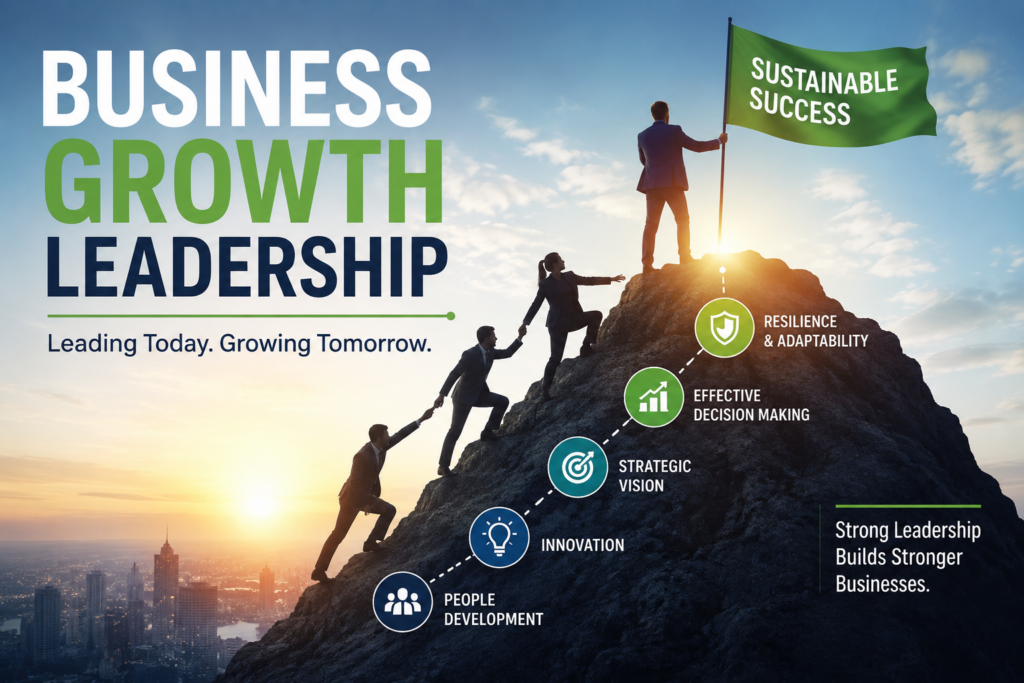
Vision Creates Direction
Every successful organization begins with a clear vision.
Business growth leadership requires leaders who understand where the organization is headed and can communicate that vision effectively.
Employees perform at higher levels when they understand how their work contributes to broader organizational goals.
A compelling vision provides purpose, alignment, and motivation across every level of the company.
Strategic Thinking Drives Growth
Growth leaders spend less time reacting to daily challenges and more time preparing for future opportunities.
Strategic leadership includes:
- Evaluating industry trends
- Identifying competitive threats
- Investing in innovation
- Managing organizational risk
- Allocating resources effectively
Organizations that consistently outperform competitors rarely do so by chance.
They grow because leaders intentionally position them for future success.
People Remain the Greatest Competitive Advantage
Technology may accelerate growth, but people sustain it.
Business growth leadership focuses on developing employees, empowering teams, and creating cultures where individuals can perform at their highest potential.
High-performing organizations invest in:
- Leadership development
- Employee engagement
- Professional growth
- Cross-functional collaboration
- Succession planning
When employees grow, organizations grow.
Strong leaders understand that business success begins with investing in people.
Innovation Fuels Sustainable Growth
Innovation is no longer optional.
Organizations that fail to innovate often lose relevance as customer expectations evolve and competitors introduce new solutions.
Business growth leadership encourages experimentation while creating environments where employees feel comfortable sharing ideas.
Innovation extends beyond products.
It includes:
- Customer experience improvements
- Operational efficiencies
- Digital transformation
- New business models
- Process optimization
Organizations that foster innovation position themselves for long-term growth.
Adaptability Separates Successful Leaders
The business environment changes constantly.
Leaders who resist change often limit organizational growth.
Business growth leadership requires adaptability.
Successful leaders continuously reassess priorities, evaluate emerging risks, and adjust strategies as conditions evolve.
Adaptability allows organizations to respond confidently to uncertainty instead of being overwhelmed by it.
Decision-Making Shapes Organizational Performance
Growth depends on consistently making sound decisions.
Business growth leadership combines data, experience, diverse perspectives, and strategic thinking to improve organizational outcomes.
Effective leaders encourage healthy discussion before making important decisions.
They welcome different viewpoints while maintaining focus on long-term objectives.
Better decisions produce stronger organizations.
Building a Culture That Supports Growth
Culture influences every aspect of organizational performance.
Even the strongest strategies struggle within unhealthy cultures.
Business growth leadership intentionally creates environments built upon:
- Trust
- Accountability
- Collaboration
- Continuous learning
- Transparency
- Shared purpose
Employees are more engaged when they trust leadership and understand organizational priorities.
Healthy cultures create momentum that extends throughout the organization.
The Role of Boards in Business Growth Leadership
Business growth leadership is not limited to executives.
Boards of directors play an essential role in supporting sustainable growth.
Effective boards provide:
- Strategic oversight
- Risk management
- Executive guidance
- Governance expertise
- Industry insight
- Long-term accountability
The strongest organizations benefit from boards that actively challenge assumptions, encourage innovation, and provide valuable external perspectives.
Experienced board members often identify opportunities and risks that operational leaders may overlook.
Leadership Development Drives Future Growth
Organizations cannot expect sustainable growth without developing future leaders.
Business growth leadership includes intentional investment in leadership pipelines across every level of the company.
Leadership development should include:
- Executive coaching
- Mentorship
- Board exposure
- Strategic planning experience
- Cross-functional leadership opportunities
- Continuous education
Leadership is not a position.
It is a capability that must be developed throughout an organization.
Technology and Business Growth Leadership
Digital transformation continues to reshape every industry.
Growth leaders understand that technology should support business strategy rather than operate independently.
Today’s leaders must evaluate how technology impacts:
- Customer engagement
- Operational efficiency
- Data analytics
- Artificial intelligence
- Cybersecurity
- Decision-making
Organizations that successfully integrate technology into their strategic planning often gain significant competitive advantages.
Measuring Business Growth Leadership
Effective leadership should be measured consistently.
Organizations often evaluate business growth leadership through metrics such as:
- Revenue growth
- Market expansion
- Employee engagement
- Leadership development
- Customer retention
- Innovation initiatives
- Operational efficiency
- Strategic execution
Regular assessments help leaders identify strengths while uncovering opportunities for continuous improvement.
Business Growth Leadership Is the Future
Organizations entering the next decade will face increasing complexity.
Success will depend less on size and more on leadership capability.
Business growth leadership enables organizations to anticipate disruption, navigate uncertainty, develop people, and create sustainable value for customers and stakeholders alike.
Companies that invest in leadership today will be better positioned to compete tomorrow.
Final Thoughts
Business growth leadership is far more than a management philosophy.
It is the foundation of sustainable organizational success.
Leaders who combine strategic thinking, innovation, accountability, adaptability, and people development create organizations that consistently outperform competitors over the long term.
As markets continue to evolve, organizations that prioritize business growth leadership will be best equipped to seize opportunities, overcome challenges, and build lasting competitive advantages.
Growth is never simply the result of favorable conditions.
It is the outcome of intentional leadership.
Call to Action
At Boardsi, we connect organizations with experienced executives and accomplished board members who bring strategic insight, governance expertise, and leadership experience to accelerate business growth. Whether you’re building your first advisory board or strengthening an existing board of directors, the right leadership can help position your organization for long-term success.
#BusinessGrowthLeadership, #BusinessGrowth, #Leadership, #StrategicLeadership, #ExecutiveLeadership, #BoardLeadership, #CorporateGovernance, #BoardOfDirectors, #BusinessStrategy, #LeadershipDevelopment, #OrganizationalGrowth, #Innovation, #DigitalTransformation, #StrategicPlanning, #Boardsi