Governance Framework: Why Every Successful Organization Needs a Strong Foundation for Leadership
Great organizations are not built on strategy alone. They are built on the systems, principles, and leadership practices that turn strategy into sustainable results.
Behind every high-performing board of directors is an essential structure that often receives less attention than it deserves: a strong governance framework.
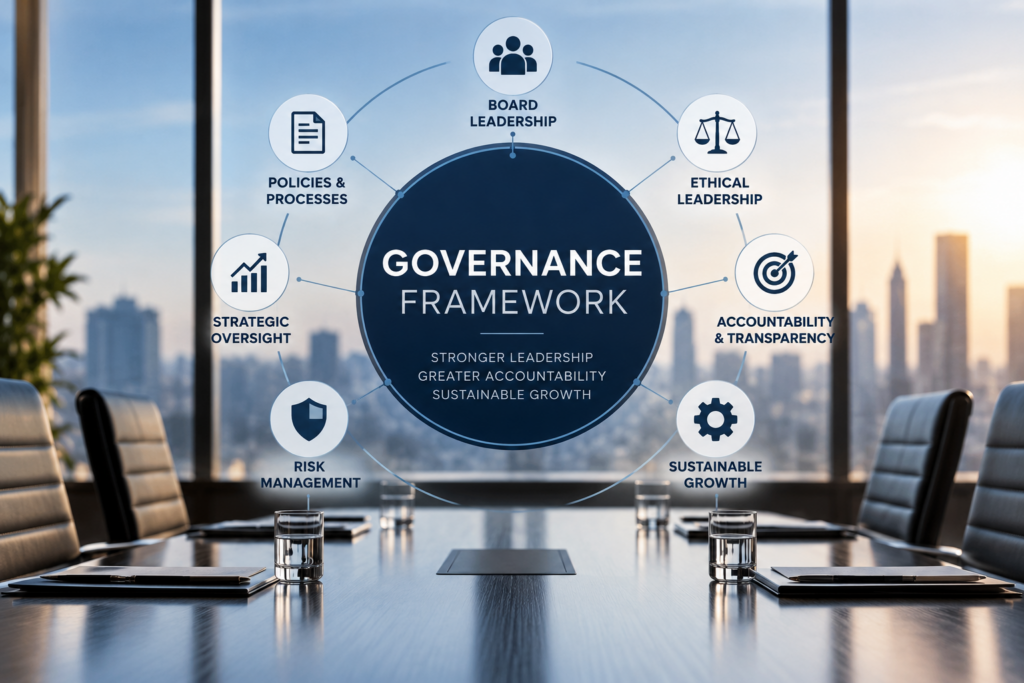
A governance framework establishes how an organization makes decisions, assigns responsibilities, manages risks, and holds leadership accountable. It provides the foundation for effective oversight while ensuring that the board, executive leadership, and stakeholders remain aligned around long-term objectives.
In today’s increasingly complex business environment, governance is no longer simply a matter of regulatory compliance. It has become a strategic advantage.
Organizations that prioritize effective governance are better positioned to navigate uncertainty, strengthen stakeholder confidence, and pursue sustainable growth.
For executives preparing to serve on corporate boards, understanding how a governance framework operates is equally important. Board leadership requires a different perspective from executive management, one grounded in oversight, accountability, and long-term value creation.
What Is a Governance Framework?
A governance framework is the structured system of policies, processes, responsibilities, and decision-making principles that guides how an organization is directed and controlled.
It defines the relationships among the board of directors, executive management, shareholders, and other stakeholders.
At its core, a governance framework answers several critical questions:
- Who has the authority to make important decisions?
- How are organizational priorities established and monitored?
- What responsibilities belong to the board versus executive management?
- How are financial, operational, and strategic risks managed?
- What mechanisms ensure accountability, transparency, and ethical conduct?
- How does the organization evaluate leadership performance and long-term success?
Without clear answers, even well-intentioned leadership teams can experience confusion, inconsistent decisions, and unnecessary exposure to risk.
An effective corporate governance framework creates clarity. It establishes the boundaries within which leaders operate while providing the flexibility necessary to respond to changing business conditions.
Why a Strong Governance Framework Matters
Governance is sometimes misunderstood as a collection of policies and procedures designed primarily to satisfy legal requirements.
Although compliance is an important component, effective governance serves a much broader purpose.
A well-designed governance framework helps organizations make better decisions, strengthen oversight, and maintain alignment between immediate priorities and long-term objectives.
1. It Creates Clear Accountability
One of the greatest challenges in organizational leadership is determining who is responsible for what.
When accountability is unclear, important decisions can be delayed, responsibilities can overlap, and performance expectations can become inconsistent.
A strong governance framework defines authority and responsibility across the organization.
The board oversees strategy, risk, executive performance, and organizational direction. Executive management is responsible for implementing strategy and managing daily operations.
This distinction is essential.
Boards that become overly involved in operational decisions risk weakening management authority. Conversely, boards that provide insufficient oversight may fail to identify emerging threats or strategic problems.
Effective governance creates the right balance between leadership autonomy and accountability.
2. It Strengthens Strategic Decision-Making
Boards are responsible for looking beyond immediate operational challenges.
Their role is to consider the organization’s future, evaluate major strategic choices, and ensure that leadership decisions support long-term value creation.
A governance framework provides a disciplined approach to strategic oversight.
Through clearly defined reporting structures, decision-making protocols, and performance measures, directors gain the information necessary to evaluate organizational direction.
This enables boards to ask more meaningful questions.
Is the organization investing in the right opportunities?
Does the current strategy reflect changing market conditions?
Are resources being allocated effectively?
What assumptions could threaten future performance?
A strong governance structure does not guarantee perfect decisions. It creates the conditions for better-informed decisions.
3. It Improves Risk Management
Every organization faces uncertainty.
Economic volatility, cybersecurity threats, regulatory changes, competitive disruption, and reputational challenges can quickly affect performance.
A governance framework establishes how these risks are identified, assessed, monitored, and escalated.
It also clarifies the board’s role in overseeing risk management without assuming responsibility for day-to-day risk controls.
Effective board governance requires directors to understand the organization’s risk appetite, challenge management assumptions, and evaluate whether appropriate safeguards exist.
Rather than treating risk management as a separate compliance exercise, successful organizations integrate it into strategic planning and decision-making.
This approach helps leaders recognize that risk and opportunity are often closely connected.
4. It Builds Stakeholder Confidence
Trust is one of an organization’s most valuable assets.
Investors, employees, customers, regulators, and business partners want confidence that leadership decisions are responsible, transparent, and aligned with organizational commitments.
A strong governance framework supports that confidence through consistent standards of conduct, financial oversight, ethical leadership, and appropriate disclosure.
When stakeholders understand how an organization is governed, they can better assess its credibility and leadership effectiveness.
Governance alone cannot create trust. But weak governance can undermine it quickly.
5. It Supports Sustainable Business Growth
Growth introduces complexity.
As organizations expand into new markets, develop new products, acquire businesses, or attract additional investors, leadership structures must evolve.
Governance practices that work for an early-stage company may become inadequate as the business grows.
A scalable governance framework helps organizations manage this transition.
It provides continuity as leadership teams change, responsibilities expand, and strategic priorities become more sophisticated.
Rather than slowing growth, effective governance can help organizations pursue ambitious objectives with greater discipline and confidence.
The Seven Essential Components of an Effective Governance Framework
Although governance structures vary according to organizational size, ownership, industry, and regulatory requirements, most effective frameworks share several foundational components.
1. Clearly Defined Board Roles and Responsibilities
The board must understand its responsibilities and the limits of its authority.
A formal board charter can establish expectations related to strategic oversight, executive accountability, financial stewardship, risk management, and governance practices.
It should also clarify the relationship between the board chair, individual directors, board committees, and executive leadership.
Clear responsibilities reduce confusion and allow directors to focus on their highest-value contributions.
2. Board Composition and Independence
The effectiveness of a governance framework depends partly on the people responsible for implementing it.
A board should possess the experience, skills, independence, and judgment necessary to oversee the organization’s strategy and risks.
Depending on the business, relevant expertise may include finance, technology, cybersecurity, operations, regulatory affairs, human capital, international expansion, and industry-specific knowledge.
Diversity of professional experience and perspective can improve the quality of boardroom discussions by challenging assumptions and broadening strategic understanding.
Board composition should be evaluated regularly as organizational needs evolve.
3. Committee Structure and Oversight
Board committees allow directors to devote focused attention to important areas of responsibility.
Common committees include:
- Audit Committee: Oversees financial reporting, external audit matters, and relevant internal controls.
- Compensation Committee: Reviews executive compensation and incentive alignment.
- Nominating and Governance Committee: Oversees director nominations, board composition, succession planning, and governance practices.
- Risk Committee: Provides dedicated oversight of significant enterprise risks where the organization’s structure and risk profile warrant it.
Committee responsibilities should be documented, coordinated, and regularly reviewed.
Committees support the board’s work, but they do not eliminate the full board’s ultimate oversight responsibilities.
4. Ethical Standards and Organizational Values
Governance is not effective simply because policies exist.
It becomes effective when leadership behavior consistently reflects organizational values.
A governance framework should include clear expectations regarding conflicts of interest, ethical conduct, confidentiality, compliance, and responsible decision-making.
Directors and executives must also demonstrate those standards through their actions.
When leaders model integrity, they help establish a culture in which accountability becomes an organizational expectation rather than an administrative requirement.
5. Risk Management and Internal Controls
Effective governance requires reliable systems for monitoring organizational exposure.
These systems may include enterprise risk assessments, internal controls, compliance programs, cybersecurity oversight, business continuity planning, and escalation procedures.
Boards should receive timely, decision-relevant information about significant risks and the effectiveness of management’s response.
The objective is not to eliminate every risk.
It is to ensure that risks are understood, managed within appropriate boundaries, and considered alongside strategic opportunities.
6. Performance Measurement and Reporting
A governance framework must connect oversight responsibilities to measurable organizational outcomes.
Boards need accurate information about financial performance, strategic progress, operational resilience, organizational culture, and emerging risks.
Effective reporting should emphasize insights rather than overwhelming directors with excessive data.
The most useful board dashboards help directors identify trends, challenge assumptions, and recognize when corrective action may be necessary.
Boards should also assess their own effectiveness through periodic evaluations of board performance, committee practices, director contributions, and governance processes.
7. Succession Planning and Leadership Continuity
Leadership transitions can significantly affect organizational stability.
A strong governance framework includes succession planning for the chief executive officer and other critical leadership positions.
It should also address board succession, director development, and the skills required for future organizational challenges.
Effective succession planning is not simply about identifying replacements.
It is about preparing the organization to maintain strategic continuity through change.
How to Build a Governance Framework That Works
Developing a governance framework requires more than adopting standard policies or replicating another organization’s board structure.
The most effective frameworks are designed around an organization’s specific needs, strategic priorities, ownership model, and risk profile.
A practical approach involves five steps.
Step 1: Assess the Current Governance Structure
Begin by evaluating how decisions are currently made and how responsibilities are distributed.
Review existing board charters, committee mandates, reporting practices, risk oversight procedures, and executive accountability mechanisms.
Identify areas where authority is unclear, oversight is inconsistent, or governance processes no longer reflect organizational complexity.
This assessment establishes a realistic starting point for improvement.
Step 2: Define Governance Objectives
Determine what the governance framework must accomplish.
For some organizations, the priority may be strengthening financial oversight or preparing for institutional investment.
For others, it may involve improving strategic alignment, managing rapid expansion, or increasing board effectiveness.
Clear objectives help ensure that governance improvements address meaningful organizational needs rather than adding unnecessary bureaucracy.
Step 3: Establish Decision-Making Authority
Document which decisions require board approval, which belong to management, and which responsibilities are delegated to committees.
This may involve creating or updating a delegation of authority policy, board charter, and committee charters.
The goal is to establish clear decision rights while preserving management’s ability to execute efficiently.
Step 4: Implement Reporting and Accountability Systems
A governance framework is only as useful as the information and processes supporting it.
Develop reporting practices that give directors timely visibility into strategic progress, financial performance, significant risks, and organizational priorities.
Establish regular board and committee meetings, appropriate escalation procedures, and mechanisms for following up on important decisions.
Governance should support meaningful dialogue, not simply the circulation of reports.
Step 5: Review and Adapt the Framework
Governance is not a one-time project.
Business models evolve, regulations change, and new risks emerge.
Boards should periodically evaluate whether their governance framework remains appropriate for the organization’s strategy, complexity, and operating environment.
Regular review allows organizations to improve oversight before weaknesses develop into larger problems.
Governance Framework vs. Corporate Governance: Understanding the Difference
The terms governance framework and corporate governance are closely related, but they describe different aspects of organizational oversight.
Corporate governance
refers to the broader system through which companies are directed, controlled, and held accountable.
A governance framework is the practical structure used to implement that system.
Corporate governance establishes the principles of responsible oversight. The governance framework translates those principles into defined roles, policies, processes, and reporting mechanisms.
For example, transparency is a corporate governance principle.
A governance framework puts transparency into practice through financial reporting requirements, disclosure policies, board information protocols, and accountability procedures.
Understanding this distinction helps directors move beyond abstract governance principles and focus on how those principles operate in practice.
The Role of the Board of Directors in Governance Framework Effectiveness
Even the most thoughtfully designed governance framework will fail if directors do not actively fulfill their responsibilities.
Effective governance depends on board members who are prepared to ask difficult questions, exercise independent judgment, and prioritize the organization’s long-term interests.
This requires directors to move beyond reviewing management presentations and approving recommendations.
Strong board members seek to understand the assumptions behind strategic decisions. They recognize emerging risks, evaluate competing priorities, and contribute perspectives informed by their professional experience.
They also understand that governance is a collective responsibility.
Individual expertise matters, but board effectiveness ultimately depends on the quality of discussion, constructive challenge, collaboration, and decision-making across the entire board.
For executives pursuing board opportunities, this represents an important shift in mindset.
Executive leadership often focuses on making decisions and delivering results.
Board leadership focuses on ensuring that the right decisions are being made through effective oversight, informed judgment, and accountability.
That distinction is central to becoming a valuable director.
Common Governance Framework Mistakes Organizations Should Avoid
A governance framework can become ineffective when its structure creates the appearance of oversight without producing meaningful accountability.
Several common mistakes deserve attention.
Overcomplicating governance processes. Excessive policies, unnecessary approvals, and overlapping responsibilities can slow decision-making without improving oversight.
Failing to distinguish governance from management. Directors who become too involved in daily operations may undermine executive authority and lose sight of strategic responsibilities.
Treating compliance as the ultimate objective. Meeting legal requirements is essential, but governance should also improve organizational judgment, resilience, and performance.
Neglecting board development. Directors need ongoing education and exposure to emerging issues to remain effective as business conditions change.
Failing to update governance practices. A framework designed for yesterday’s organization may not adequately support tomorrow’s challenges.
The most effective governance systems strike a balance between structure and adaptability.
They provide clear expectations without limiting the organization’s ability to innovate, respond, and grow.
Why Governance Expertise Matters for Aspiring Board Members
As board responsibilities become more complex, organizations need directors who can contribute more than executive experience alone.
They need leaders who understand governance principles and can apply them to real business challenges.
For aspiring board members, developing governance expertise can strengthen board readiness in several important ways.
First, it demonstrates an understanding of the distinction between executive authority and board oversight.
Second, it enables candidates to articulate how their professional experience supports strategic decision-making, risk management, and organizational accountability.
Third, it helps prospective directors identify the types of boards where their expertise may provide the greatest value.
A technology executive, for example, may contribute meaningful insight into cybersecurity oversight and digital transformation.
A financial leader may bring experience in capital allocation, audit oversight, and financial risk.
An operations executive may offer valuable perspectives on organizational resilience, scaling, and performance management.
The key is translating professional accomplishments into contributions that matter at the board level.
This is where thoughtful board positioning becomes essential.
How Boardsi Helps Connect Executive Expertise With Board Opportunities
Understanding governance is an important step toward effective board leadership. Finding the right opportunity to apply that knowledge is another.
At Boardsi, the focus is on connecting executive talent with organizations seeking board-level expertise and leadership perspectives.
For executives exploring board service, the process begins with understanding the value they can contribute beyond their current management responsibilities.
That includes identifying governance-related strengths, articulating strategic expertise, and positioning professional experience for relevant board opportunities.
For organizations, building an effective board means identifying leaders whose knowledge, judgment, and experience align with strategic priorities and oversight needs.
The right board composition can strengthen a governance framework by bringing complementary expertise and independent perspectives into the boardroom.
Effective governance requires both sound structures and capable people.
Neither can fully substitute for the other.
The Future of Governance Frameworks: More Strategic, Adaptive, and Accountable
The expectations placed on boards continue to evolve.
Emerging technologies, artificial intelligence, cybersecurity, regulatory complexity, geopolitical uncertainty, and changing stakeholder expectations are expanding the range of issues directors must understand.
As a result, governance frameworks must become more adaptive.
Boards need processes that support timely information sharing, ongoing director education, thoughtful risk assessment, and strategic responsiveness.
They must also recognize that governance effectiveness cannot be measured solely by the existence of formal policies.
The more meaningful question is whether those policies improve leadership decisions and organizational outcomes.
Future-ready boards will be those that combine strong governance discipline with the curiosity and flexibility to challenge established assumptions.
Final Thoughts: Governance Is the Foundation of Lasting Leadership
A strong governance framework does more than define rules.
It establishes how leadership responsibility is exercised, how decisions are evaluated, and how organizations protect and create long-term value.
For companies, effective governance strengthens accountability, strategic alignment, risk oversight, and stakeholder confidence.
For executives, understanding governance creates a pathway toward more meaningful contributions in the boardroom.
The most successful organizations recognize that governance is not separate from leadership.
It is one of the ways leadership becomes sustainable.
The question is not simply whether your organization has a governance framework. It is whether that framework is helping your leaders make better decisions today while preparing the organization for tomorrow.
Explore Boardsi to learn more about executive board opportunities, board leadership, and the expertise organizations need to strengthen their boards.
Frequently Asked Questions About Governance Frameworks
What is a governance framework in business?
A governance framework is a structured system of policies, responsibilities, decision-making processes, and oversight mechanisms that guides how an organization is directed and controlled. It helps establish accountability, manage risk, and align leadership decisions with strategic objectives.
What are the main components of a governance framework?
Key components typically include board roles and responsibilities, board composition, committee structures, ethical standards, risk management, internal controls, performance reporting, and succession planning.
Why is a governance framework important?
A governance framework helps organizations clarify decision-making authority, strengthen accountability, improve risk oversight, support strategic planning, and build stakeholder confidence.
Who is responsible for a governance framework?
The board of directors generally oversees the organization’s governance framework, while executive management implements relevant policies, controls, and operational processes. Specific responsibilities depend on the organization’s structure and applicable legal requirements.
How often should a governance framework be reviewed?
Organizations should review their governance framework periodically and whenever significant changes occur, such as major acquisitions, leadership transitions, regulatory developments, or shifts in business strategy. Many boards incorporate governance reviews into their annual evaluation cycle.
How does a governance framework improve board effectiveness?
A governance framework improves board effectiveness by clarifying responsibilities, establishing decision-making processes, organizing oversight activities, and ensuring directors receive information needed to exercise informed judgment.
#GovernanceFramework, #CorporateGovernance, #BoardLeadership, #BoardOfDirectors, #BoardGovernance, #ExecutiveLeadership, #CorporateAccountability, #BoardEffectiveness, #StrategicLeadership, #RiskManagement, #BoardReadiness, #BusinessGrowth, #LeadershipDevelopment, #Boardsi