
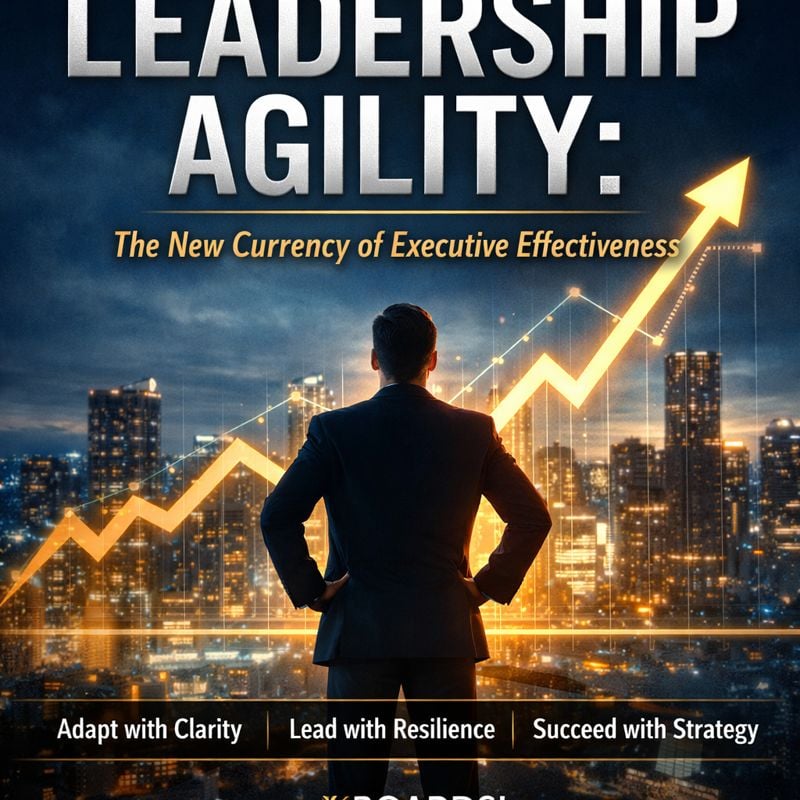
In a business climate defined by constant flux, yesterday’s strategies are obsolete before they’re implemented. The pressure is mounting—from digital disruption to workforce transformation to a rapidly shifting geopolitical landscape. Against this backdrop, a new leadership imperative is emerging: agility.
Leadership agility is not simply a soft skill. It’s the defining characteristic of effective executives in the modern era. More than IQ, EQ, or technical acumen, agility separates those who thrive in turbulence from those who get stuck in legacy thinking.
What Is Leadership Agility?
At its core, leadership agility is the capacity to adapt quickly and intelligently in the face of change, while maintaining strategic focus and emotional steadiness. Agile leaders pivot when necessary but don’t drift. They listen deeply but decide swiftly. They revise plans without compromising vision.
Agility, in this context, is not about speed—it’s about precision in movement. It’s the executive’s ability to read the field, sense what’s shifting, and act with both confidence and humility.
Why Agility Now?
Organizations once competed on scale, efficiency, and even data. Today, they compete on adaptability. The shelf life of a business model is shrinking. Customer preferences evolve overnight. Market-entry barriers are falling across industries.
In this environment, executive effectiveness isn’t about having all the answers. It’s about being able to ask better questions, engage in dynamic learning, and rally teams around evolving priorities.
Rigid leadership slows companies down. Agile leadership accelerates them.
The Three Dimensions of Agile Leadership
Cognitive Agility: Effective executives today must process complexity and ambiguity with clarity. They must be systems thinkers who synthesize competing priorities and anticipate second-order consequences. It’s not about binary decisions—it’s about managing paradoxes.
Emotional Agility: The emotionally agile leader maintains poise in volatility. They embrace feedback without defensiveness, navigate conflict with empathy, and bounce back from setbacks without losing morale. This type of resilience is what allows leaders to inspire during uncertainty.
Strategic Agility: This is where vision meets execution. Leaders with strategic agility don’t wait for perfect conditions. They place smart bets, iterate rapidly, and evolve strategy in real-time. They empower teams to move fast but stay aligned with purpose.
Building Leadership Agility in the C-Suite
Leadership agility isn’t innate—it’s developed. The most effective executives make agility a daily practice. Here’s how:
Prioritize Learning Over Knowing: Curiosity beats certainty. The best leaders stay students of their business and their people.
Create Feedback-Rich Cultures: Agility thrives in environments where candid dialogue is safe and expected. This includes feedback flowing up, down, and across.
Diversify Your Inner Circle: Homogeneous teams breed blind spots. Agile leaders surround themselves with diverse thinkers who challenge assumptions.
Practice Strategic Reframing: When confronted with disruption, ask not just “How do we survive?” but “How might this become a catalyst for growth?”
Boards, Agility, and the Future of Governance
At Boardsi, we see firsthand that leadership agility isn’t just an executive advantage—it’s a board-level necessity. Agile boards make space for bold discussions. They adapt oversight models. They push for innovation while protecting core values.
Companies that prioritize leadership agility at the board and executive levels are better positioned to navigate uncertainty, attract top talent, and deliver sustained performance.
Final Thought: Agility as a Legacy
In a world where the only constant is change, agility isn’t reactive. It’s proactive. It’s not about being flexible to the point of formlessness. It’s about having the range and depth to flex with integrity, lead with clarity, and execute with impact.
Ultimately, leadership agility is not just a method—it’s a mindset. And for the modern executive, it may be the most powerful legacy you can build.
#LeadershipAgility,#ExecutiveEffectiveness,#AgileLeadership,#Boardsi,#StrategicLeadership,#CLevelLeadership,#LeadershipDevelopment,#CorporateGovernance,#MartinRowinski,#AdaptiveLeadership