
In boardrooms around the world, performance is discussed frequently—but measured inconsistently. Directors review financials, approve strategy, and monitor risk. Yet one critical question often goes unexamined: How do we know if the board itself is performing at a high level?
In an era where governance is expected to drive—not just protect—enterprise value, board performance metrics are no longer optional. They are foundational.
From Oversight to Impact
Traditionally, board effectiveness has been evaluated through compliance lenses: attendance rates, committee participation, and adherence to governance protocols. These are necessary—but insufficient.
High-performing boards recognize a fundamental shift. Their role is no longer limited to oversight. It now includes:
- Enabling strategic clarity
- Accelerating decision-making
- Expanding organizational access
- Strengthening long-term resilience
The challenge is that these outcomes are harder to measure—but far more meaningful.
The Four Dimensions of Board Performance
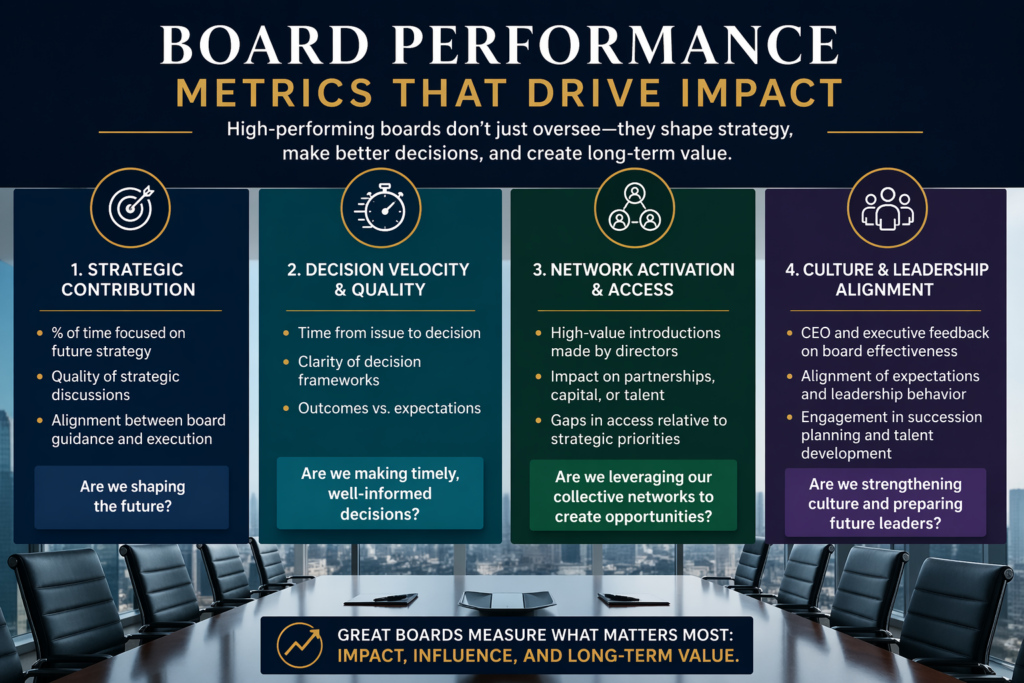
The most effective boards measure performance across four interconnected dimensions. Together, they create a balanced view of governance impact.
1. Strategic Contribution
A board’s primary responsibility is not to manage—but to ensure the right strategy is in place.
Key metrics include:
- Percentage of board time dedicated to forward-looking strategy vs. historical review
- Speed and quality of strategic decision-making
- Alignment between board guidance and executive execution
A simple test: Is the board shaping the future—or reviewing the past?
2. Decision Velocity and Quality
In today’s environment, speed is a competitive advantage. But speed without rigor is risk.
Boards should assess:
- Time from issue identification to decision
- Clarity of decision frameworks
- Post-decision outcomes versus expectations
Great boards don’t just make decisions. They make timely, well-informed decisions that hold up under pressure.
3. Network Activation and Access
One of the most underutilized assets in governance is the collective network of the board.
Metrics here include:
- Number of high-value introductions made by directors
- Impact of those introductions on partnerships, capital, or talent
- Gaps in access relative to strategic priorities
When measured intentionally, this shifts the board from a passive body to an active growth engine.
4. Culture and Leadership Alignment
Boards shape culture—whether intentionally or not.
Performance indicators include:
- CEO and executive feedback on board effectiveness
- Alignment between board expectations and leadership behavior
- Board engagement in succession planning and leadership development
Culture is not a soft metric. It is a leading indicator of long-term performance.
The Pitfall of Vanity Metrics
Many boards fall into the trap of measuring what is easy instead of what is meaningful.
Attendance rates. Meeting length. Number of agenda items.
These metrics create the illusion of productivity without capturing real impact.
A board can have perfect attendance and still be ineffective.
The goal is not activity. It is influence.
Embedding Metrics into Board Culture
Metrics only matter if they are used.
Leading boards operationalize performance measurement through:
- Annual and quarterly board evaluations tied to strategic outcomes
- Independent third-party assessments for objectivity
- Real-time feedback loops between directors and executives
Most importantly, they treat board performance as a continuous improvement process—not a compliance exercise.
A New Standard for Governance
John Maxwell’s principle that “everything rises and falls on leadership” applies as much to boards as it does to executives.
If the board is misaligned, slow, or disconnected, the organization will feel it—strategically and culturally.
But when boards measure what truly matters, something powerful happens:
- Conversations
- become sharper
- Decisions become faster
- Accountability becomes real
And governance evolves from a static function into a dynamic advantage.
Final Thought
Boards do not create value by sitting in meetings.
They create value by shaping decisions, opening doors, and guiding organizations through complexity.
The question is not whether your board is busy.
It is whether your board is effective—and whether you are measuring what proves it.
#boardgovernance, #corporategovernance, #leadership, #businessstrategy, #executiveleadership, #boardofdirectors, #governance, #businessgrowth