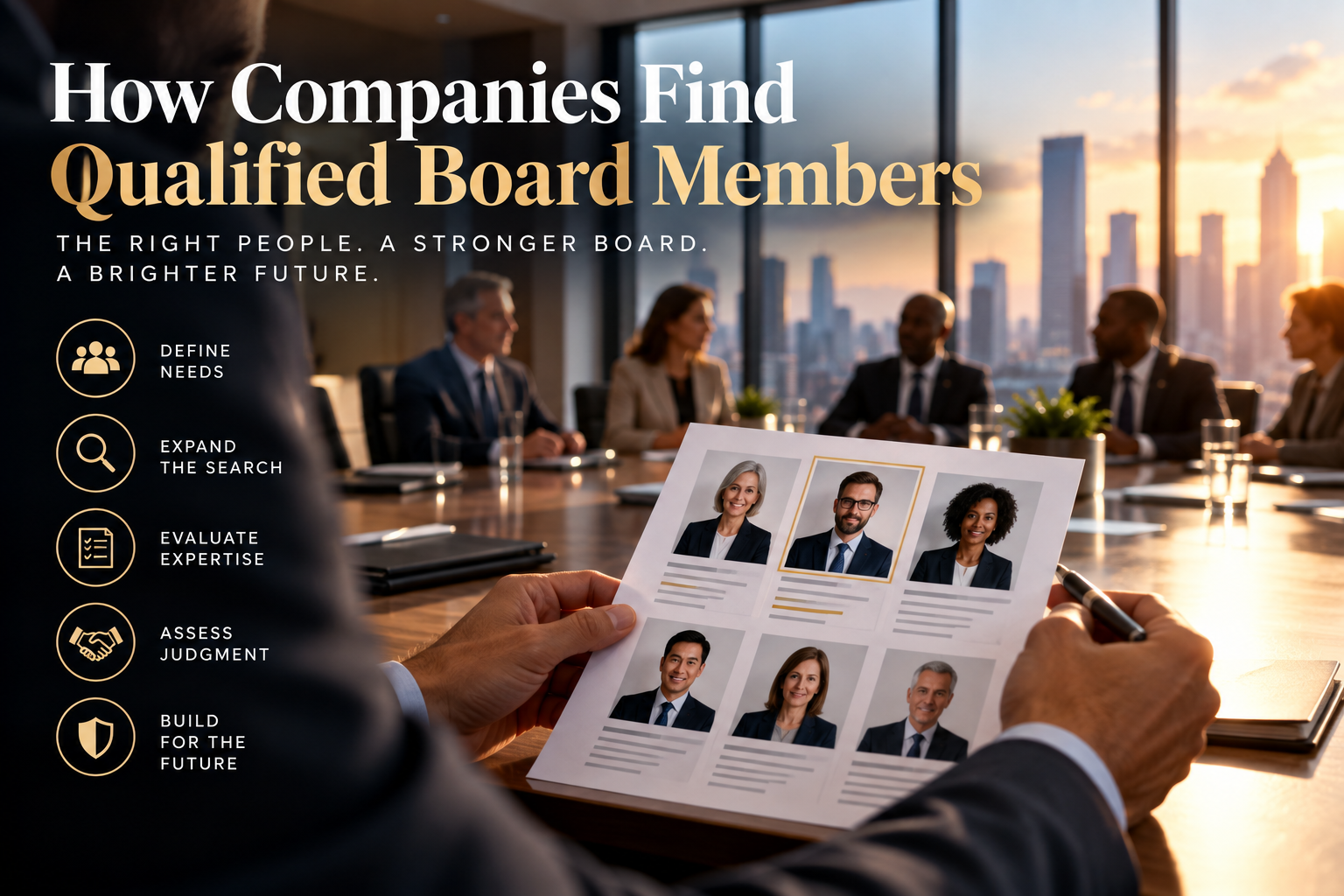

When organizations discuss growth, innovation, and competitive advantage, the conversation often centers on leadership teams, business strategy, and market opportunities.
Far less attention is given to one of the most influential decisions a company can make: selecting the right board members.
Yet board appointments have consequences that extend far beyond governance. The individuals who occupy board seats influence strategic direction, leadership development, risk management, succession planning, and long-term organizational resilience.
The challenge is that many organizations still approach board recruitment as a networking exercise rather than a strategic matching process.
In today’s business environment, that approach is no longer sufficient.
The future belongs to organizations that treat board candidate matching as a critical leadership strategy.
The End of One-Size-Fits-All Boards
Historically, board recruitment often focused on reputation, industry status, or personal relationships.
Companies sought recognizable names that would enhance credibility with investors, stakeholders, or the broader business community.
While reputation remains valuable, organizations increasingly recognize that prestige alone does not create board effectiveness.
A highly accomplished executive may be an exceptional leader yet still be the wrong fit for a particular board.
The question is no longer:
“Who is available?”
The question is:
“Who can help this organization achieve its future objectives?”
Effective board candidate matching begins with understanding where the company is headed rather than where it has been.
Strategy Should Drive Board Composition
Every organization faces a unique set of opportunities and challenges.
A technology company preparing for rapid expansion may require directors with experience in scaling businesses.
A healthcare organization navigating regulatory complexity may benefit from expertise in compliance and public policy.
A family-owned business approaching succession may need leaders skilled in governance transitions and organizational continuity.
The strongest boards are intentionally built around strategic needs.
Rather than filling vacancies, they fill capability gaps.
This shift transforms board recruitment from an administrative process into a strategic advantage.
Beyond Skills and Experience
While qualifications matter, effective board candidate matching extends far beyond résumés.
The most successful boards evaluate three critical dimensions.
Capability
Can the candidate contribute expertise that aligns with the organization’s future needs?
Industry knowledge, financial acumen, cybersecurity experience, artificial intelligence expertise, and global market understanding may all be valuable depending on the company’s objectives.
Culture
Will the candidate strengthen the board’s culture and dynamics?
Even highly accomplished directors can become ineffective if their leadership style creates friction or discourages healthy dialogue.
Board effectiveness depends heavily on trust, communication, and mutual respect.
Contribution
Will the candidate actively engage in meaningful discussions and provide thoughtful guidance?
The best directors do more than attend meetings.
They challenge assumptions, ask difficult questions, and help leadership teams think more strategically.
The difference between a good board member and a transformative board member often lies in the quality of their contribution.
Why Diversity Improves Board Matching
One of the most significant developments in modern governance is the growing recognition that diversity strengthens board performance.
Diversity is often discussed through demographic representation, and that remains important.
However, organizations should also consider diversity of experience, expertise, thought processes, and leadership approaches.
Boards composed of individuals with similar backgrounds frequently encounter groupthink.
Boards composed of leaders with varied perspectives tend to produce more robust discussions, better risk assessments, and stronger strategic decisions.
Effective matching is not about finding directors who think alike.
It is about finding directors who think differently while remaining aligned around the organization’s mission and values.
Technology Is Transforming the Process
Board recruitment has traditionally relied on personal networks and executive search firms.
Today, technology is introducing a more data-driven approach.
Sophisticated board matching platforms can evaluate leadership experience, industry expertise, governance background, strategic competencies, and organizational needs to identify stronger candidate alignments.
These tools do not replace human judgment.
They enhance it.
Technology allows organizations to expand beyond familiar networks and discover candidates who may otherwise remain invisible.
As boards increasingly seek expertise in emerging fields such as artificial intelligence, cybersecurity, sustainability, and digital transformation, technology-driven matching will become even more valuable.
The Cost of a Poor Match
Most organizations recognize the financial cost of a bad executive hire.
Few fully appreciate the cost of a poor board appointment.
An ineffective director can slow decision-making, weaken board dynamics, create strategic blind spots, and limit organizational growth.
Because board terms often last several years, the impact can be significant and long lasting.
In many cases, organizations do not realize a mismatch exists until critical decisions must be made during periods of uncertainty or crisis.
By then, valuable time and opportunities may have already been lost.
The Future of Board Recruitment
The organizations that will thrive in the coming decade are those that recognize board recruitment as a strategic discipline rather than a governance requirement.
They will focus less on prestige and more on alignment.
Less on relationships and more on contribution.
Less on filling seats and more on building capabilities.
Board candidate matching represents the evolution of corporate governance.
It acknowledges a simple but powerful truth:
The effectiveness of an organization is shaped not only by the leaders running the company but also by the leaders advising them.
Final Thoughts
Great boards do not happen by accident.
They are intentionally designed through thoughtful selection, strategic alignment, and a clear understanding of future organizational needs.
As companies navigate increasing complexity, disruption, and uncertainty, board candidate matching will become one of the most important leadership decisions executives and nominating committees make.
The right director does more than occupy a seat at the table.
They help shape the future of the organization.
And in a world where leadership quality increasingly determines organizational success, that may be one of the most valuable contributions any board member can make.
#BoardOfDirectors, #CorporateGovernance, #BoardLeadership, #ExecutiveLeadership, #Leadership, #BusinessStrategy, #BoardRecruitment, #Governance, #LeadershipDevelopment, #StrategicLeadership, #CorporateBoards, #BoardEffectiveness, #BusinessGrowth, #DirectorRecruitment, #BoardDiversity