
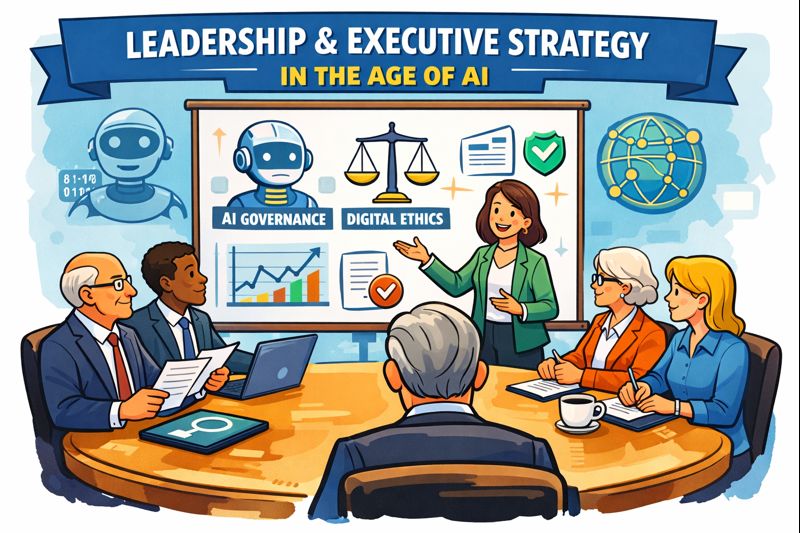
In a business environment transformed by artificial intelligence, big data, and evolving stakeholder expectations, the role of executive leadership is undergoing its most significant shift in decades. For today’s board members, CEOs, and executive teams, it is no longer enough to deliver short-term gains or maintain status quo governance models. The future belongs to leaders who can blend strategic vision with technological literacy, ethical foresight, and cultural stewardship.
The New Mandate: Strategic Leadership Meets AI
Leadership and executive strategy are being reshaped by the accelerating pace of technology. AI now informs everything from supply chain optimization to customer engagement, talent acquisition, and product development. Boards and C-suites must understand how algorithmic systems work, what data they use, and whether their outputs align with the company’s mission and values.
This means executive strategy can no longer be developed in isolation from digital transformation. Leaders must become conversant in AI ethics, cybersecurity, digital resilience, and data governance to drive responsible innovation and mitigate risk.
Digital Ethics Is a Boardroom Issue
One of the most urgent developments in leadership today is the rise of digital ethics as a core governance responsibility. AI and data-driven tools come with profound ethical risks, including bias, discrimination, lack of transparency, and misuse of consumer data. Regulatory bodies are catching up quickly, with legislation such as the EU AI Act and the U.S. Executive Order on AI placing greater accountability on organizations.
For executive teams, this signals a need for proactive AI governance frameworks. Boards should not only demand transparency and explainability from technology teams but should also set the cultural tone that prioritizes integrity over expediency.
Strategic Leadership Requires Diverse Expertise
A future-ready executive strategy requires more than business acumen. Boards should consider adding leaders with backgrounds in AI, data science, cybersecurity, and digital law. This kind of cognitive diversity helps organizations foresee unintended consequences, challenge blind spots, and adapt to emerging challenges.
Moreover, executive leaders must invest in continuous learning. Digital transformation is not a one-time pivot—it’s an ongoing journey that requires curiosity, humility, and the ability to ask better questions.
From Risk Mitigation to Competitive Advantage
The organizations that will thrive in the next decade will not be those that simply manage technological risk, but those that embrace responsible leadership and executive strategy as a source of differentiation. Companies that lead on digital ethics will earn trust, attract top talent, and open new markets.
As we enter an era where AI and automation influence every decision, leadership must become more human, not less. Empathy, transparency, and principled thinking are no longer “soft skills”—they are strategic imperatives.
Conclusion: Redefining Executive Strategy for the Future
The age of AI demands a new kind of leadership—one grounded in strategic clarity, digital fluency, and moral courage. Boardsi.com helps connect forward-thinking executives with companies looking to future-proof their leadership. If your board is ready to evolve, now is the time to align leadership and executive strategy with the digital age.
#Leadership, #ExecutiveStrategy, #AIGovernance, #DigitalEthics, #BoardLeadership, #FutureOfWork, #ResponsibleInnovation, #Csuite, #TechnologyLeadership