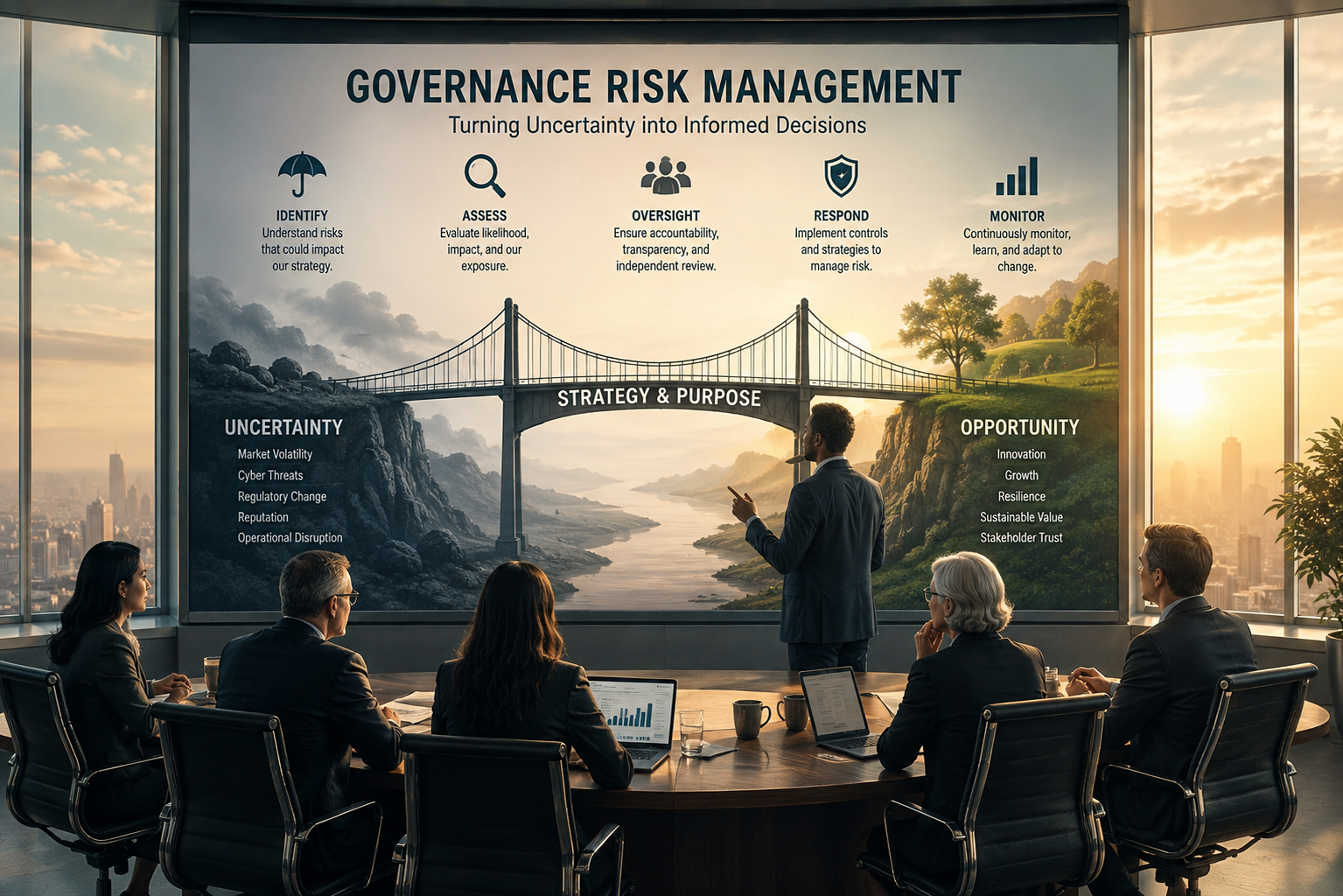
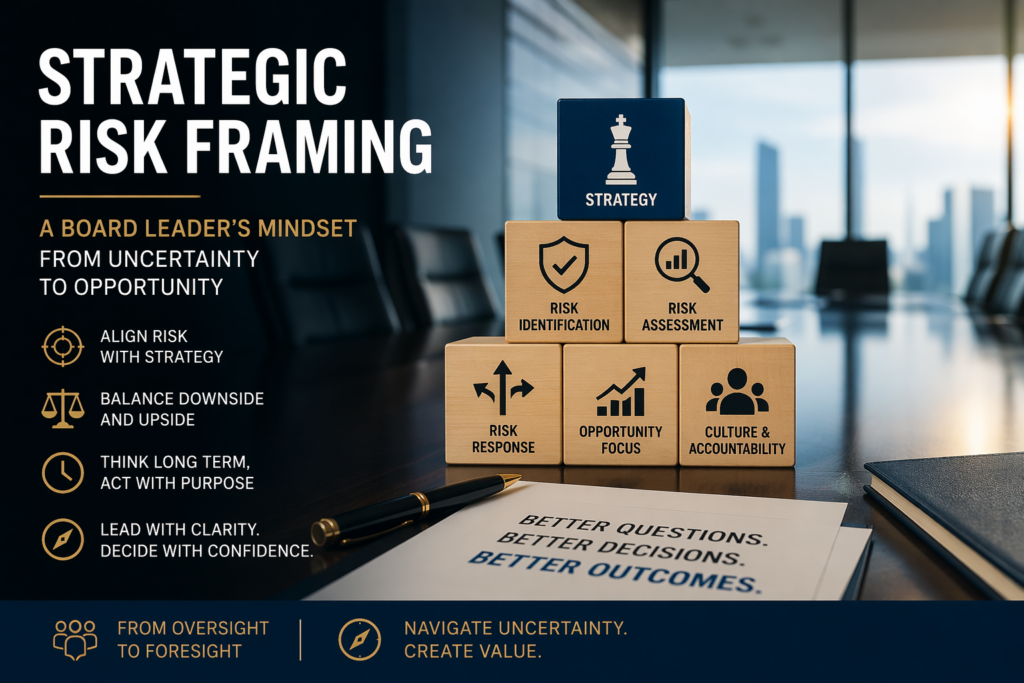
In most boardrooms, risk is discussed frequently—but framed poorly.
It appears as a checklist. A compliance exercise. A quarterly review item tucked between financials and forward guidance. Yet the organizations that consistently outperform their peers treat risk very differently. They don’t just manage risk—they frame it strategically.
And that distinction changes everything.
The Problem: When Risk Is Reduced to Oversight
Traditional governance approaches tend to position risk as something to control. Identify it, mitigate it, report on it.
This mindset creates two unintended consequences.
First, it narrows perspective. Boards begin to see risk primarily as downside exposure—cyber threats, regulatory pressure, operational failures—rather than a spectrum that also includes opportunity.
Second, it slows decision-making. When risk is treated as something to avoid, organizations default to caution. Innovation stalls. Strategic bets become diluted.
The result is not safety—it’s stagnation.
Reframing Risk as a Strategic Asset
High-performing boards understand a more nuanced truth:
Risk is not the enemy of growth—it is the price of it.
Strategic risk framing shifts the conversation from What could go wrong? to What must we be willing to risk to win?
This reframing introduces three critical dimensions:
1. Risk in Context of Strategy
Risk cannot be evaluated in isolation. It must be anchored to strategic intent.
A digital transformation initiative, for example, carries cybersecurity and execution risks—but avoiding it may pose a greater strategic risk: irrelevance.
Effective boards ask:
- Which risks are we choosing because of our strategy?
- Which risks are we avoiding that may limit future growth?
This moves risk from a defensive posture to a deliberate choice.
2. Asymmetry of Risk and Reward
Not all risks are created equal.
Some carry limited downside with significant upside. Others offer marginal gain with disproportionate exposure.
Strategic boards focus on asymmetry:
- Where is the upside meaningfully greater than the downside?
- Where are we overprotecting against low-impact scenarios?
This lens allows leaders to allocate attention and capital more intelligently.
3. Time Horizon Alignment
One of the most overlooked elements of risk framing is time.
Boards often evaluate risk through a short-term lens—quarterly performance, near-term volatility—while strategy unfolds over years.
This misalignment creates tension:
- Short-term risk aversion undermines long-term value creation
- Long-term bets appear unjustifiable under short-term scrutiny
Effective boards explicitly distinguish between:
- Immediate risks that require mitigation
- Strategic risks that require patience
The Board’s Role: From Gatekeeper to Navigator
This shift in framing requires a shift in role.
Boards are no longer just gatekeepers of risk—they are navigators of uncertainty.
That means moving beyond reviewing risk reports to actively shaping how risk is understood across the organization.
Leading boards do this in three ways:
Elevating the Conversation
They ensure risk discussions are integrated into every major strategic decision—not siloed in audit committees.
Challenging Assumptions
They probe management not only on identified risks, but on unseen risks—the assumptions underlying forecasts, market positioning, and competitive dynamics.
Defining Risk Appetite with Clarity
They articulate—not vaguely but explicitly—what level of risk the organization is willing to take in pursuit of its goals.
Without this clarity, organizations drift into either excessive caution or reckless exposure.
Where Most Boards Fall Short
Despite good intentions, many boards struggle with strategic risk framing for a simple reason: they conflate information with insight.
More dashboards. More metrics. More reporting.
But better data does not automatically produce better decisions.
What’s missing is interpretation—an ability to connect risk signals to strategic implications.
Boards that excel do not ask for more information.
They ask better questions.
A Practical Framework for Strategic Risk Framing
To elevate risk discussions, boards can anchor conversations around four questions:
- What risks are inherent in our strategy?
Not incidental—inherent. - Which risks are we underestimating because they fall outside traditional categories?
Think culture, talent, reputation, technological disruption. - Where are we over-indexing on protection at the expense of growth?
Identify friction points in decision-making. - What would need to be true for this risk to become an opportunity?
This question alone can reshape how leaders think.
The Cultural Multiplier of Risk Framing
Strategic risk framing doesn’t just influence decisions—it shapes culture.
When boards model a balanced, forward-looking approach to risk:
- Executives become more decisive
- Innovation becomes more intentional
- Accountability becomes clearer
Conversely, when boards default to fear-based framing, organizations become cautious, slow, and internally focused.
Culture, in this sense, is a downstream effect of how leaders talk about risk.
Final Thought: Risk Is a Leadership Signal
In the end, how a board frames risk sends a signal—to executives, investors, and the market.
It communicates whether the organization is:
- Protecting the past
or - Building the future
The strongest boards recognize that risk is not something to eliminate. It is something to understand, choose, and lead through.
Because in a world defined by uncertainty, the organizations that win are not those that avoid risk.
They are the ones that frame it better—and act accordingly.
#StrategicRisk, #BoardLeadership, #CorporateGovernance, #RiskManagement, #ExecutiveLeadership, #BusinessStrategy, #Leadership, #DecisionMaking